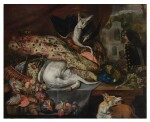

Circle of Frans Snyders
Still life with peacock and swan, other game, fowl, fruit, and vegetables, a parrot, cat, and dog, and a church in the distance
Lot Closed
May 26, 02:25 PM GMT
Estimate
10,000 - 15,000 USD
Lot Details
Description
Circle of Frans Snyders
Still life with peacock and swan, other game, fowl, fruit, and vegetables, a parrot, cat, and dog, and a church in the distance
oil on canvas
canvas: 60 ¼ by 75 in.; 153 by 190.5 cm.
framed: 67 ¼ by 82 ¾ in.; 170.8 by 210.2 cm.
Mrs. Bloomfield Moore, Philadelphia;
By whom donated to the Pennsylvania Academy of the Fine Arts, Philadelphia, 1881 (as Frans Snyders);
By whom deaccessioned ("Property of the Pennsylvania Academy of the Fine Arts, Sold to Benefit the Museum Acquisition Fund"), New York, Sotheby's, 16 May 1996, lot 179 (as Studio of Frans Snyders);
Where acquired by the father of the present owner.
Philadelphia, Rittenhouse Club, 1937-1947;
Philadelphia, Racquet Club, 1950-1951;
Philadelphia, Atheneum, 1956-1970.
Catalogue of the Permanent Collection, Philadelphia 1886, p. 7, cat. no. A257 (as F. Snyders);
Descriptive Catalogue of the Permanent Collections of Works of Art on Exhibition in the Galleries, Philadelphia 1897, p. 76, cat. no. C333;
H. Henderson, The Pennsylvania Academy of the Fine Arts and Other Collections of Philadelphia, Boston 1911, p. 152.
The composition of this elaborate still life makes use of elements from an autograph painting by Frans Snyders in the Mead Museum's collection (inv. no. AC 1962.20). Both paintings depict the central elements of a swan, its elegant and elongated neck curved to the right, displayed on a table and draped with the voluminous plumes of a peacock's train. Each composition features an artichoke positioned on the front right corner of the table, and the attentive dog at the lower right is nearly identical in both paintings.
While these elements appear to derive from Snyder's example, other motifs suggest the influence of Peeter Boel, a seventeenth-century Flemish painter whose lavish still lifes merited his appointment as peintre ordinaire by King Louis XIV. Probably created in the second half of the seventeenth century, this large-scale work is a pastiche of the era's most distinguished still life and animal painters and was likely the effort of more than one hand.
You May Also Like


