
Wolfers
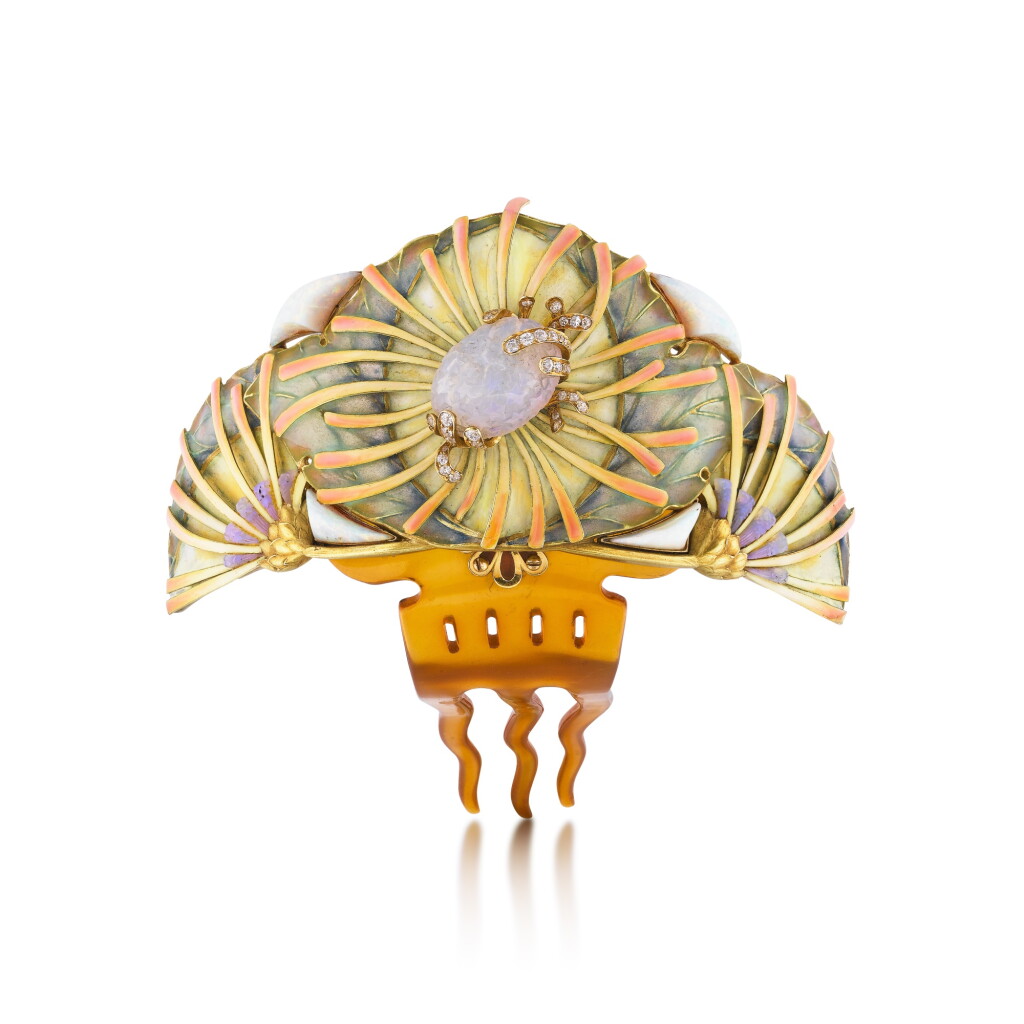
Diadème émail, opale, pâte de verre et diamants | Enamel, opal, glass paste and diamond tiara
Auction Closed
March 26, 04:38 PM GMT
Estimate
18,000 - 30,000 EUR
Lot Details
Description
A décor de fleurs de chrysanthèmes réhaussées d'émail peint et rhaussées de diamants taille anciene, sur un fond d'émail plique-à-jour polychrome, orné de cabochons de pâte de verre opalescente à décor d'étoiles et d'opales, sur un peigne en corne de bovidé, dimensions 110 x 55 mm, longueur du peigne 115 mm, signé, poinçon français d'import pour l'or 18K (750°/00), poids brut 94.0 g, vers 1900.
Decorated with chrysantheum flowers applied with painted enamel and enhanced with circular-cut diamonds, to a polychromous plique-à-jour enamel background, ornated with opalescent glass paste cabochons decorated with stars and opals, to a bovine horn comb, measuring approximately 110 x 55mm, comb length 115mm, signed, French import assay mark for 18 carat gold, gross weight 94.0 grams; circa 1900.
The magnificent tiara, decorated with enameled chrysanthemums highlighted by diamonds and featured in our sale, is signed by Maison Wolfers and comes from the descendants of Hélène-Eugénie Lamarche.
Hélène-Eugénie Lamarche (1853–1937) was born in Liège. In 1873, she married Théodore-Victor de Luesemans (1850–1911). Théodore-Victor was the son of Charles-Joseph-Pascal de Luesemans, a Doctor of Law, deputy, mayor of Louvain, and governor of the province of Liège. The couple, enjoying considerable wealth, resided at Château d'Awan in Aywaille from the time of their marriage.
Château d'Awan, located southwest of Aywaille near the hamlet of Awan, dates back to the 18th century. As they had no children, the château and their belongings were inherited by Hélène-Eugénie's nephew, including the tiara, which had been gifted to her by her husband, Théodore-Victor de Luesemans.
The Wolfers family, of Dutch origin, settled in Brussels in 1812 and began their activity as goldsmiths, supplying the principal European courts, including that of Belgium. However, it was in the field of jewelry that the Wolfers family truly distinguished itself, opting for objects of unprecedented quality while remaining resolutely innovative.
Over the generations, Maison Wolfers became known for its unique style. The "Wolfers style" is characterized by an innovative approach in which the floral theme, rather than being used as mere decoration, becomes a genuine source of inspiration in determining the shape of objects.
Philippe Wolfers, one of the most emblematic members of the family, was a pioneer of this approach. His numerous travels across Europe, as well as his visits to exhibitions in Vienna and Paris, strengthened his interest in new techniques and forms influenced by Japonism.
Through his Art Nouveau jewelry, he transformed natural elements into delicate and original creations, drawing inspiration from flora while reinventing forms. His work earned him the nickname of the "Belgian René Lalique" due to his exceptional creations and his ability to merge jewelry and design at a time when nature was at the heart of art.
He also turned to small-scale sculpture, combining marble, bronze, ivory, enamel, fine stones, and crystal. He was one of the first to work with ivory with great finesse while learning the cloisonné enamel technique from Louis Houillon, a master Parisian enameler.
The influence of Maison Wolfers extended beyond Belgium, and in the 1970s, Maison Chaumet established a partnership with Wolfers that lasted for about ten years. By combining their expertise, the two houses produced exceptional pieces marked by elegance and sophistication.
Among the emblematic pieces of the House is Queen Fabiola's tiara, a testament to both the exceptional craftsmanship of the Wolfers family and Belgium’s royal heritage. Offered in 1960 on the occasion of Queen Fabiola’s marriage to King Baudouin, this jewel stands out for its modular design, allowing it to be worn as both a necklace and a tiara— a versatility that makes it all the more precious.
The tiara in our sale fully aligns with the tradition of Maison Wolfers, which, since its inception, has always combined quality and creativity.
Through these creations, the Wolfers family embodies the very essence of Art Nouveau— a period where innovation and nature merged into objects that were both functional and artistic. From silverware to jewelry and sculpture, their work defined an era and continues to inspire artisans and designers today.