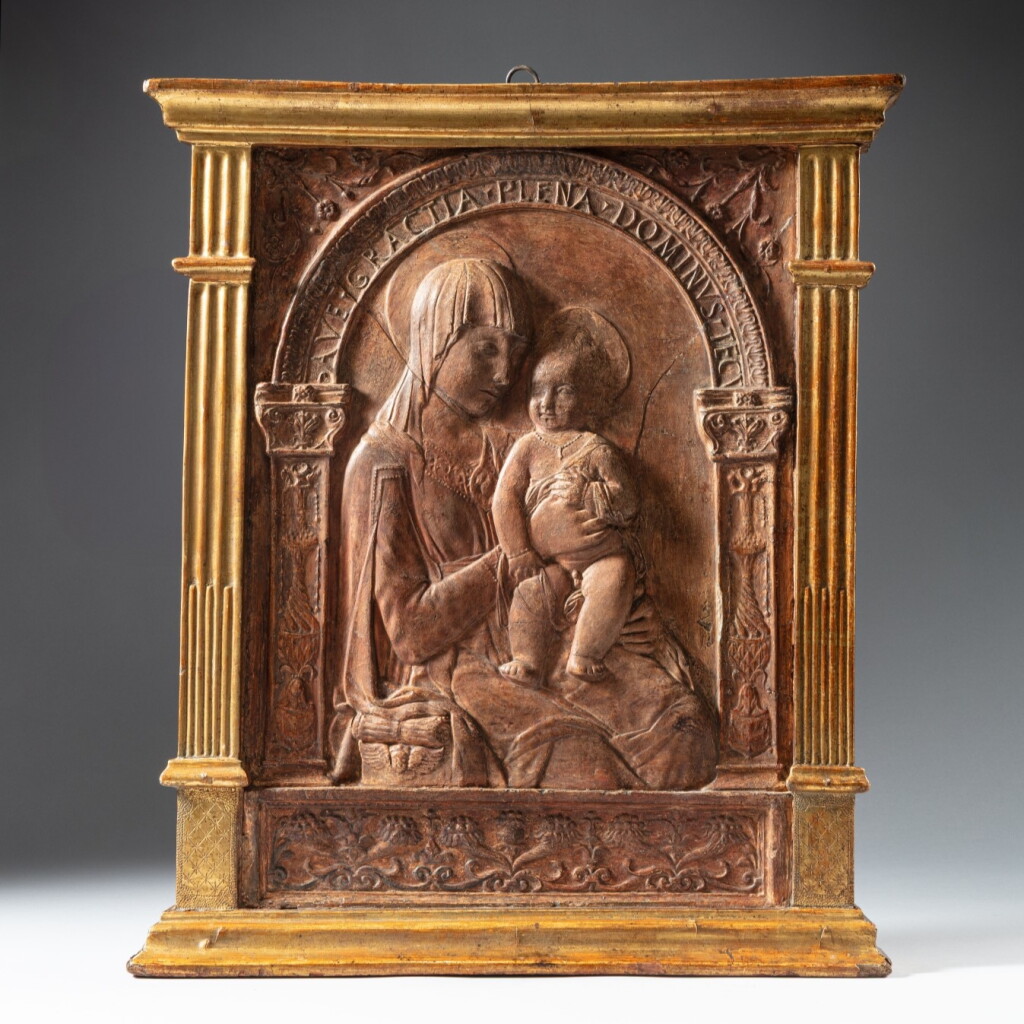
Workshop of Antonio Rossellino (1427/28-1479), Northern Italy, probably Ferrara, circa 1475-1480
Virgin and Child, so called "Leningrad Madonna"
Auction Closed
November 13, 02:30 PM GMT
Estimate
7,000 - 10,000 EUR
Lot Details
Description
Workshop of Antonio Rossellino (1427/28-1479)
Northern Italy, probably Ferrara, circa 1475-1480
Virgin and Child, so called "Leningrad Madonna"
stucco relief, imitating terracotta ; in a partly guilloché gilt wood tabernacle frame
Relief : 58.4 by 42cm.; 23 by 42½in.
Frame : 68 by 58cm.; 26¾ by 22 ⅞in.
This graceful composition is based on a model attributed to Antonio Rossellino, one of the leading Florentine sculptors of the second half of the Quattrocento, dating from the 1460s and 1470s. Several marble examples are known, the most accomplished of which is the one in the Hermitage in Saint Petersburg, from which the composition takes its name (Leningrad). Other moulded and polychromed stucco examples are known, with variations. As with the Virgins with Candlesticks, another composition by Rossellino, two groups can be distinguished: one of reliefs similar in size to the Leningrad Virgin (67 x 54 cm), the other smaller in size. In the present relief, together with two others in the National Gallery of Umbria and the Hermitage, the Virgin's forehead is covered with a veil.
It has been suggested that the group of smaller reliefs, including the present relief, did not originate in Rossellino's Florentine workshop, but rather from the master's followers in Emilia and Veneto. In the 1470s, Rossellino's presence in Ferrara is documented, where he worked on the imposing Funerary Monument of Lorenzo Roverella (San Giorgio Fuori le Mura; c. 1475-76). Among Antonio's works in Ferrara, one can also mention a marble Virgin and Child, circa 1470, now covered by the high altar of the church of San Domenico. This group of smaller reliefs, probably of Ferrarese origin, is also distinguished by a more pronounced decorative style. Several examples of this type are preserved in northern Italy, such as the Madonna del Molino (Lugo di Romagna), one example at the Palazzo Calcagni (Reggio Emilia), another at the Museo Ala Ponzone (Cremona), another at the Museo Cagnola (Varese), and yet another at the Museo San Martino (Olivone). Their decorative exuberance, often accentuated by the composite and whimsical nature of the frames, can be compared to the work of Domenico di Paris, a Paduan sculptor active in Ferrara, to whom we owe, in particular, the sumptuous decorations of the Stucco Room in the Schifanoia Palace (end of the 1460s).
The present relief of the Virgin and Child, of the Leningrad Madonna type, is a significant testimony to the wide influence of Florentine culture in the Quattrocento, reflected in objects of private devotion imbued with quotations of Ancient world.
A written report by Alfredo Bellandi and Giancarlo Gentilini, dated 30 September 2013, is available on request.
RELATED LITERATURE
C.-L. Ragghianti, « Scultura a Budapest », in Critica d’Arte, XLI, 1976, 147, pp. 67-71;
P. Bergamelli, A. Veca « Una moda antiquaria », in TRA/E Teche, pissidi, cofani e forzieri dall’Alto Medioevo al Barocco, exh. cat. Bergamo & London, Bergamo, 1984, pp. 271-288;
V. Sgarbi, Domenico di Paris et la sculpture à Ferrare au Quattrocento, Milan, 2006;
F. Petrucci, "Da Firenze marmi e terrecotte invetriate: Antonio Rossellino e Andrea della Robbia per Ferrara", in G. Gentilini et L. Scardino, Crocevia Estense. Contributi per la storia della Scultura a Ferrara nel XV secolo, Ferrara, 2007, pp. 151-188;
G. Gentilini, Dal rilievo alla pittura delle Candelabre di Antonio Rossellino, Florence, 2008.
You May Also Like