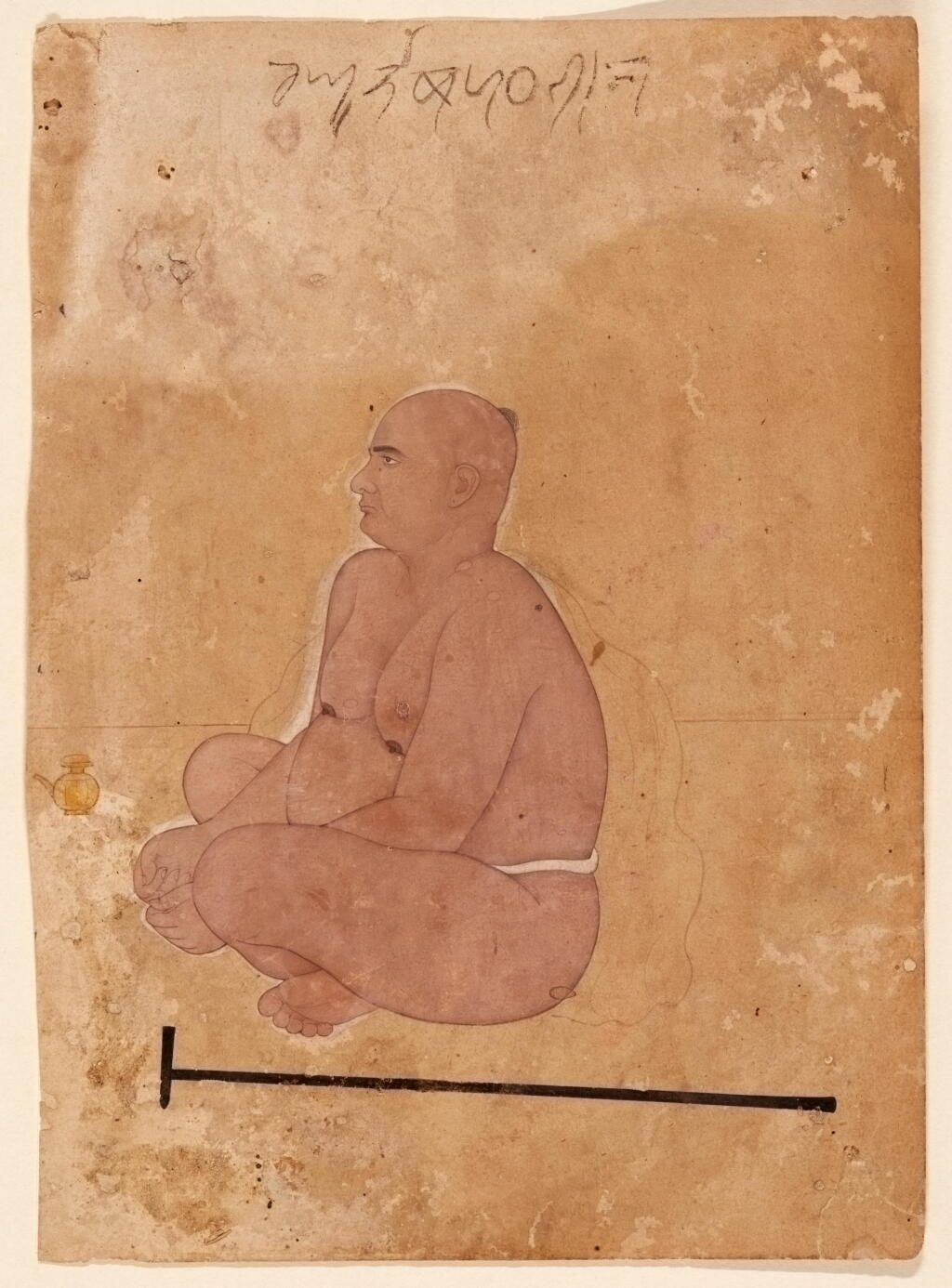
Raghunath Pathania, a holy man, attributed to Nainsukh, India, probably Guler, circa 1760
Auction Closed
April 30, 03:48 PM GMT
Estimate
40,000 - 60,000 GBP
Lot Details
Description
brush and ink with gouache heightened with gold on paper, takri inscription to upper edge, inscribed in pencil 'WB Manley' on reverse
25.8 by 18.8cm.
Samuel Fyzee Rahamin (1880-1964)
Sotheby's, London, 30 April 1935, lot 442
Dr. W.B. Manley (1883-1972)
Sotheby's, London, 14 July 1971, lot 249
Charles Ewart
Sven Gahlin (1934-2017)
In the Image of Man, Hayward Gallery, London, 1982
The Indian Portrait, The National Portrait Gallery, London, 2010
Masters of Indian Painting, Museum Rietberg Zurich, 2011
G. Michell (ed.), In the Image of Man, London, 1982, p.172, no.272
B.N. Goswamy, Nainsukh of Guler, Zurich, 1997, no.85
R. Crill & K. Jariwala (eds.), The Indian Portrait, London, 2010, no.47
M.C. Beach, B.N. Goswamy & E. Fischer (eds.), Masters of Indian Painting, Zurich, 2011, p.677, fig.12
This is a rare opportunity to acquire a portrait with exceptional provenance and exhibition history by one of India's most important painters.
This portrait possesses a dignity and poise that only the hand of Nainsukh could achieve. His father Pandit Seu was responsible for transforming the Pahari school of painting, bringing about a stylistic change towards a more naturalistic approach influenced by the late Mughal school. Nainsukh took this to another level and became a master draughtsman whose minimal use of line encapsulated the character as well as the likeness of his subjects. This painting displays Nainsukh's distinctive crisp and precise line that successfully suggests the heavy volume of the sitter's naked form, rendering every subtle change in his skin tone. The little shikha-topnot on his otherwise shaven head and his naked body apart from his kaupina - loincloth, indicates that he is a recluse or sannyasi. The thumb and forefinger placed together, a firm jaw and a concentrated but calm gaze, suggests he is in meditation. BN Goswamy described the painting as "a wonderfully sensitive portrait, virile and warm at the same time, subtly evocative... not even a hint of ridicule or fun-poking in his depiction of this ponderous figure" (Goswamy 1997, p.220).
Nainsukh places him centrally within the uncoloured page, within a simple setting, just a thin horizontal line that delineates the floor from the wall. Only his walking stick and small brass ewer are present, with traces of a cloth across his back. Within his oeuvre Nainsukh has depicted the common man; singers, musicians, attendants and pandits, people often within the household of his long term patron Balwant Singh. However they are always conceived within a multifigure composition. Unusually here the artist has chosen to focus solely on an unknown overweight man. Why did Nainsukh paint him, was it possibly a request from his patron or was he a personal friend of the artist? All we have is the Takri inscription at the upper edge giving his name. Goswamy and Fischer identify two strands that characterise Nainsukh's later work of which this portrait falls into his study of "uncommon physiognomies and characters: works that were neither commissioned nor produced for a given patron but made only for the delectation of the painter himself." (Goswamy and Fischer 2011, p.678).
This portrait also has a fascinating provenance, with records from the 1930s indicating that the painting belonged to the artist Samuel Fyzee Rahamin (1880-1964). Regarded as one of the founders of Modern Indian art, Rahamin received a scholarship to the Slade School of Art London and was the first Indian to study at the Royal Academy. Although originally trained in the western academic tradition his work became inspired by Mughal and Rajput miniature painting (see Catalogue of the Tate Gallery's Collection of Modern Art other than Works by British Artists, London 1981, p.229). The portrait was then acquired by Dr. W.B. Manley from a Sotheby's sale in 1935. Dr. Manley also owned two other masterpieces by Nainsukh that are now in the Victoria & Albert Museum (see Goswamy 1997, pp.130-1 & 186-7). Dr. Manley served in the Indian Police in Bombay from 1905-24 and on his return to England studied law and then medicine. He became an important collector of Indian miniatures, with paintings from his collection included in the Arts of India and Pakistan exhibition at the Royal Academy in London from 1947-48. After his death in 1972, the British Museum acquired from his executors an album of ragamala paintings (c.1610) that have come to be known as the 'Manley Ragamala' (inv.1973.9-17.01-057).
Other Pahari studies of large figured sannyasi, inspired rather than by the hand of Nainsukh are published in B.N. Goswamy, Essence of Indian Art, San Francisco 1986, pp.115-6, nos.78-79; W.G. Archer, Indian Paintings from the Punjab Hills, vol.2, London, 1973, p.97, no.5. and J. Mittal, Indian Drawings 16th-19th century, New Delhi, 1989, no.21.
You May Also Like