Property from a Private Collection, Sydney
Uta Uta Tjangala
Untitled
Auction Closed
May 20, 09:03 PM GMT
Estimate
50,000 - 70,000 USD
Lot Details
Description
Uta Uta Tjangala
circa 1920- 1990
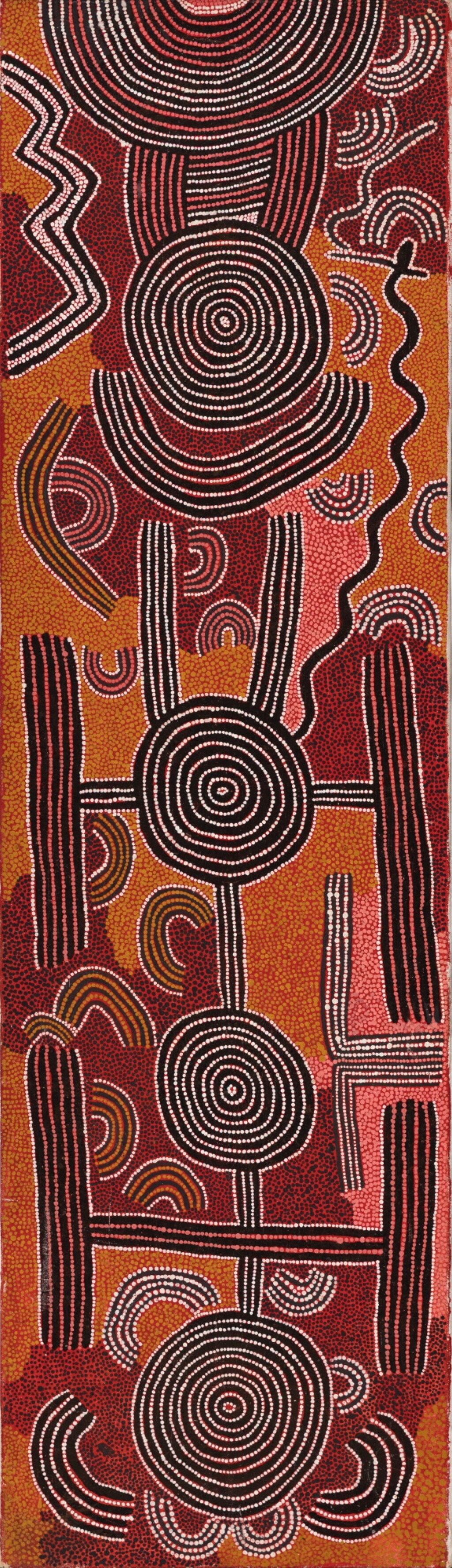
Untitled, 1980
Synthetic polymer paint on linen
64 ⅝ in x 18 ⅞ in (164 cm x 48 cm)
Painted at Kintore for Papunya Tula Artists, Alice Springs, 1980
Private Collection, Sydney, acquired from the above with the assistance of Andrew Crocker, Alice Springs
National Gallery of Victoria, Melbourne, The Face of the Centre: Papunya Tula Painting 1971-1984, September 7, 1985 - January 27, 1986
Annemarie Brody, The Face of the Centre: Papunya Tula Painting 1971-1984, Melbourne, 1985, p. 39
One of the major subjects of Uta Uta Tjangala’s art relates to Yumari, an important ancestral site in his mother’s country which is associated with the artist’s conception site at Ngurrapalangu through Yina, the ancestral man.1 In Pintupi, ‘yumari’ means mother-in-law and the ancestral narratives that formed the basis for much of Tjangala’s paintings relate Yina’s sexual proclivities that lead to an intimate encounter with his mother-in-law, thus breaking one of the strictest prohibitions in Aboriginal society. The punishment meted out to Yina was harsh, disfiguring his sexual organs which, in Tjangala’s accounts, separated from his body and travelled far and wide.
Uta Uta Tjangala created this picture less than a decade after the acrylic painting movement emerged at Papunya. Faced with a new viewership, untutored in the ways of Aboriginal law and customs, the debate raged among artists and their communities about the revelation of restricted narratives and the depiction of ritual objects in paintings intended for an uninitiated public. Uta Uta Tjangala was an elder with vast ancestral knowledge and immense authority that enabled him to determine the images and narratives he saw fit to paint.
On October 7, 1980, Andrew Crocker, the manager of Papunya Tula Artists cooperative at the time the painting was created, documented it as follows:
"The painting tells a portion of the mythology of the Travelling Old Man. The Story, and the painting, is susceptible of interpretation on a number of levels. This is often the case in this art. At one level it is the simplest tale of travel and making camp, with the ever-important cartographic details predominating. The travelogue starts at Kamberarpa [Kampurrarpa], by the Ehrenburg Range and due west of Alice Springs, and carries on through Sandy Blight Junction to Nginana, again due west, and finally to Umari [Yumari]. At the next level it is an aetiological tale of incest and its disastrous and rather comic consequences. At Umari there are standing stones, hollow stones and other geological features which suggested to the [Pintupi] a story of a man who had intercourse in violation of a kinship taboo and suffered the retribution of horribly distended sexual organs and pursuit by hordes of women. In this interpretation the roundels in the painting are testicles while the other motif which is usually people at camp is a sub-incised penis and testicles. It is probable, given the Aboriginal scheme of things that there would also be a spiritual allegory encompassed also."
Uta Uta Tjangala’s work has been shown in several major exhibitions including the São Paolo Biennale in 1983; Dreamings: The art of Aboriginal Australia at the Asia Society Galleries, New York in 1988; L'été australien à Montpellier: 100 chefs-d'œuvre de la peinture australienne, at Musée Fabre, Montpellier, France, in 1990; Aratjara: Art of the First Australians at the Kunstsammlung Nordrhein-Westfalen, Dusseldorf, the Hayward Gallery, London, and the Louisiana Museum, Humlebaek, Denmark, in 1993–4; Crossroads-Towards a New Reality, Aboriginal Art from Australia, at the National Museums of Modern Art, Kyoto and Tokyo in 1992; Icons of the Desert: Early Aboriginal Paintings from Papunya, at the Herbert F. Johnson Museum of Art at Cornell University, Ithica, then at the Fowler Museum of Cultural History, University of California, Los Angeles, and the Grey Art Gallery at New York University, New York, in 2009; and Tjukurrtjanu: Origins of Western Desert art, at the National Gallery of Victoria, Melbourne, in 2011, and at the Musée du quai Branly, Paris, in 2012.
1 Myers, F.R., Painting Culture: The Making of an Aboriginal High Art, Duke University Press, Durham and London, 2002, p.113. Myers worked closely with Uta Uta Tjangala in the 1970s: see the section ‘Yumari: The Painting of Place’, pp. 112-117.