
The Property of a Gentleman
A Bizen katana | Attributed to Osafune Nagayoshi (Chogi) and Osafune Nagamori | Nanbokucho period, 14th century
Lot Closed
May 10, 01:51 PM GMT
Estimate
14,000 - 16,000 GBP
Lot Details
Description
The Property of a Gentleman
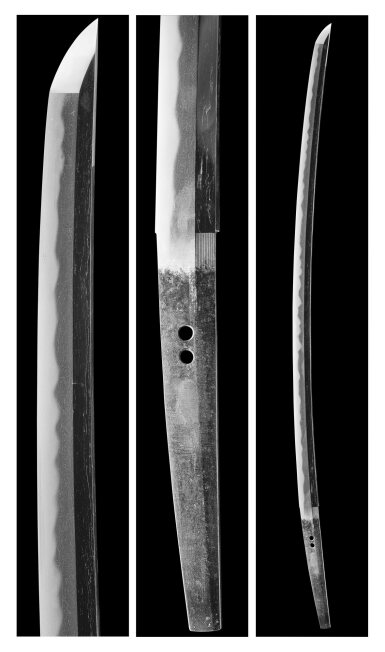
A Bizen katana
Attributed to Osafune Nagayoshi (Chogi) and Osafune Nagamori
Nanbokucho period, 14th century
Sugata [configuration]: Honzukuri, iori-mune, extended chu-kissaki, sakizori with a wide mihaba and medium kasane
Kitae [forging pattern]: Itame mixed with mokume and covered in jinie, with visible utsuri
Hamon [tempering pattern]: Flamboyant choji midare forged in nioi and tending to ko-nie, mixed with gunome and togari midare in nie and nioi with ashi, profuse tobiyaki and yubashiri
Boshi [tip]: Midare komi
Nakago [tang]: O-suriage with later yasurime [file markings], two mekugi ana
Habaki [collar]: Gold foil, double clad
In shirasaya [plain wood scabbard] with sayagaki [attestation] by Sato Kanzan (1907-19738 attributing the blade to Chogi and documenting the blade as an heirloom of the Shonai Sakai family, dated 1972
Nagasa [length from kissaki to machi]: 70.9 cm., 27⅞ in.
Sori [curvature]: 1.9 cm., ¾ in.
Saki-haba [width at the yokote]: 2.1 cm., ⅞ in.
Moto-haba [width at the machi]: 2.9 cm., 1⅛ in.
Accompanied by a certificate of registration attributing the blade to Osafune Nagamori and as Tokubetsu Hozon Token [Sword Especially Worthy of Preservation], no. 1015521 issued by the Nihon Bijutsu Token Hozon Kyokai [Society for the Preservation of the Japanese Art Sword], dated Reiwa 3 (2021).
Shono Sakai (as described on the shirasaya)
This sword was forged in the first half of the 14th century in Bizen province, modern Okayama Prefecture. It exhibits various typical Soden features associated with works by the well-known Soden Bizen mastersmith Chogi and his direct students such as Nagamori. The robust blade is wide, with little taper from the hamachi to the kissaki. The hamon is very active and comprises an undulating clove-shaped choji pattern along the hassaki, in places reaching almost to the shinogi-ji.
The sword is kept in an old wooden storage scabbard bearing an attestation to Bizen Chogi written by Kanichi “Kanzan” Sato (1907-1978). Born in 1907 in Tsuruoka, Kanzan commenced work in the Japanese sword department of the Tokyo National Museum in 1948. The same year, together with his fellow Kokugakuin University alumnus Junji Honma (1904-1991), he co-founded the Nihon Bijutsu Token Hozon Kyokai (Society for the Preservation of Japanese Art Swords) as an authorised non-profit association by the Japanese government. He was instrumental in opening the Japanese Sword Museum affiliated with the NBTHK in May 1968. After Kanzan retired from his position at the Tokyo National Museum in 1969 he was appointed managing director of the NBTHK, and deputy director of the Japanese Sword Museum. He also devoted himself to the revival of traditional Japanese iron manufacture through a traditionally built forge, the tatara.
Nagayoshi, also known as Chogi, was the son of Osafune Mitsunaga and a descendant of the founder of the Osafune school, Mitsutada. He is thought to have studied under Masamune and has historically been included in the list of the Masamune juttetsu (ten famous students). Chogi and Kanemitsu are referred to as the founders of the Soden Bizen sword school, characterised primarily by the Soshu den forging style, while still being Bizen in origin. Among the Soden Bizen works, those by Chogi and his students show the most distinct features of the Soshu tradition. The five smiths considered as students of Chogi include: nidai (second generation) Chogi, Nagatsuna (worked during the Eiwa era, 1375-1379), Nagamori (mainly during Enbun, 1356-1361), Nagasuke (Eiwa era), and Nagatsuna (Joji era, 1362-1368). While the softer steel used by the Bizen smiths is deemed to have been difficult to forge with jinie, Chogi and his students succeeded, retaining the varied and expressive Bizen hamon but imbuing various nie-based hataraki in the blade. Swords by Nagamori are scarce.
The sayagaki is inscribed:
Chogi, Resident of Bizen Province
[This blade is] o-suriage and mumei.
Heirloom of the Shonai Sakai family.
Blade length ~ 70.9 cm
Written by Kanzan on an auspicious day in July of the year of the rat of the Showa era (1972) / [signed with]
cursive monogram.
備前國住⻑義
但⼤磨上無銘也
庄内酒井家伝来之⼀
刃⻑貮尺参⼨参分有之
昭和壬⼦年初秋吉⽇
寒⼭誌「花押」
You May Also Like


