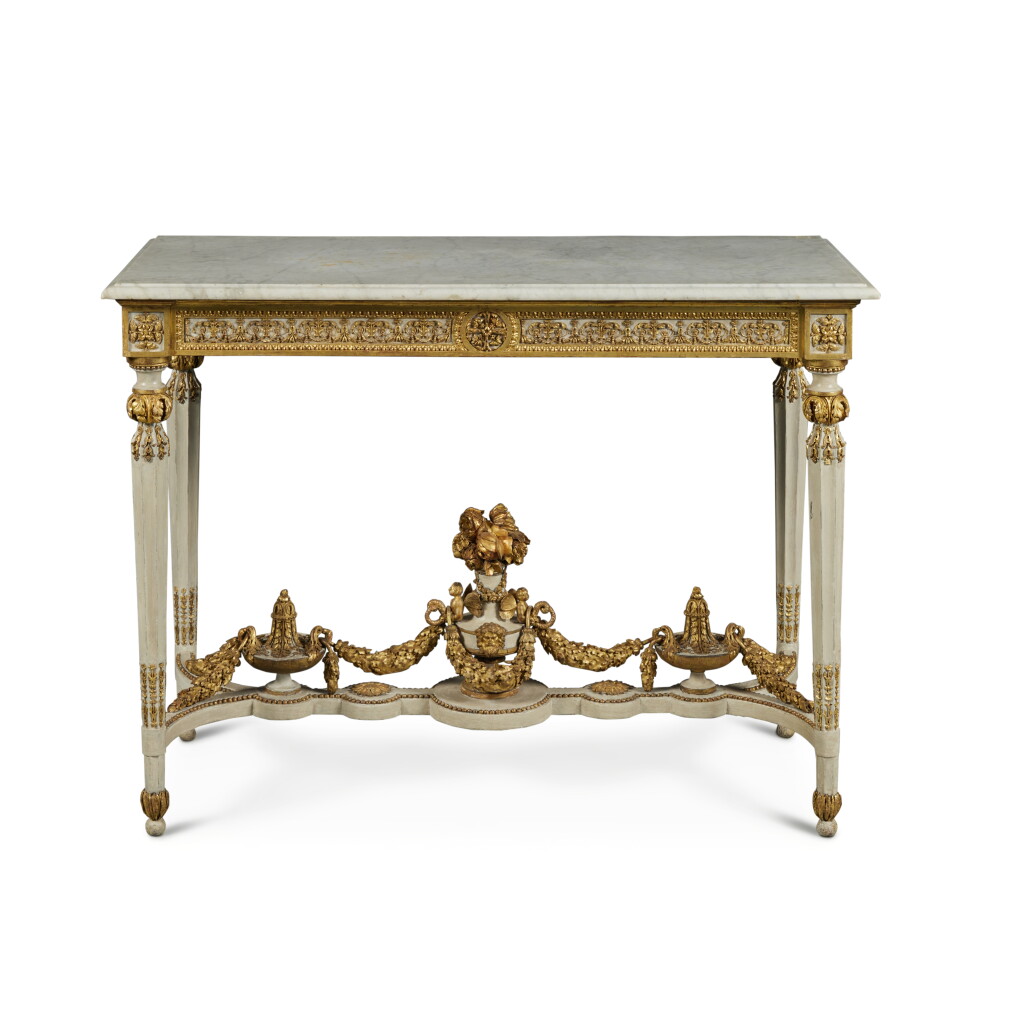
An Austrian Neoclassical Grey-Painted and Parcel Gilt Console Table, Late 18th Century
Lot closes
10:50:22
•
October 28, 03:27 PM GMT
Estimate
30,000 - 50,000 USD
Starting Bid
20,000 USD
We may charge or debit your saved payment method subject to the terms set out in our Conditions of Business for Buyers.
Read more.Lot Details
Description
the moulded grey veined white marble top above an arabesque carved frieze centered by foliate medallions within a leafy border, on tapering faceted octagonal legs joined by a stretcher with three flower-festooned urns joined by swags; the central urn with bearded mask and winged putti; the top rails inscribed twice in black chalk KKV 929 and once in blue chalk AR 606/ 1M1258 |?|, with graphite inscription on masking tape 30970, the underside of the marble with black chalk AR/ 3513 and Kis...187
Height 34 1/2 in.; width 46 in.; depth 21 1/4 in.
87 cm; 116.5 cm; 54 cm.
The Rothschild Family, Vienna, probably Baron Nathaniel Mayer von Rothschild (1836-1905) or Baron Albert Salomon Anselm von Rothschild (1844-1911) at the Palais Rothschild, Theresianumgasse, Vienna;
By descent to Baron Alphonse de Rothschild (1878-1942), Vienna;
Confiscated by the occupying Nazi forces in 1938 and transferred in 1941 to Kremsmünster Abbey, Upper Austria;
Restituted by the Austrian government to Baron Alphonse's widow Clarice, née Sebag-Montefiore (1894-1967) in 1947;
Gifted by Baroness Clarice to the Rosenberg & Stiebel Gallery, New York, in the 1950s;
Private Collection of Mr. and Mrs. Eric Stiebel, New York;
Thence by descent.
The highly sophisticated and exuberantly stylised carving of the frieze and stretcher of this elegant console is typical of the Viennese interpretation of the neoclassical idiom in the late 18th century. Comparably decorated parcel gilt and white or grey painted console tables and seat furniture were recorded in the early twentieth century in the collection of the Archduke Albrecht Palais, Vienna, now the Albertina (illustrated in Josef Folnesics, Alte Innenräume österreichischer Schlösser, Palässte und Wohnhäuser, Vienna 1912-193).
The table was formerly in the possession of the Austrian branch of the Rothschild family, who like their counterparts in Paris and London formed one of the most important collections of paintings, works of art and furniture in Europe in the late 19th and early twentieth centuries. The nucleus was created by Baron Nathaniel Mayer von Rothschild and housed in his palatial residence constructed between 1871 and 1878 at 16-18 Theresianumgasse in Vienna; part of his collection derived from an inheritance from his father Baron Anselm (1803-1874) divided with his brother Ferdinand (who had settled in England and built Waddesdon Manor in the 1870s). Following Nathaniel's death without issue his collection would later pass to his nephews Alphonse at the Theresianumgasse and Louis n(1882-1955) who resided in the Palais Albert Rothschild completed in 1884 by the French architect Gabriel-Hippolyte Destailleur in the Heugasse in Vienna.
Following the Anschluß in 1938 the Rothschilds were compelled to flee Vienna, with Alphonse and Louis both eventually settling it in the United States, where Alphonse would pass away in 1942. Their houses and art collections were confiscated, and many of the most important works were sent in 1941 to the Bendectine Abbey of Kremsmünster in Upper Austria under the orders of the Sonderauftrag LinzI, the special commission charged with acquiring and appropriating works of art for Hitler's planned Führermuseum in nearby Linz. After the war Alphonse's widow Clarice was able to return to Vienna and reclaim some of the artworks, many of which were exported to the United States and sold through the New York gallery Rosenberg & Stiebel, although numerous masterpieces of paintings and French furniture, including a royal commode supplied by Riesener to Fontainebleau, were retained by the Austrian state and integrated into the national collections of the Kunsthistorischesmuseum and the Museum für Angewandte Kunst before being restituted to Rothschild heirs in 1998.
You May Also Like