
Cartier
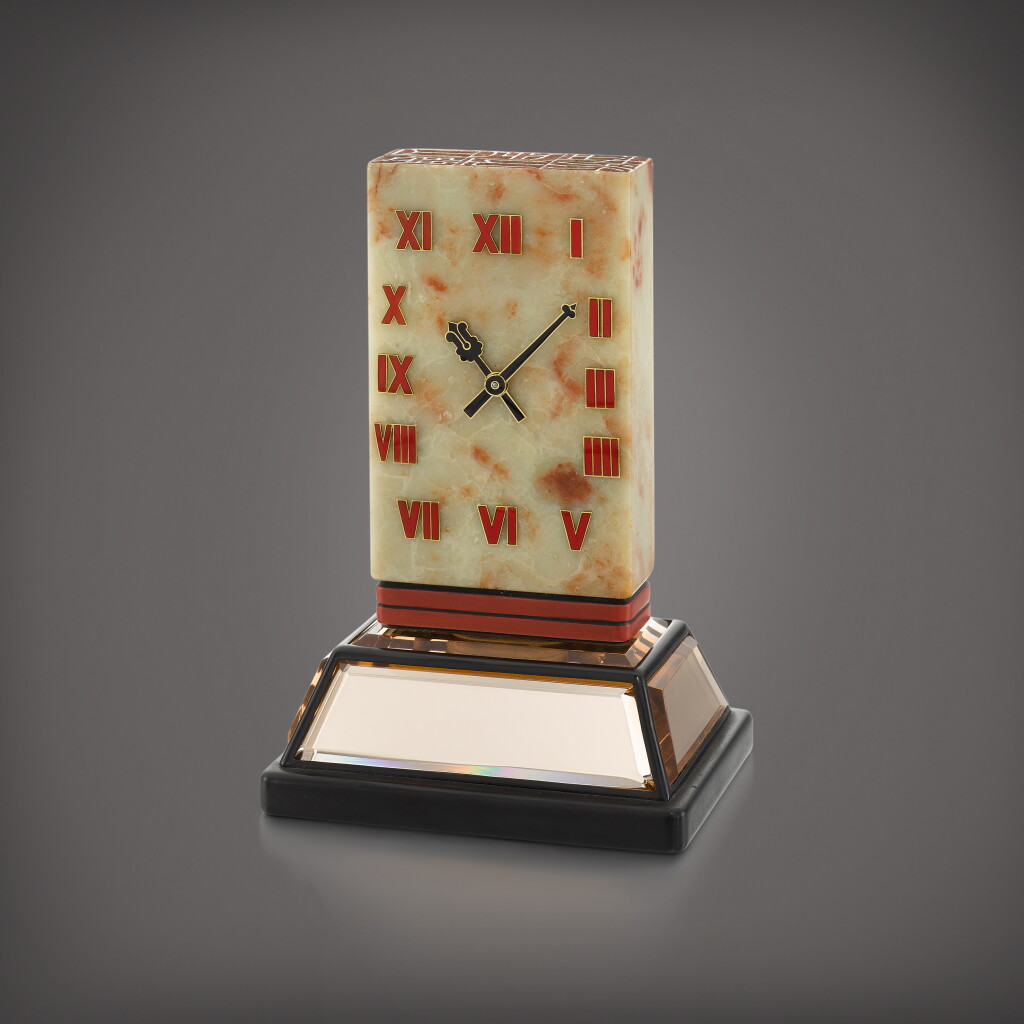
A Chinese seal desk clock in yellow gold, tinted glass, enamel, steatite, ebonite and gilt bronze | Circa 1930
This lot has been withdrawn
Lot Details
Description
Cartier
A Chinese seal desk clock in yellow gold, tinted glass, enamel, steatite, ebonite and gilt bronze
Circa 1930
Dial: steatite with red and black enamelled yellow gold indexes and hands
Calibre: mechanical, jewelled
Case: Chinese seal steatite block, red painted and black ebonite plinth and tinted glass base
Case number: HSA4182, S573 and 2’884
Size: 150 mm high x 102 mm length x 79 mm width
Signed: base and movement
Box: yes
Papers: no
Accessories: Cartier laminated Certificate of Authenticity signed May 2020 and modern presentation case with outer packaging
Between 1919 and 1936, Cartier enjoyed a flourishing period in the design and production of some of the world’s most captivating clocks. The combination of exotic motifs and materials showcased the period’s interest in non-European objects and cultures. Among these, Asian influences played a capital role in the development of the Art Deco style. In 1925, the report on Cartier’s contribution to the Paris Exhibition published in the Gazette du bon stated that 'once, Cartier was master of the exquisite objet d’art: his miniature plants, destined for the princely boudoir in their delicate houses, reminded us of the Japanese and Chinese art of the Belle Epoque, with their jade leaves and quartz blossoms’ and in the 1929 Paris Exhibition Cartier pieces were seen as ‘the incarnation of an impalpable dream of the Orient.' (Barracca et al. pp. 81-2, 180.)
The present lot stands as a proud example of this European fascination with other cultures and its adaptation, reinvention and reimagining. In fact, Cartier used an ancient Chinese steatite block bearing a seal to create this clock, complementing it with a variety of rich materials and Asian-influenced motifs such as the black enameled hands. Indeed, this rare and unusual clock illustrates Cartier’s creative mastery and is a proud exponent of the aesthetic aspirations of Europe in the 1930s.