
Property from an Important American Collection
Collins, Wilkie | The trailblazer of British detective fiction
Lot Closed
December 8, 07:13 PM GMT
Estimate
50,000 - 70,000 USD
Lot Details
Description
Property from an Important American Collection
Collins, Wilkie
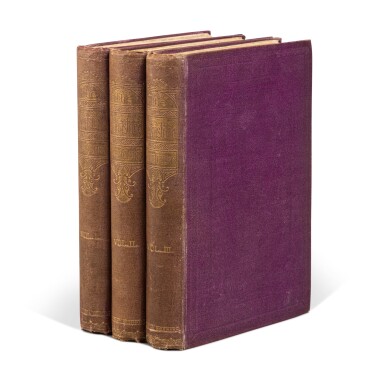
The Moonstone. A Romance. London: Tinsley Brothers, 18, Catherine Street, Strand, 1868
3 volumes, 8vo. Half-titles, 2pp. publisher's advertisements at front of volume II and at end of volume III; title-page of volume I toned showing transfer of inscription, advertisement leaf in volume II toned, scattered light spotting. Publisher's purple sand-grained cloth, spines gilt; spines just sunned, some restoration and recoloring to upper cover of volume I following repair of abrasion, lightly bumped at extremities, some hinges strengthened. Collector's morocco slipcase, folding chemise.
First edition of "the first, the longest, and the best of modern English detective novels" (T.S. Eliot).
The Kaye-Slater-Manney copy.
The Moonstone presents the mystery of the cursed, eponymous stolen Indian yellow diamond that was given to Rachel Verinder by her uncle. It is significant in introducing several traits of classic detective fiction, including an English country house robbery, the gentleman detective, the "least likely suspect" amongst a large number of false suspects ("red herrings"), and a final twist in the plot.
Sergeant Cuff was inspired by the real-life Detective Inspector Jack Whicher, who was one of the most famed and respected detectives in Europe. He was lead detective in the infamous murder at Road Hill House case which influenced Collins greatly; indeed, Whicher also inspired Dicken's Inspector Bucket, Dexter's Inspector Morse and Wingfield's Jack Frost.
Collins was under enormous physical and mental stress at the time; his mother died in March 1868, he was suffering from a severe attack of gout, and to combat the pain he began taking laudanum. The resulting drug-induced haze meant that Collins couldn't recall writing large portions of the novel. The act of Franklin Blake, where he takes the diamond in a laudanum-induced trance, therefore can be linked to Collins personal experiences of the drug.
A fine copy of this thrilling tale with charming contemporary provenance.
REFERENCES:
Sadleir 598; Wolff 1368; Parrish p.89
PROVENANCE:
Elizabeth Ward (inscribed "To Elizth Ward from her aff. Husband Mr., Derby, 18 July 1868) according to Rare Book Hub, the copy bearing this inscription is the Kaye-Slater-Manney copy: Florence and Edward Kaye (bookplate presumably removed) — Dr. Gerald E. Slater (his sale, Christie's New York, 12 February 1982, lot 273) — Richard Manney (bookplate presumably removed; his sale, Sotheby's New York, 11 October 1991, lot 56) — Christie's New York, 7 October 1994, lot 72