
Léon-Augustin Lhermitte
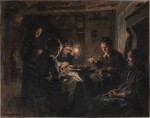
La Veillée, ou les Couturières
Auction Closed
January 31, 03:58 PM GMT
Estimate
30,000 - 50,000 USD
Lot Details
Description
Léon-Augustin Lhermitte
1844 - 1925
La Veillée, ou les Couturières
Pastel
signed, lower left: L. Lhermitte
15 by 18 ⅞ in.; 380 by 480 mm
With Boussod, Valadon & Cie, Paris (stock no. 14121);
Montaignac Collection, by 1889;
Private collection, Honfleur;
With Galerie de Bayser, Paris;
From whom acquired by the present owner, 2009.
Paris, Exposition des pastellistes, 1889.
Galignani’s Messenger, 5 April 1889;
L’Événement, 6 April 1889;
L. Plée, Le Parti national, 7 April 1889;
Le Rappel, 7 April 1889;
Écho de Paris, 9 April 1889;
L’Intérêt public, “Le mouvement artistique,” 9 April 1889;
Le Mot d’ordre, 9 April 1889;
La Liberté, 10 April 1889;
Le Temps, April 1889;
L’Art français, 13 April 1889;
T. Durand, Revue des Beaux-Arts, 13 April 1889;
O. Merson, Le Monde illustré, 20 April 1889, p. 262;
E. Jacques, L’Instransigeant, 23 April 1889;
Courrier de l’Aisne, 30 April 1889;
Jardin des Arts, September 1967;
M. Le Pelley Fonteny, Léon Augustin Lhermitte (1844-1925): catalogue raisonné, Paris 1991, p. 214, cat. no. 304.
This beautifully preserved and highly atmospheric pastel, which depicts a group of women sewing by candlelight near the hearth of a peasant dwelling, was executed in April of 1889 in the house of Monsieur Drux in Mont-Saint-Père, Picardie, the village in which Léon Lhermitte was born. The Drux and the Lhermitte houses were opposite each other, and the subjects depicted in the present work were in all likelihood members of the two households. This was also the site depicted in Lhermitte's luminous oil painting of the same subject now preserved in the Glasgow Museums Resource Centre (GMRC).1 The same interior also appears in Lhermitte’s painting Friend of the Humble (Supper at Emmaus) in the Museum of Fine Arts, Boston, of 1892,2 and in a preparatory pastel for that painting showing the empty room, formerly in the Tannenbaum collection, Toronto.3
The muted palette highlighted with exquisite, radiant touches of pastel, as well as the subject matter, is highly reminiscent of the early work of Vincent van Gogh (1853-1890) and it can be of little surprise that Lhermitte’s work was so admired by his Dutch contemporary who wrote of it to his brother Theo:
"He (Lhermitte)’s a master of the figure. He’s able to do what he likes with it — conceiving the whole neither from the color nor from the local tone, but rather proceeding from the light - as Rembrandt did - there’s something astonishingly masterly in everything he does - in modelling, above all things, he utterly satisfies the demands of honesty”.4
1. M. Le Pelley Fonteny, Léon Augustin Lhermitte (1844-1925): catalogue raisonné, Paris 1991, p. 104, cat. no. 44, reproduced
2. Ibid., p. 110, cat. no. 56, reproduced
3. Ibid., p. 170, cat. no. 42, reproduced
4. Vincent van Gogh to Theo van Gogh, 2 September 1885, letter 531
You May Also Like


