
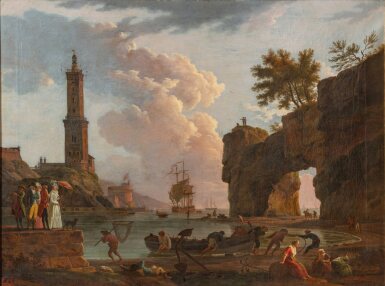
Joseph Vernet and Workshop | Joseph Vernet et Atelier
Quiet sea at sunset with the Vernet family | Mer calme au soleil couchant avec la famille Vernet
Auction Closed
June 13, 02:06 PM GMT
Estimate
80,000 - 120,000 EUR
Lot Details
Description
Joseph Vernet and Workshop
Avignon 1714 - 1789 Paris
Quiet sea at sunset with the Vernet family
Oil on canvas
Bears a signature and a date lower left on the pier J. Vernet. / f. 1788.
87,6 x 116,9 cm; 34½ by 46 in.
____________________________________________
Joseph Vernet et Atelier
Avignon 1714 - 1789 Paris
Mer calme au soleil couchant avec la famille Vernet
Huile sur toile
Porte une signature et une date en bas à gauche sur la jetée J. Vernet. / f. 1788.
87,6 x 116,9 cm ; 34½ by 46 in.
Jean Baptiste Bergeret de Frouville Collection, Sceaux, circa 1900;
Thence by descent to the present owner.
____________________________________________
Collection Jean Baptiste Bergeret de Frouville, Sceaux, vers 1900 ;
Par descendance au propriétaire actuel.
In a beautiful sunset atmosphere, fisherman and their families in the foreground are finishing their day’s work, while a group of elegantly dressed figures on the left seems to be in conversation at the end of the jetty, above a calm sea.
This composition is a replica, by the artist and his studio, of the original painting sold in our salerooms (Sotheby’s, New York, 31 janvier 2013, lot 95, sold for 2,546,500 USD). The original painting is larger than ours (87 x 113 cm) and its history enables identification of the figures on the jetty on the left: the painting was presented at the 1789 Salon, with its pendant The Storm, as ‘Mer calme au coucher du soleil avec un groupe de figures sur le devant, qui est la famille de l’auteur’ [A calm sea at sunset with a group of figures in front, who are the family of the artist].
It is possible to recognize the artist Joseph Vernet himself, in a red dress coat and tricorn hat, holding a paintbrush and conversing with his daughter Emilie Chalgrin (1760-1794), then aged eighteen and married for two years, wearing a white dress and holding a pink umbrella. Behind them is Carle Vernet (1758-1836), son of the artist, who became a very successful equestrian artist and later a painter of Napoleonic battles, with Fanny Moreau (1741-1814), who had been his wife for a year, daughter of the painter, engraver and illustrator Jean-Michel Moreau, known as Moreau the Younger. Finally, the figure behind them seems to be their faithful servant, Saint-Jean, who had attended the artist for more than thirty years, holding a portfolio probably containing his master’s drawings. Notably absent from this family group is Virginia Parker, Joseph Vernet’s wife and the mother of his children Carle and Emilie, who spent the last years of her life in a nursing home.
It is probable that after fulfilling his commission for Monsieur Pope, a Parisian collector and great admirer of Vernet, the artist, then aged seventy-four – both this painting and the original version are dated 1788 – wanted to preserve a memory of the composition for himself: he would thus have produced the present painting with help from his studio. Some details seem to suggest the hand of the master himself, such as the foliage of the tree at the top right of the composition, the rocks in tones of brown painted with a spontaneous brush, some of the fishermen and above all the calm sea. It is not impossible that Carle Vernet painted the figures representing the artist and his family: he was still spending a lot of time in his father’s studio and may have retouched some of his works.
____________________________________________
Dans une belle atmosphère de coucher du soleil, les pêcheurs et leurs familles au premier plan finissent leur journée, tandis qu’à gauche un groupe de figures élégamment vêtues semble en pleine conversation à l’extrémité de la jetée surplombant une mer calme.
Cette composition est une reprise, par l’artiste et son atelier, du tableau original vendu dans nos salles (vente Sotheby’s, New York, 31 janvier 2013, lot 95, vendu 2,546,500 USD), de plus grandes dimensions (87 x 113 cm) et dont l’historique nous permet d’identifier les personnages à gauche sur la jetée : le tableau était en effet présenté au Salon de 1789 avec son pendant représentant une Tempête, comme Mer calme au coucher du soleil avec un groupe de figures sur le devant, qui est la famille de l’auteur.
Sont ainsi reconnaissables le peintre Joseph Vernet lui-même, en habit rouge avec un tricorne et tenant dans sa main un pinceau, conversant avec sa fille Emilie Chalgrin (1760-1794), âgée de 18 ans et alors mariée depuis 2 ans, vêtue d’une robe blanche et tenant une ombrelle rose. Derrière eux se tiennent Carle Vernet (1758-1836), le fils de l’artiste qui connaîtra un grand succès comme peintre équestre puis grâce à ses scènes de batailles napoléoniennes, et Fanny Moreau (1741-1814), son épouse depuis un an, fille du peintre, graveur et illustrateur Jean-Michel Moreau dit Moreau le Jeune. Enfin, la figure derrière eux semble être leur fidèle domestique, Saint-Jean, présent aux côtés de l’artiste depuis plus de 30 ans et tenant à la main un portefeuille contenant vraisemblablement des dessins de son maître. La grande absente de cette représentation familiale est l’épouse de Joseph Vernet et la mère de ses enfants Carle et Emilie, Virginie Parker, celle-ci ayant été internée durant toute la fin de sa vie.
Il est probable qu’après avoir honoré sa commande auprès de Monsieur Pope, collectionneur parisien et grand admirateur de Vernet, l’artiste alors âgé de 74 ans – le tableau et sa version originale étant tous deux datés de 1788 – ait voulu conserver pour lui le souvenir de cette composition : il aurait alors réalisé le présent tableau avec l’aide de son atelier. Certains détails semblent en effet trahir la main du maître lui-même, comme par exemple le feuillage de l’arbre en haut à droite de la composition, les rochers dans un camaïeu de bruns appliqués d’un pinceau spontané, certaines figures parmi les pêcheurs, ou encore et surtout le traitement de la mer calme… Il n’est pas exclu que les figures représentant l’artiste et sa famille aient pu quant à elles être exécutées par Carle Vernet lui-même, qui passait encore beaucoup de temps dans l’atelier de son père et retouchait peut-être certaines de ses œuvres…
You May Also Like


