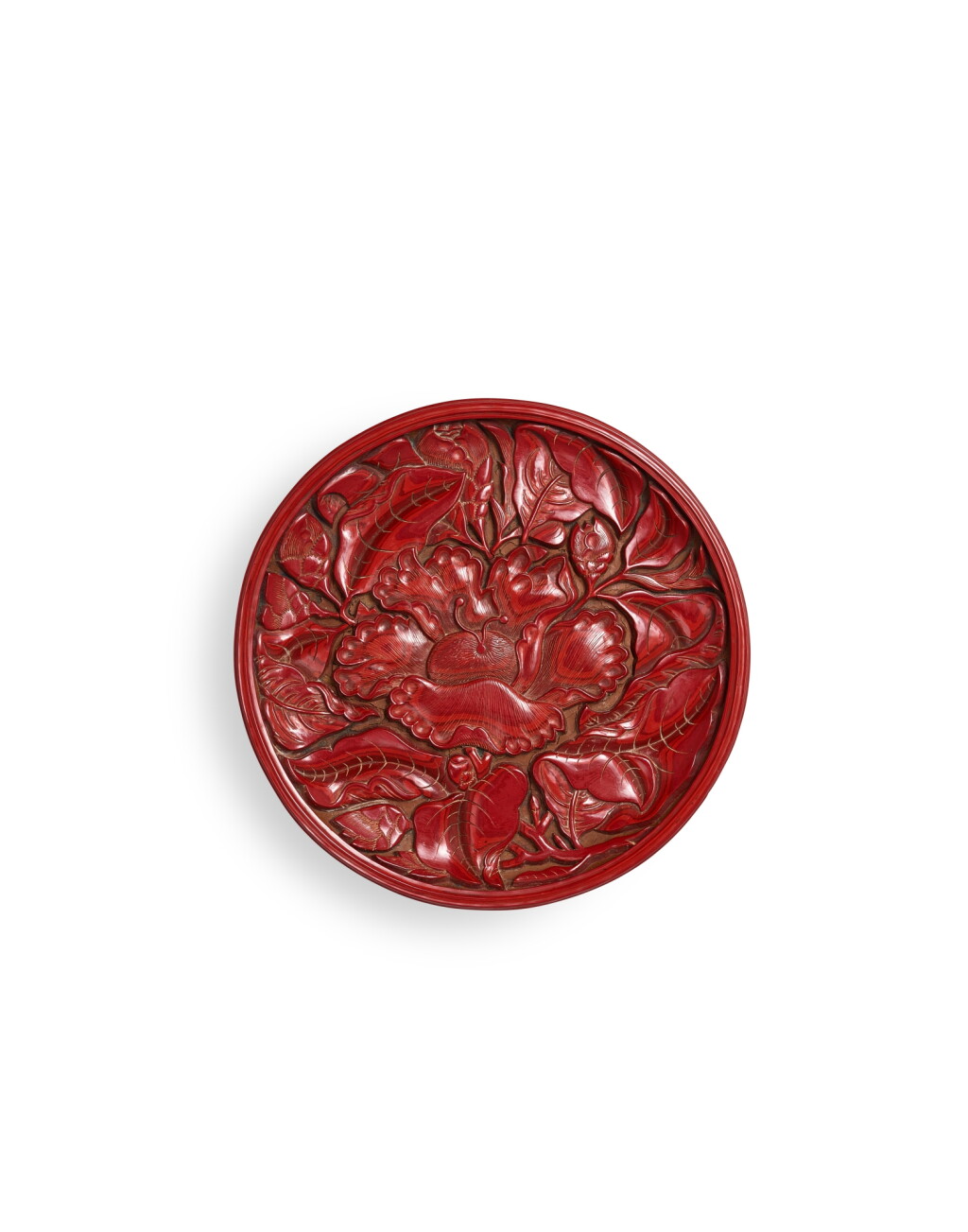
A carved cinnabar lacquer 'camellia' dish, Yuan dynasty | 元 剔紅茶花紋盤
Auction Closed
September 9, 11:30 AM GMT
Estimate
1,200,000 - 1,800,000 HKD
Lot Details
Description
of shallow circular form supported on a short slightly tapered foot, deftly carved through the layers of rich cinnabar lacquer with a lush hibiscus blossom and attendant buds wreathed in dense curling foliage, the large central bloom with lobed petals naturalistically detailed with incisions and concentric hollows at their tips, the dense central pistil sprouting two curling stamen, the underside deeply carved with cloud scrolls, the base lacquered brown, Japanese double wood box
19.5 cm
Hirano Kotoken.
Chugoku Urushi Kogei Ten [Exhibition of Chinese lacquer], Hirano Kotoken, Osaka, 1991, cat. no. 46.
Yuan floral dishes of this type are notable for the varied depths of carving and dynamically rendered designs. The skill and flair of the craftsman of the present piece are particularly evident on the curling petals of the present dish. A similar dish of this type was included in the exhibition Kaikan Jusshunen Kinen Tokubetsu-ten: Chugoku no Urushi Kogei, Hirano Kotoken, Osaka, 1991, cat. no. 46.
Compare a dish with a central gardenia bloom surrounded by buds and leaves, in the Palace Museum, Beijing, published in The Complete Collection of Treasures of the Palace Museum: Lacquer Wares of the Yuan and Ming Dynasties, Hong Kong, 2006, pl. 3; and another decorated with a large peony and three further flowers and leaves, from the Edward T. Chow and Lee Family collections, sold in these rooms, 3rd/4th May 1994, lot 276, and again at Christie’s Hong Kong, 28th November 2012, lot 2083. Another similar Yuan cinnabar lacquer 'hibiscus' dish was offered in these rooms, 8th October 2013, lot 3282. As seen on the present lot, the latter two dishes are also carved with xiangcao scrolls on the exterior, a feature typical of Yuan lacquer dishes. This camellia motif, popular in the Yuan dynasty, extends into the early Ming period, featuring notably similar central stamens, though simplified. Compare a 15th-century example in the Palace Museum, Taipei, illustrated in Carving the Subtle Radiance of Colors: Treasured Lacquerware in the Palace Museum, Taipei, 2008, cat. no. 13.
來源
平野古陶軒
展覽
《中国漆工藝展》,平野古陶軒,大阪,1991年,編號46
盤呈圓形,弧形壁,矮圈足,盤邊凸起弦紋。通體黃漆為地,上深刻一朵盛開折枝茶花,伴以四朵花蕊,盤外雕捲草紋,底髹深赭色漆。本器堆漆肥厚,雕刻紋飾豐碩圓潤,淳樸渾成,而細部精緻,在質感上表現了一種特殊的魅力。元代剔紅漆器是中國漆藝史上的巔峰之作,其工藝之精湛,奠定了後世雕漆藝術的典範。
此盤盤心刻大朵花卉,外壁則剔犀捲草紋,有典型元代風格,參考北京故宮藏一件元代張成造剔紅梔子花圓盤,見夏更起編,《故宮博物院藏文物珍品全集·元明漆器》,香港,2006年,編號3;另可比較仇焱之及李氏家族舊藏一件類似漆盤,1994年5月3日至4日售於香港蘇富比,後售於香港佳士得,2012年11月28日,編號2083。再比較一例,上拍於香港蘇富比2013年10月8日,編號3282。
茶花一直延續到明早期,參考台北故宮藏一件明十五世紀選的款剔紅茶花盒頂部所雕茶花與本件如出一本,特別是花蕊正中凸起之兩條細蕊,然而已見簡化,著錄於《和光剔彩—故宮藏漆》,台北,2008年,編號13。細觀此盤漆層頗厚,以黃漆為地,疊以朱髹,層層密密。類似做法可比較松濤美術館展覽一例,見《中國の漆工藝:開館10周年記念特別展》,平野古陶軒,大阪,1991年,編號46。
You May Also Like