
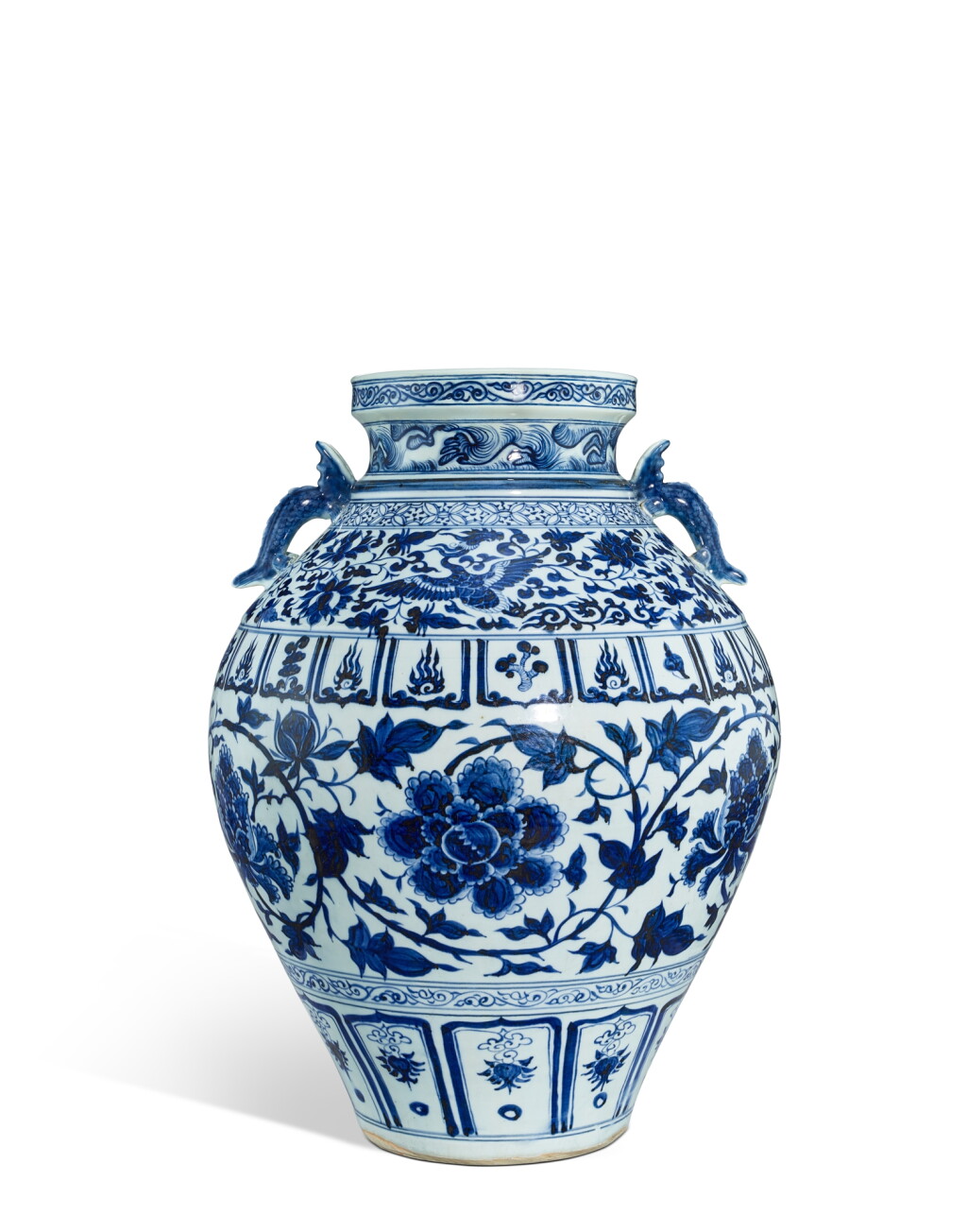
A rare blue and white 'peony and phoenix' jar, Yuan dynasty | 元 青花鳳凰牡丹紋罐
Auction Closed
September 9, 11:30 AM GMT
Estimate
3,000,000 - 6,000,000 HKD
Lot Details
Description
superbly painted in rich tones of cobalt blue accented with 'heaping and piling', the central register adorned with a broad scroll of six large peony blooms, each rendered in full, luxuriant detail borne on a meandering leafy stem, above a classic scroll and a band of upright lotus lappets around the foot, the shoulders encircled by a register depicting on each side with a phoenix soaring amidst scrolling lotus, between a diapered band and a lappet border enclosing auspicious emblems
52.8 cm
Christie's London, 10th December 1990, lot 163.
Hirano Kotoken.
Chugoku Toji Meihin Ten Ise Korekushon no Shiho / Masterpieces of Chinese Ceramic Art Exhibition, Ishikawa Prefectural Museum of Art, Ishikawa, 2012, cat. no. 46.
Chugoku Toji Ise Korekushon [Chinese ceramics. The Ise collection], Tokyo, 2012, pp. 55-57.
Adorned with graceful peony scrolls and soaring phoenixes, the present jar is a superb example of the marvellous blue-and-white wares produced at the height of the Yuan dynasty. From the varied tone of its fine underglaze blue decoration to its imposing bulbous form, each feature of this piece speaks of the hand of a long-forgotten master – immortalised forever in this remarkable work of art.
Thrown and glazed in Jingdezhen in the 14th century, this jar was among the first wares produced in China in the now ubiquitous blue-and-white palette. In what scholars have dubbed the ‘Mongol Corporation,’ Kublai Khan and his Yuan dynasty built upon and expanded the Silk Road like never before. Introducing paper currency and an early form of passports, the Emperor and his court empowered merchants to travel the length and breadth of the vast empire, from China to Europe, and bring with them priceless goods including silk, livestock and – crucially for our purposes – cobalt.
This blue mineral, once considered as rare and valuable as gold, had long been used as a pigment in Islamic ceramics but rose to even greater heights on its arrival in China. Although some earlier blue-and-white wares from the Tang dynasty had exploited small cobalt deposits in Henan Province, it was not until the Yuan dynasty that the finest cobalt, imported from Persia, became available and gained its famed status in China. Featuring detailed decorations in a luscious variegated blue tone, the present jar exemplifies what became possible with the advent of cobalt: lifelike shading and brushwork reminiscent of ink painting, rendered in a rich enchanting blue.
This type of large jar, primarily produced for export, also found significant domestic use in China, as evidenced by archaeological findings. Compare a jar housed in the Shanghai Museum, decorated with phoenixes and peonies and sharing the same form but set with animal mask embellishments on the shoulder, illustrated in Yulan Shencai. Yuandai Qinghua Ciqi Teji / Splendors in Smalt. Art of Yuan Blue-and-White Porcelain, Shanghai, 2012, cat. no. 8. Compare also another related jar, once part of the esteemed Meiyintang collection, showcasing comparable artistic element, illustrated in Regina Krahl's Chinese Ceramics from the Meiyintang Collection, vol. 2, London, 1994-2010, no. 640, and later sold in these rooms on 7 April 2013, lot 17.
來源
倫敦佳士得1990年12月10日,編號163
平野古陶軒
展覽
《中国陶磁名品展―イセコレクションの至宝》,石川縣立美術館,石川,2012年,編號46
出版
《中国陶磁―イセコレクション》,東京,2012年,頁55至57
造於元代青花工藝之巔,瓷罐造形圓潤豐美,青花細緻亮麗,色調濃淡,層次豐富,器身纏枝牡丹紋與鳳凰紋,端雅相映,銘記元瓷工藝之最,雋永悠長。
本品造於十四世紀景德鎮,可謂中國出產的首批青花瓷。當時,忽必烈所領導之元帝國版圖,沿著絲路,橫跨歐亞,前所未見。始創通用紙幣、符牌,方便商人於廣大國境內旅行與發展貿易,地理上東西方的珍貴貨品流通頻繁,包括絲綢、牲口,以及此處要述的重要陶瓷發色原料,鈷藍。
鈷藍,曾一度與黃金一樣珍稀昂貴,長久以來作為伊斯蘭陶瓷的重要發色劑,而傳入中國後,鈷料的重要性更是發揚光大。雖然青花裝飾的陶瓷,可上溯至唐代,使用河南開採的鈷礦,然而元代時,從波斯傳入品質精良的鈷藍,促使青花瓷繪一日千里,享譽中國。本品可證,青花發色艷麗光耀,色澤豐富,淡濃層次、運筆賦形,皆隨心所欲,宛若水墨畫一般。
此類大罐雖多為外銷而製,然據考古發現,其於中國本土亦曾廣泛使用。可資比照者包括:上海博物館藏一例,肩飾獸面鋪首而非螭龍,鳳穿牡丹紋飾及器形與本品相類,著錄於《幽藍神采:元代青花瓷器特集》,上海,2012年,編號8;另見玫茵堂舊藏一例,紋飾風格相近,刊於康蕊君《玫茵堂藏中國陶瓷》,卷2,倫敦,1994-2010年,編號640,後於2013年4月7日經香港蘇富比釋出,2013年4月7日,編號17。
You May Also Like


