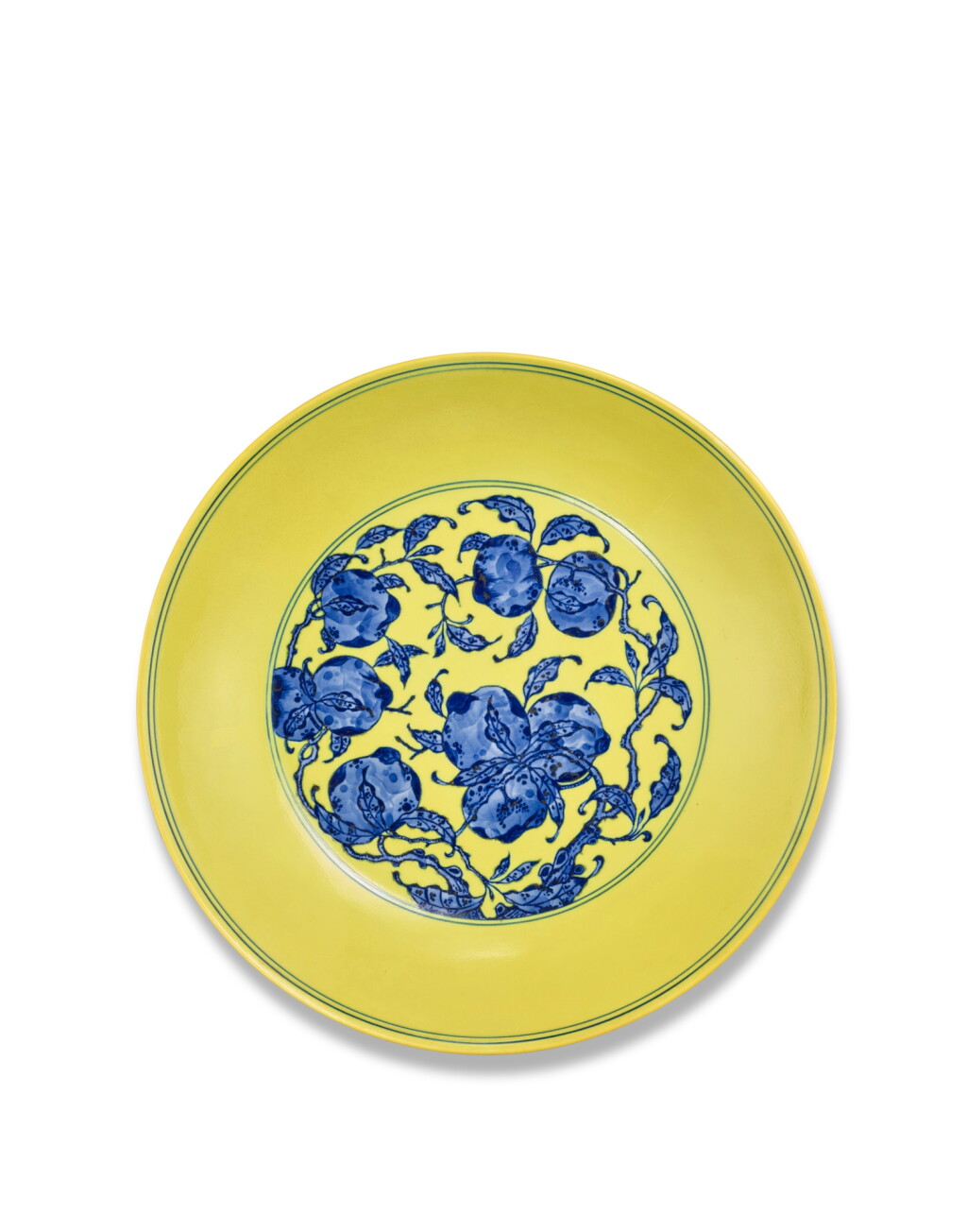
A yellow-ground underglaze-blue 'nine peaches' dish, Seal mark and period of Qianlong | 清乾隆 黃地青花九桃紋盤 《大清乾隆年製》款
Auction Closed
September 9, 11:30 AM GMT
Estimate
2,000,000 - 4,000,000 HKD
Lot Details
Description
the interior painted in inky cobalt blue with a medallion enclosing nine peaches borne on gnarled leafy branches, the succulent ripe peaches and furled leaves accented by simulated 'heaping and piling' of the cobalt, all within a double-line border repeated at the rim, the exterior with an undulating leafy scroll bearing morning glory buds and blooms, all reserved against a brilliant lemon-yellow ground, the similarly yellow-enamelled base centred with an underglaze-blue six-character seal mark within a white cartouche
26.8 cm
Collection of Edward T. Chow (1910-1980).
Collection of T.Y. Chao (1912-1999).
Sotheby's Hong Kong, 19th May 1987, lot 316 (one of a pair).
Ch’ing Porcelain from the Wah Kwong Collection, Art Museum, Chinese University of Hong Kong, Hong Kong, 1973, cat. no. 45 (one of a pair).
Chugoku Toji Meihin Ten Ise Korekushon no Shiho / Masterpieces of Chinese Ceramic Art Exhibition, Ishikawa Prefectural Museum of Art, Ishikawa, 2012, cat. no. 112.
Shika Meisai: Ise Korekushon no Meito / Imperial Colors: Peerless Chinese Porcelains from the Ise Collection, Gotoh Museum, Tokyo, 2015, cat. no. 61.
Porcelaine. Chefs-d'œuvre de la Collection Ise, Musée Guimet, Paris, 2017, cat. no. 60.
Ise Korekushon Sekai wo Miryoshita Chugokutoji / The Enchanting Chinese Ceramics from the Ise Collection, Museum of Oriental Ceramics, Osaka, 2017, cat. no. 81.
Chugoku Toji. Ise Korekushon / Chinese Ceramics. The Ise Collection, Tokyo, 2012, pp. 116-117.
Geijutsu Shincho [A Monthly Japanese Art Journal], May 2012 (Supplement), pl. 11.
This dish reveals the Qianlong Emperor’s admiration for the celebrated wares of the early Ming dynasty. The motif of fruiting peaches was first devised during the Yongle period and became a favourite motif of the Qing emperors because of its association with longevity. Although the decoration on this dish is a Qianlong-era reinterpretation, it is intentionally painted in the Ming style with the characteristic ‘heaping and piling’ effect, evoking the iconic porcelains of the previous dynasty. Similarly, the attractive contrasting palette of blue and yellow first appeared on porcelain during the Xuande reign, but continued to be produced throughout the Ming and Qing dynasties.
Dishes of this type are held in important private and museum collections worldwide. One in the Taipei Palace Museum is illustrated in Blue and White Ware of the Ch’ing Dynasty, vol. 2, Hong Kong, 1968, pl. 29; another in the Nanjing Museum, Nanjing, is published in Treasures in the Royalty: The Official Kiln Porcelain of the Chinese Qing Dynasty, Shanghai, 2003, pl. 221; and a third from the Yokogawa Collection, is published in the Illustrated Catalogues of the Tokyo National Museum. Chinese Ceramics II, Tokyo, 1965, pl. 625. For an example sold at auction, see one from the collection of Bruce Dayton and Ruth Stricker Dayton, sold in our New York rooms, 21st September 2021, lot 72.
For examples of Xuande-period predecessors, see four broken dishes decorated with various fruit and flower motifs, excavated from the imperial kiln site at Jingdezhen, included in the exhibition Jingdezhen chutu Ming Xuande guanyao ciqi / Xuande Imperial Porcelain Excavated at Jingdezhen, Chang Foundation, Taipei, 1998, cat. nos 78-2, 82-2, 85-3, and 88.
來源
仇焱之(1910-1980年)收藏
趙從衍(1912-1999年)收藏,香港
香港蘇富比1987年5月19日,編號316(一對之一)
展覽
《華光草堂珍藏清代瓷器》,香港中文大學文物館,香港,1973年,編號45(一對之一)
《中国陶磁名品展―イセコレクションの至宝》,石川縣立美術館,石川,2012年,編號112
《瓷華明彩―イセコレクションの名陶》,五島美術館,東京,2015年,編號61
《Porcelaine. Chefs-d'œuvre de la Collection Ise》,吉美博物館,巴黎,2017年,編號60
《イセコレクション―世界を魅了した中国陶磁》,大阪市立東洋陶瓷美術館,大阪,2017年,編號81
出版
《中国陶磁―イセコレクション》,東京,2012年,頁116至117
《芸術新潮》,2012年5月別冊,編號11
黃地青花九桃盤取材明初名瓷,足證乾隆帝慕古之情。碩果桃枝紋首見於永樂瓷,寓意高壽,深得清朝帝王青睞。乾隆桃紋瓷傚仿永樂紋飾,並以鈷青點染,巧擬早明青花特有之濃黑鐵斑,黃地青花相互輝映,始作於宣德朝,端莊而華貴,得後朝續作。
此類瓷盤得大博物館及重要私人藏家收藏。台北故宮博物院藏一盤,載於《故宮藏瓷.清青花瓷》,卷2,香港,1968年,圖版29。南京博物院亦有一例,收錄於《宮廷珍藏.中國清代官窰瓷器》,上海,2003年,圖版221。橫河民輔珍藏一盤,載於《東京國立博物館圖版目錄.中國古陶磁篇》,卷2,東京,1965年,圖版625。另可參考代頓伉儷舊藏一例,釋於紐約蘇富比2021年9月21日,編號72。
宣德朝黃地青花盤,參考景德鎮官窰遺址出土四盤,繪各式花果紋飾,錄於《景德鎮出土明宣德官窰瓷器》,鴻禧美術館,台北,1998年,編號78-2、82-2、85-3及88。
You May Also Like