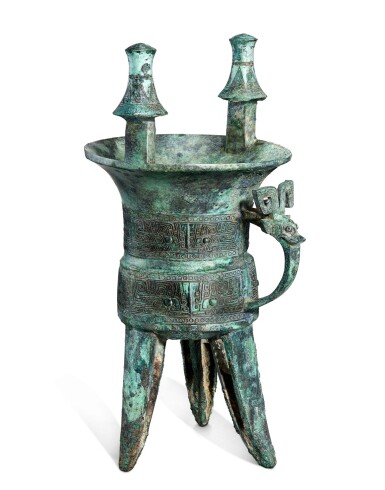
A large and exceptional bronze ritual wine vessel, jia, Mid Shang dynasty | 商中期 青銅饕餮連珠紋斝
Auction Closed
September 9, 11:30 AM GMT
Estimate
2,500,000 - 5,000,000 HKD
Lot Details
Description
supported on three tall blade legs, the cylindrical vessel rising to a flared mouth set with two upright posts capped with mushroom finials decorated with stylised banana leaves, the body crisply cast with two horizontal registers, each finely decorated with pairs of low-relief taotie masks formed by raised bosses for eyes, reserved on a leiwen ground, all between two beaded bands, the bands interrupted on one side by a single loop handle issuing from the mouth of a dragon, the green patina covered with light malachite encrustation, Japanese wood box
h. 42.8 cm
Kochukyo Co., Ltd, Tokyo.
Himerareta Sanzen-nen Toyo Bijutsu Bunka [3000 Years History of Asian Art], Aichi Prefectural Museum of Art, 1958, p. 8.
The present jia stands as a masterpiece of mid-Shang bronze work, representing the period's technical mastery through its monumental scale, refined metallurgy, and imaginative zoomorphic decoration. Its substantial size and sophisticated craftsmanship mark it as an exceptional example of Shang dynasty ritual bronze production.
The ritual wine vessels jia (斝) and jue (爵) were frequently conflated in classical Chinese texts. This confusion was addressed by the Han dynasty lexicographer Xu Shen (c. 58-148 CE) in Shuowen Jiezi, which states: "The jia is a jade jue. In Xia times it was called zhan, in Shang times jia, and in Zhou times jue." Examination of extant artifacts reveals an important distinction - while the jia features two vertical posts arranged perpendicular to its handle, the jue's posts align directly with its handle, confirming they represent distinct vessel types. Archaeological evidence suggests the jia form emerged during the Bronze Age, likely evolving from earlier pottery prototypes, as discussed by Li Ji in his seminal work “Jia de xingzhi jiqi yuanshi [The Form and Origins of Jia]”, in Li Ji wenji [Collected Works of Li Ji], Shanghai, 2006, pp. 651-657.
During the early to mid-Shang period, bronze jia typically featured flat bases with decoration executed in low relief. As the dynasty progressed into the Anyang period (c. 1300-1028 BCE), these vessels underwent significant development. Their ornamentation became more sophisticated, often incorporating high relief elements that created striking dimensionality, while the quality of the metalwork improved. The present jia, standing over 40 cm tall with its substantial body and refined craftsmanship, exemplifies the technical and artistic achievements of mid-Shang bronze casting.
Compare several related examples: The Shanghai Museum holds two mid-Shang jia with similar taotie motifs, illustrated by Chen Peifen in Xia Shang Zhou qingtongqi yanjiu [Study of archaic bronzes from Shang, Shang and Zhou dynasties], Shanghai, vol. 1 of Xia and Shang, 2004, nos. 37 and 38; earlier variants of this form can be seen in two thinner-walled, shorter jia excavated from Panlongcheng, Hubei province, illustrated in Zhongguo qingtongqi quanji [Complete collection of Chinese bronze vessels], Beijing, 2019, vol. 11, nos. 56 and 58; an early Shang jia sold at Sotheby's New York on 21 September 2005, lot 142 and another early example sold at Sotheby's London on 18 June 1968, lot 135.
Jia with animal-head handles were rarely seen in mid-Shang, but more common in Anyang period. Compare a late Shang example featuring a cast bull's-head handle in the National Museum of Asian Art Freer Gallery, illustrated in R.W. Bagley, Shang Ritual Bronzes in the Arthur M. Sackler Collections, Washington, 1987, pp. 164-165, fig. 7. Compare also a similarly ornamented jia sold at Christie's Paris on 22 June 2016, lot 374.
來源
壺中居,東京
展覽
《東洋美術文化 秘められた3000年》,愛知縣美術館,愛知,1958年,頁8
侈口,兩側立柱呈菌形頂,長頸微收,折腹略鼓,平底下承三棱形錐足。頸腹一側鑄長鋬,鋬首飾扇耳龍首,頸部及腹部上下皆以連珠紋為欄,其內飾平雕饕餮紋,前後兩組,惟雙目凸起如豆,鼻梁起棱。
古人爵、斝不分,許慎《說文解字》解釋「斝,玉爵也。夏曰琖,殷曰斝,周曰爵。」而已現存實物來看,斝二柱與鋬成垂直排列,而爵之兩柱與鋬在一條直線,並非同類。青銅器時代發軔之際便有斝這一器型,其原始器型可能來自於陶鬶,相關討論參見李濟,《斝的形制及其原始》,載於《李濟文集》,上海,2006年,頁651至657。
商代早中期斝多作平底,紋飾以平雕為主,中期紋飾則更為生動複雜,鼻眼常作浮雕,以有高低錯落之美。用料更為精實,器型日趨大氣,此斝高逾四十公分,器身厚實,乃此時期鑄造佳器。可參考上海博物館藏一件商中期獸面紋青銅斝,紋飾器型與本件類似,見陳佩芬,《夏商周青銅器研究·夏商篇上》,上海,2004年,編號37;又可上海博物館藏另一件商中期青銅斝,獸面紋飾亦似本品,見同書,編號38。湖北武漢盤龍城商代遺址出土兩件青銅斝,其紋飾頗似,然壁偏薄,身形較矮,為此類青銅獸面紋斝較早之例,見《中國出土青銅器全集》,卷11,北京,2019年,編號56及58。紐約蘇富比見售一件商代早期青銅斝,可為類似參考,2005年9月21日,編號142,;又可比較倫敦蘇富比售出一件早期之例,1968年6月18日,編號135。
鋬首飾獸首之斝,在商代中期頗為少見,可參考美國賽克勒及弗利爾美術館藏一件商代晚期青銅斝,其鋬上鑄牛首,見R.W. Bagley著,《Shang Ritual Bronzes in the Arthur M. Sackler Collections》,華盛頓,1987年,頁164至1655,圖7。巴黎佳士得售出一例,其鋬首與本件相類,2016年6月22日,編號374。
You May Also Like