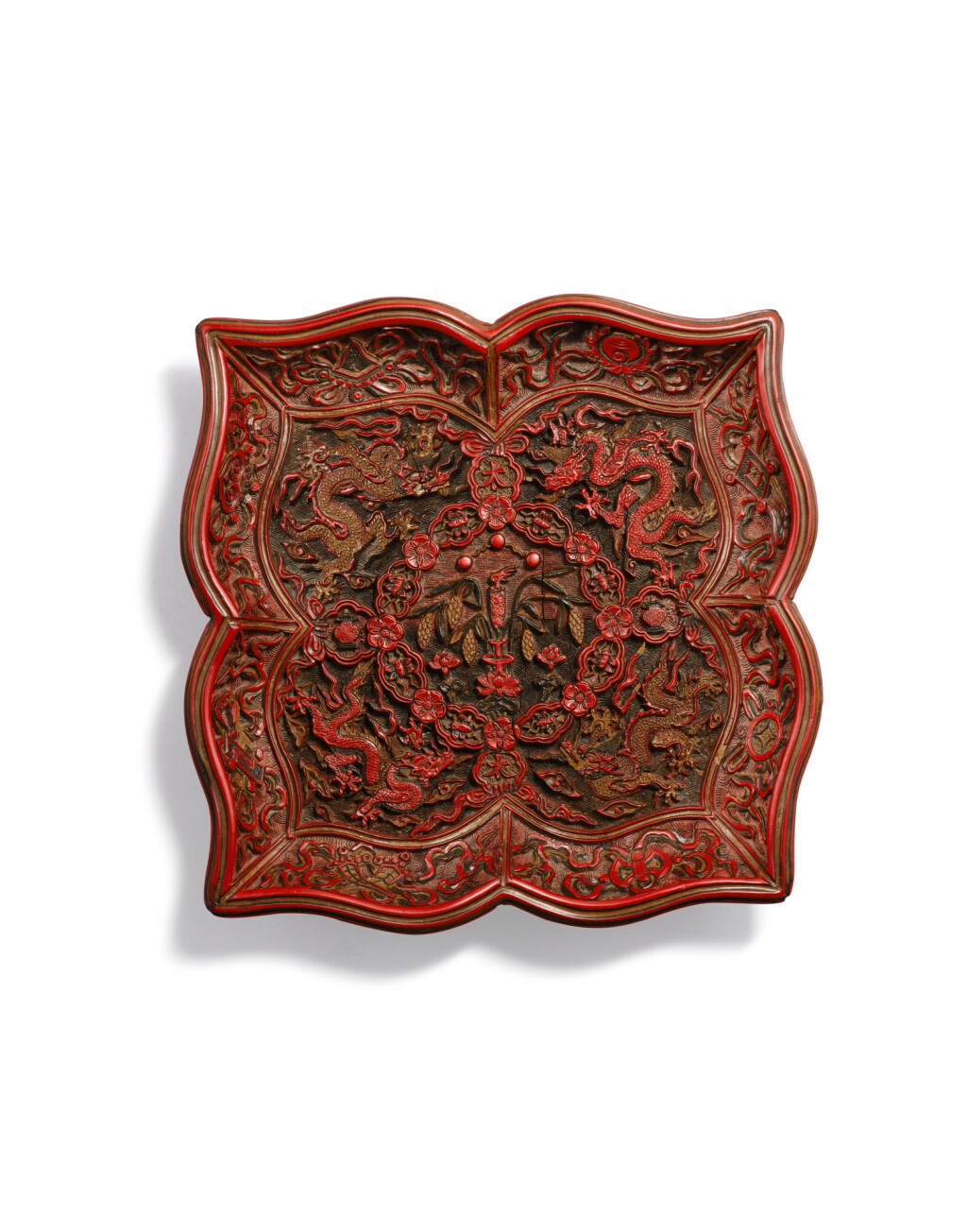
A rare carved polychrome lacquer quatrefoil dish, Mark and period of Jiajing | 明嘉靖 剔彩龍紋菱花式盤 《大明嘉靖年製》款
Auction Closed
September 9, 11:30 AM GMT
Estimate
900,000 - 1,800,000 HKD
Lot Details
Description
of quatrefoil form, the shallow rounded sides rising from a tapered foot of corresponding form, intricately carved in various levels of relief revealing multiple layers of red, yellow and green lacquer, the interior centred with a medallion enclosing a candle flanked by millet ears, surrounded by two tai characters and two vases at the cardinal points, further adorned with two pairs of five-clawed dragons and cartouches enclosing the Eight Treasures, the lobed exterior adorned with panels of flowers, the base lacquered black and gilt-incised with a vertical six-character reign mark, Japanese double wood box
17.3 cm
Collection of Sir Percival and Lady David.
Hirano Kotoken.
Collection of the Idemitsu Museum, Tokyo.
Mayuyama & Co., Ltd, Tokyo.
The Arts of the Ming Dynasty, Oriental Ceramics Society, Arts Council Gallery, London, 1957, illustrated in Transactions of the Oriental Ceramic Society, vol. 30, 1955-57, cat. no. 251.
Chugoku Urushi Kogei ten [Exhibition of Chinese lacquers], Hirano Kotoken, Osaka, 1991, cat. no. 55.
Chugoku Toji. Ise Korekushon / Chinese Ceramics. The Ise Collection, Tokyo, 2012, pp. 132-135.
The lacquerware of the Jiajing period is characterised by its ingenious shapes and exquisitely intricate motifs. Due to the Emperor’s deep devotion to Daoism, Daoist incantations and auspicious symbols frequently adorned these objects.
This lobed dish, crafted in the polychrome carved lacquer technique using red, yellow, and green layers, features a central medallion formed by alternating plum blossoms and bees, a design symbolising the cosmic harmony of "round heaven and square earth" (tian yuan di fang). Within the medallion, a dragon-engraved candle rises from a lotus pedestal beneath a constellation, flanked by abundant ears of millet. Above and below, the character tai (太, "great" or "supreme") is carved within plum petals, forming an auspicious talisman. Outside the medallion, four dynamic dragons twist vigorously amid a ground of miscellaneous treasures (zabao). The exterior is decorated with four groups of seasonal flowers, while the base bears the incised six-character mark Da Ming Jiajing nian zhi ("Made in the Great Ming Jiajing reign") in a vertical cartouche.
A closely related carved cinnabar lacquer carved lobed dish in the Palace Museum, Beijing, illustrated in The Complete Collection of Treasures of the Palace Museum: Yuan and Ming Lacquerware, pl. 126, features Buddhist iconography, dragons and the Four Heavenly Kings’ attributes (sword, pipa lute, umbrella, and snake), symbolising "favourable winds and timely rains" (feng tiao yu shun). In contrast, the present dish employs Daoist motifs to express wishes for a "Great Peace" (taiping shengshi), likely forming part of the same imperial series. Together, they reflect the Jiajing Emperor’s religious syncretism and his vision of universal harmony (wan bang xian ning). See also a similar dish sold at Christie's Hong Kong, 3rd June 2015, lot 3151.
來源
大維德爵士伉儷收藏
平野古陶軒
出光美術館收藏,東京
繭山龍泉堂,東京
展覽
《The Arts of the Ming Dynasty》,東方陶瓷學會, Arts Council Gallery,倫敦,1957年,載於《Transactions of the Oriental Ceramic Society》,卷30,1955-57年,編號251
《中国漆工藝展》,平野古陶軒,大阪,1991年,編號55
出版
《中国陶磁―イセコレクション》,2012年,東京,頁132至135
嘉靖朝漆器造型靈巧多樣,紋飾圖案精美豐富,因皇帝迷信道教,各種道教符咒及象徵吉祥的圖案呈現於器物之上。
此盤菱花式,以紅、黃、綠剔彩雕琢。盤心梅花「意祥」和蜜蜂(音「豐」)相間形成圓形開光,有天圓地方之意。開光內星宿下蓮花上托龍紋蠟燭(「燈」音「登」),兩側麥穗豐碩累累,上下方梅花瓣內刻「太」字,形成吉祥符箓,象徵五穀豐登,天下太平之美好意願。開光外四遊龍矯健威猛,盤壁飾雜寶。盤外壁四組四季花卉,盤底心正中刀刻《大明嘉靖年製》直款。
北京故宮博物院藏一件剔紅菱花式盤,見《故宮博物院藏文物珍品全集:元明漆器》,圖版126,故宮例飾龍紋及佛教四大天王法器劍、琵琶、傘、蛇,寓意「風調雨順」。然本器以道家紋飾,祝「太平盛世」之願,應與故宮剔紅例為同系列作品,體現嘉靖皇帝對宗教文化的寬容及萬邦咸寧的美好意願。可參考香港佳士得售於一類例,2015年6月3日,編號3151。
You May Also Like