
PROPERTY FROM AN IMPORTANT EUROPEAN PRIVATE COLLECTION | 歐洲私人收藏
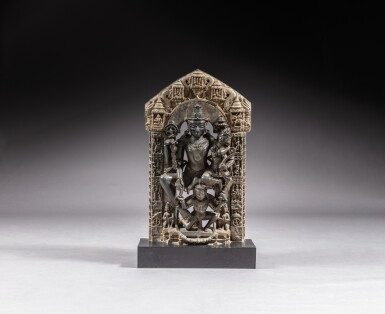
A black stone seated figure of Lakshminaryana, India, Rajasthan, circa 15th century | 印度 拉賈斯坦邦 約十五世紀 黑石雕吉祥天女與毗濕奴坐像
Lot Closed
December 12, 11:03 AM GMT
Estimate
15,000 - 25,000 EUR
We may charge or debit your saved payment method subject to the terms set out in our Conditions of Business for Buyers.
Read more.Lot Details
Description
Property from an Important European Private Collection
A black stone seated figure of Lakshminaryana
India, Rajasthan, circa 15th century
the inscription mentions the name of Maharaja Dharagara
Height 107 cm, 42⅛ in.
__________________________________________________________________________
Collection particulière européenne
Sculpture de Lakshminaryana en pierre noire, Inde, Rajasthan, circa XVe siècle
__________________________________________________________________________
歐洲私人收藏
印度 拉賈斯坦邦 約十五世紀 黑石雕吉祥天女與毗濕奴坐像
A private German collection, since the 1960s.
Acquired from the above by the present owner. and reproduced in the circa 1985 inventory of the family collection.
__________________________________________________________________________
德國私人收藏,自1960年代
現任藏家自上述收藏購得,約1985年收錄於家族收藏冊
The four-armed Vishnu with the wheel (chakra) and conch (sankha) in his right hands, the mace (gada) in his upper left, and holding his consort Lakshmi around the waist with his lower left hand. Vishnu is seated at ease with one leg pendant (lalitasana), supported by the god’s winged vehicle (vahana) Garuda flanked by two kneeling devotees. Avatars of Vishnu are depicted on the uprights and the separately carved pointed arch, with an inscription along the lower rim of the stepped pedestal: compare a very similar example formerly in the Belmont Collection, in Sotheby’s New York, 26th March 1998, lot 53; and a fourteenth or fifteenth century Rajasthan stele in the Folch Foundation, in Cruanas et al, Arte Sagrado de las Traditiones Indicas, 2005, cat. no. 5; and one in The Avery Brundage Collection at Asian Art Museum, no. B605108.
The inscription on the sculpture is written in Devanagari script.
Translation and interpretation:
"॥महाराजा धीराज श्री श्रीराज ..."
- "॥महाराजा धीराज": "Great King of Kings" or "Maharaja Dhiraja," a royal title implying a supreme or paramount ruler.
- "श्री श्रीराज": "Shri Shri Raj," a reverential prefix often used for kings or revered figures, indicating their grandeur and holiness.
The rest of the inscription after "श्रीराज" might give more context (e.g., a specific king's name, a dedication, or the purpose of the sculpture).
The additional inscription appears to read "श्री कंबोज" in Devanagari script.
- "श्री": An honorific title meaning "Lord" or "Respected."
- "कंबोज": Refers to "Kamboj," which could indicate a person, a dynasty, or a geographical region. The Kambojas were an ancient tribe or kingdom often associated with Indian and Central Asian history.
This suggests the sculpture might have been commissioned or dedicated by someone connected to the Kamboja lineage or region, or it could be a title or identifier of the figure represented in the sculpture. Combined with the earlier text ("Maharaja Dhiraja"), it reinforces its connection to royalty or high status.
________________________________________________________________________
此尊四臂毗濕奴神像,右手握神輪與海螺,左上手持金剛杵錘,左下手擁抱妻子吉祥天女。毗濕奴以自在坐姿,一腿垂懸,身形穩坐於坐騎(迦樓羅)神獸之上,兩側跪立著虔誠信徒。毗濕奴的化身雕像分別刻於兩側立柱及上方獨立雕刻之尖頂拱門上。基座下緣附有一行銘文。可參考一件與之極為相似之作,為貝爾蒙特舊藏,並於1998年3月26日紐約蘇富比上拍,編號53。另見一件十四或十五世紀來自拉賈斯坦的石刻碑,現藏於 Folch基金會,見《Cruanas et al, Arte Sagrado de las Tradiciones Indicas》,2005年,編號5;另比一件來自舊金山亞洲美術博物院收藏,編號B605108。