Property from the Collection of Leslie and Peter Warwick, Middletown, New Jersey
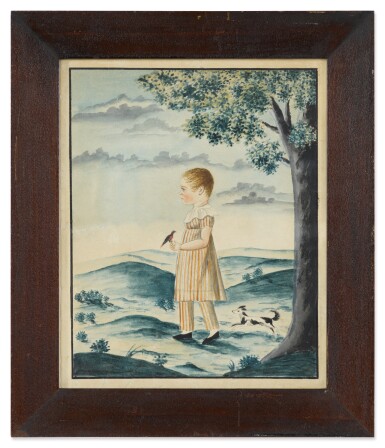
Jacob Maentel (1763 - 1863)
Edward Schriver
Auction Closed
January 25, 06:34 PM GMT
Estimate
15,000 - 25,000 USD
Lot Details
Description
watercolor, graphite, and ink on paper
circa 1818
10 ½ in. by 8 ½ in.
Please note that we have a new registration process and we highly recommend registering early to the sale. If you encounter any difficulty, please contact the Bids Department at bids.newyork@sothebys.com or call +1 (212) 606-7414 for assistance.
By family descent;
David Wheatcroft, the Mid-Week Show, Manchester, New Hampshire, 2006.
Leslie and Peter Warwick, Love At First Sight: Discovering Stories About Folk Art & Antiques Collected by Two Generations & Three Families, (New Jersey: 2022), pp. 232, fig. 404-5.
Edward Shriver (1812-96) was the fifth child of federal judge and founder of the Democratic Party in Maryland, Abraham Shriver (1771-1848), and Ann Margaret Leatherman (1777-1840). Upon marrying Elizabeth Lydia Reigart in 1839, Edward, like his father, also practiced law and lead an impressive career as a politician and lawyer in Frederick, Maryland; serving as a member of the Maryland House of Delegates, representing Frederick County from 1843-44, and as a clerk of the Frederick County Circuit Court between 1851-57. Edward began his a military career thereafter and was Colonel of the 16th Regiment of Maryland.
On October 7, 1859, John Brown, prominent leader in the American abolitionist movement, led a raid on the federal arsenal at Harpers Ferry, Virginia; a key event that spurred the American Civil War. Edward Shriver unsuccessfully attempted to get John Brown to surrender, but successfully prevented him from escaping. Brown was captured the following day by Colonel Robert E. Lee, and Shriver was commended, and was made a Brigadier General in the Union Army by Lincoln on the outbreak of the Civil War. After the War, Shriver became head of the Baltimore Post Office for four years and then head of the Baltimore Waterworks. He later became president of Frederick College for 25 years and died in 1896 at his home in Baltimore.
You May Also Like