
The Property of a Gentleman
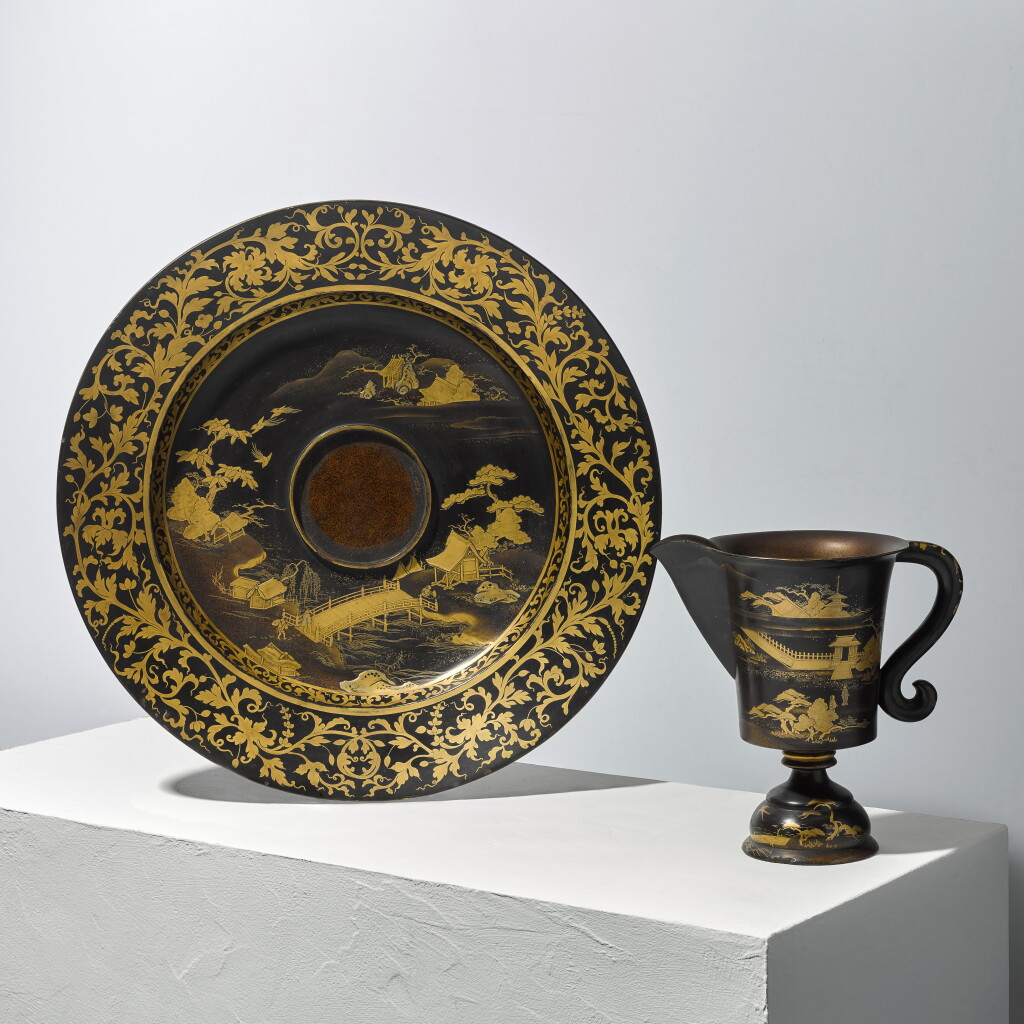
A fine lacquer ewer and basin | Edo period, late 17th century
Lot Closed
November 5, 01:10 PM GMT
Estimate
300,000 - 400,000 GBP
We may charge or debit your saved payment method subject to the terms set out in our Conditions of Business for Buyers.
Read more.Lot Details
Description
The Property of a Gentleman
A fine lacquer ewer and basin
Edo period, late 17th century
decorated in gold hiramaki-e, hirame, nashiji and kirigane on a black lacquer ground, with various landscape and scenes including figures approaching the precincts of a temple, people relaxing on wooden platforms built over a meandering stream, a traveller by a riverscape with an arched bridge leading to a shrine, pine trees and mountains in the distance
25.5 cm., 10 in. high (the ewer)
52.7 cm., 20¾ in. diam. (the basin)
When the Dutch were the only Europeans left to trade with Japan in the early 17th century, the Dutch East India Company (VOC) became the main exporter of Japanese commodities to Europe, such as lacquerware. In records of the VOC from 1613 the head of the VOC in Japan, Hendrik Brouwer (1581–1643), wrote about a shipment of lacquer: ‘This stuff is very expensive, but it is exceptionally beautiful and the process to make it is very protracted as I have seen by experience. One can put water in it without it receiving any damage. Such cups and saucers have never before been made in Japan.’1
This exquisite Japanese lacquer set, consisting of an ewer and basin, is a remarkable example from the 17th century, made for export. At least four similar sets are known to have been produced between the late 1630s and 1690s. Comparable sets can be found at the Peabody Essex Museum in Salem, Massachusetts, The Herzog Anton Ulrich Museum in Braunschweig, Germany and the Royal Ontario Museum in Toronto. Additionally, two sets were sold at auction houses in London in the 1980s and 2000s. This type of export lacquer, known as pictorial style, reflects the Dutch's preference for detailed depictions of exotic landscapes, figurative scenes, and floral motifs. These wares, featuring naturalistic designs and intricate craftsmanship, became highly popular in Europe.
The ewer has a cylindrical shape with a slightly flared rim and sits on a stepped pedestal. Its design is based on European or Middle Eastern silver, pewter, or brass models. The outer wall of the ewer is adorned with two landscape scenes. One scene depicts two figures approaching a temple gate with a pagoda and a temple hall in the background, surrounded by clouds and trees. In the foreground pine trees are visible. The other scene of the ewer shows a riverscape with a wooden platform over the water where people enjoy a picnic. Along the riverbank in the background, buildings are surrounded by trees. These landscape scenes continue with mountain sceneries across the spout. The spout appears large compared to the body and extends above the top of the ewer. The handle of the ewer is rounded in cross-section and is attached at the rim and about two-thirds down the body. The lower end of the handle curls upward and is decorated with a floral motif. The motifs continue along the stepped foot of the ewer and correspond with the scenes of the basin.
The basin has a raised circular ring in the centre to secure the foot of the ewer. This raised rim is surrounded by a landscape scene of a meandering river and its banks. In the foreground, travellers cross a bridge. Along the banks of the river are various buildings and huts, situated among trees, shrubs, reeds, and rocks.
Along the basin's wall, a stylised band of scrolling foliage is depicted between two continuous borders of gold. The same pattern continues across the outer flattened rim of the basin. The reverse side of the basin and the inside of the ewer foot are unadorned in black lacquer.
The decoration of the basin and ewer showcase a variety of lacquer techniques. Both parts of the set are coated with black lacquer, probably over a cypress wood base. The well of the basin and the inner walls of the ewer are decorated in the so-called nashiji (lit. pear-skin ground) technique in which fine gold particles are sprinkled onto the surface without being polished and covered with transparent lacquer.
The main decorative technique used on the outer surfaces of both vessels is called maki-e, which means ‘sprinkled picture’. This decorative technique involves sprinkling fine gold, silver or coloured lacquer particles to create the motifs. For example, the movement of the water is beautifully depicted with strands and swirls in gold maki-e. Other parts of the design, such as architectural elements, figures, birds and flora, showcase different variations of the maki-e technique. The raised designs were created using the takamaki-e and hiramaki-e techniques. Takamaki-e (raised maki-e) involves a mixture of metallic powders applied to the surface designs, built up through a combination of lacquer and charcoal or clay dust. The relief design is then secured with a protective lacquer coat and polished. Hiramaki-e (flat maki-e) involves sections of gold design being polished immediately after drying. A simpler gold design, often found in exported goods, is not polished. A third applied technique is hirameji (flat dust base), where flakes of gold or silver are embedded in the lacquer, visible in the river scenes.
This rare and important ewer and basin set highlights the remarkable craftsmanship in export lacquer ware of the Edo period (1603–1868). It would have been used in Europe at mealtimes to rinse the fingers or placed on dressing tables.
Sources:
Martha Boyer, Japanese Export Lacquers from the Seventeenth Century in the National Museum of Denmark, Copenhagen 1959.
Oliver Impey and Christiaan Jörg, Japanese Export Lacquer, Hotei, 2005.
Christiaan Jörg, ‘Japanese Export Lacquer for the Dutch Market’, in: Heidelberger OJS-Journals, 2004, p. 43-46.
1. Jörg, ‘Japanese Export Lacquer for the Dutch Market”, p. 43.
──────────────────
Monika Hinkel
You May Also Like


