
The Property of a Gentleman
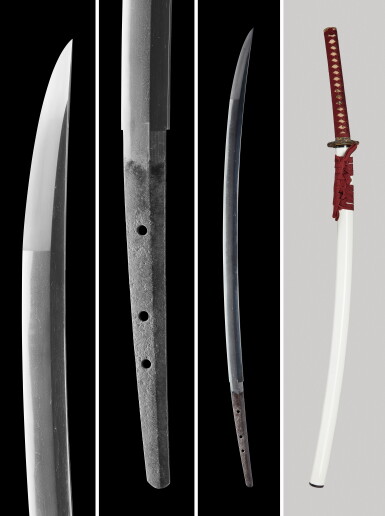
A naginata-naoshi katana | Attributed to Bungo Tomoyuki (active circa 1356-1367) | Nambokucho period, 14th century
Lot Closed
November 5, 01:50 PM GMT
Estimate
25,000 - 30,000 GBP
We may charge or debit your saved payment method subject to the terms set out in our Conditions of Business for Buyers.
Read more.Lot Details
Description
The Property of a Gentleman
A naginata-naoshi katana
Attributed to Bungo Tomoyuki (active circa 1356-1367)
Nambokucho period, 14th century
Sugata [configuration]: naginata-naoshi-zukuri, iori-mune, wide mihaba, subtle widening from base to tip, shinogi-ji is wide in relation to mihaba, high shinogi that drops off noticeably towards the mune, relatively deep curvature, o-kissaki
Kitae [forging pattern]: rather pronounced itame mixed with o-itame and mokume, featuring plenty of ji-nie and much fine chikei
Hamon [tempering pattern]: on the omote side a gunome-midare that is mixed with ko-notare and ko-gunome and whose elements are overall rather densely arranged, on the ura side a gunome that is mixed with an angular style gunome, ko-gunome, ko-choji, ashi, and yo, some mura-nie appear in places, the nioiguchi is subdued, sunagashi, kinsuji, and a few yubashiri and tobiyaki are also visible
Boshi [tip]: sugu-cho with hotsure, on the omote side with plenty of hakikake and running out in yakitsume manner, on the ura side with some hakikake at the tip and with a brief rounded turnback
Nakago [tang]: o-suriage, the yasurime on the omote side is katte-sagari on the hira-ji and kiri on the shinogi-ji, the yasurime on the ura side is katte-sagari on the hira-ji until around the middle of the tang and then downwards kiri and kiri on the shinogi-ji, three mekugi-ana
Habaki [collar]: copper-gilt, single clad
In shirasaya plain wood scabbard]
Koshirae [mount]: the saya of later date decorated overall in white lacquer, the iron and gilt nanako fittings carved, chased and engraved with crickets and grasshoppers among autumn flowers and foliage, including field chrysanthemum, bush clover and bellflowers, the mokko-gata tsuba similarly decorated, the menuki in the form of wheels before further foliage, Showa period, 20th century
Nagasa [length from kissaki to machi]: 73.2 cm., 28⅞ in.
Sori [curvature]: 2.2 cm., ⅞ in.
Saki-haba [width at the yokote]: 3 cm., 1¼ in.
Moto-haba [width at the machi]: 2.9 cm., 1¼ in.
Kissaki-nagasa [length of the tip]: 15.2 cm., 6 in.
Nakago-nagasa [length of the tang]: 22.4 cm., 8⅞ in.
Accompanied by a certificate of registration as Juyo Token [Important Sword], no. 18200652 issued by the Nihon Bijutsu Token Hozon Kyokai [Society for the Preservation of the Japanese Art Sword], dated Heisei 18 (2006).
The sword making tradition in Bungo Province (present-day Oita Prefecture) was dominated by So Sadahide (dates unknown) and Yukihira (circa 1141 - circa 1222) who were active in the early Kamakura period (1185-1333). There were no noted masters after them until the Nanbokucho period (1336-1392), when the smith Tomoyuki was active in the local Takada manor and acted as founder of the eponymous Takada school which flourished throughout the Muromachi (1392-1573) and Edo period (1615-1868).
Dated works by Tomoyuki are extant from the Joji (1362-1368) and Shohei (1346-1370) eras. His workmanship is fundamentally similar to that of the contemporary Samonji school, but the features of his ha work are overall more densely arranged, at long intervals, more angular gunome, and much shirake and some jifu appears in his ji.
This blade was originally a naginata which was shortened and reworked into a katana. It has a forging pattern in a rather pronounced itame that is mixed with o-itame and world burl mokume and that features plenty of ji-nie and fine chikei. The tempering pattern is on the omote side a gunome-midare that is mixed with ko-notare and ko-gunome whose elements are overall rather densely arranged, and on the ura side a gunome that is mixed with further angular gunome, ko-gunome, and small clove-like patterns (ko-choji) that appears partially as a flamboyant midareba. There are ashi and yo, clusters of nie (mura-nie) in places, the nioiguchi is rather subdued, and we see sunagashi, kinsuji, and a few yubashiri and tobiyaki.

