
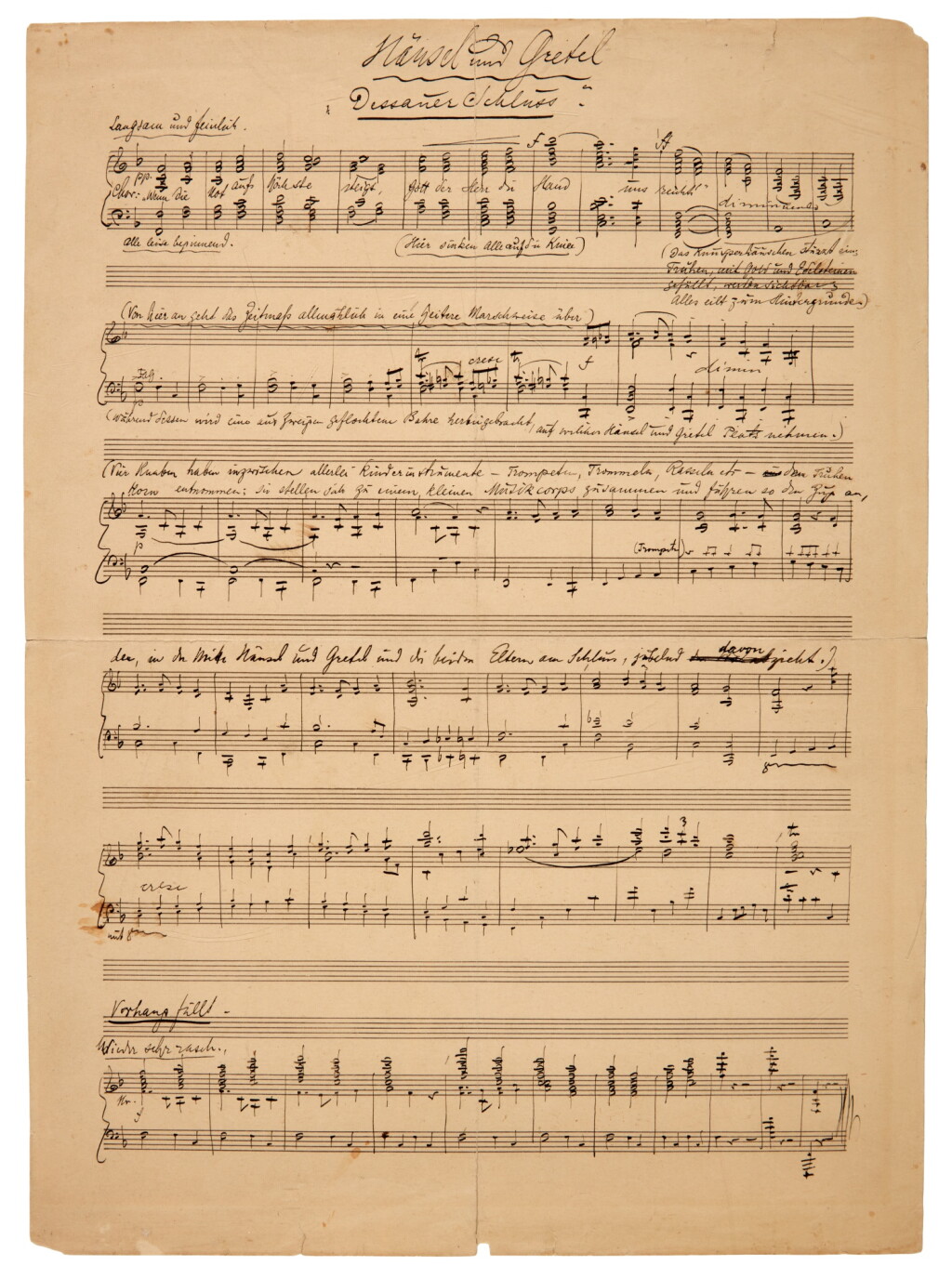
Engelbert Humperdinck. Autograph manuscript revised ending of "Hänsel und Gretel", 1894
Lot Closed
July 11, 12:12 PM GMT
Estimate
3,000 - 4,000 GBP
Lot Details
Description
Engelbert Humperdinck
Autograph manuscript of part of "Hänsel und Gretel", being the revised ending composed for Dessau in 1894
with the title "Hänsel und Gretel/ Dessauer Schluss", the short score, unsigned, notated in black ink on six two-stave systems, containing the final chorus “Wenn die Not aufs höchste steigt”, slightly simplified and without the solo singers, followed by a completely different continuation for orchestra from that found in the original version, incorporating an old march-tune ('Der alte Dessauer-Marsch'), with copious stage directions written above the music, explaining that the gingerbread house collapses ("Das Knusperhäuschen stürzt ein"), and a trunk with gold and jewellery appears, from which the children take various instruments (trumpets, drums, rattles etc.) and join the march until the curtain falls, the manuscript comprising 57 bars in all, with some deletions and alterations and a few instrumental markings ("Fag", "Horn", "Trompeten", "Hr.")
1 page, folio (c.35.5 x 25.7cm), 16-stave paper, no place or date [c.1894], some splitting at folds and marginal tears, trace of mount on verso
RARE: Hänsel und Gretel is Humperdinck's masterpiece and autograph manuscripts from it are seldom offered for sale. His "fairy-tale opera" is one of the most enduring works of post-Wagnerian German opera. Richard Strauss, who conducted the premiere in Weimar in 1893, declared it a masterpiece and it has never fallen out of the repertory.
Humperdinck composed this revised ending for a production in Dessau in 1894, staged by Cosima Wagner, in which he incorporated 'Der alte Dessauer-Marsch', an infantry march dating from c.1705. The march dominates the music from the third system until the end, creating a much more extended instrumental ending than the original Weimar version, which is only eleven bars long. The march is here notated in double the time values found in contemporary printed sources for the tune, such as Emil Pauer's Sammlung der berühmtesten Deutschen, Französischen und Italienischen Märsche (1875), no.36 (p.69).
You May Also Like




![Venn, Thomas | Military & Maritine [sic] Discipline in Three Books... London, 1672, first edition, contemporary calf](https://sothebys-md.brightspotcdn.com/dims4/default/4a076e7/2147483647/strip/true/crop/2000x2000+0+0/resize/150x150!/quality/90/?url=http%3A%2F%2Fsothebys-brightspot.s3.amazonaws.com%2Fmedia-desk%2Fwebnative%2Fimages%2F3f%2F4d%2Ff75147e94e3aaef0e11650a8d6b7%2Fn12451-bkgtd-t2-02.jpg)


