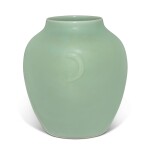

A celadon-glazed ovoid jar, Seal mark and period of Daoguang | 清道光 粉青釉月牙耳罐 《大清道光年製》款
Auction Closed
March 21, 02:11 PM GMT
Estimate
10,000 - 15,000 USD
Lot Details
Description
A celadon-glazed ovoid jar
Seal mark and period of Daoguang
清道光 粉青釉月牙耳罐 《大清道光年製》款
the base with a six-character seal mark in underglaze blue, together with a Sotheby's New York catalogue, 19th November 1982 (2)
及 紐約蘇富比拍賣圖錄,1982年11月19日
Height 7 ½ in., 18.9 cm
Sotheby's New York, 19th November 1982, lot 267.
紐約蘇富比1982年11月19日,編號267
This vessel form, with its harmonious profile and its C-shaped motifs on the sides appears to have originated during the Kangxi reign. The shape is often called riyueguan ('sun-and-moon jar'), its cover supposedly representing the sun and the crescents at its sides the moon, but no comparable iconography appears to be known from other works of art. A rare Kangxi version of this design in the National Palace Museum, Taipei, is included in the Museum's exhibition Catalog of the Special Exhibition of K'ang-hsi, Yung-cheng and Ch'ien-lung Porcelain Ware from the Ch'ing Dynasty in the National Palace Museum, Taipei, 1986, cat. no. 27.
A closely related jar and cover from the Meiyintang Collection was sold in our Hong Kong rooms, 4th April 2012, lot 14; and another, similarly with a cover, from the T.Y. Chao Collection, was sold in the same rooms, 19th May 1987, lot 283; one without a cover in the Hong Kong Museum of Art was included in the Museum's exhibition The Wonders of the Potter's Palette. Qing Ceramics from the Collection of the Hong Kong Museum of Art, Hong Kong, 1984, cat. no. 79.
A closely related jar and cover from the Meiyintang Collection was sold in our Hong Kong rooms, 4th April 2012, lot 14; and another, similarly with a cover, from the T.Y. Chao Collection, was sold in the same rooms, 19th May 1987, lot 283; one without a cover in the Hong Kong Museum of Art was included in the Museum's exhibition The Wonders of the Potter's Palette. Qing Ceramics from the Collection of the Hong Kong Museum of Art, Hong Kong, 1984, cat. no. 79.
You May Also Like


