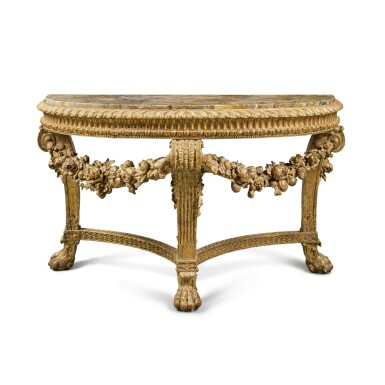
A George III Giltwood Console Table, Circa 1765
No reserve
Auction Closed
October 15, 06:30 PM GMT
Estimate
20,000 - 30,000 USD
Lot Details
Description
with later yellow breccia marble top; back rail bearing a printed label Cowley & Co Depository Oxford Number 166 and a further label A311 / A. & N. Aux C S L
height 32 in.; width 59 in.; depth 24 in.
81.5 cm; 150 cm; 61 cm
Possibly commissioned by Sir Lawrence Dundas, 1st Baronet (1710-81), for Moor Park, Hertfordshire, and sold with the house to Robert Grosvenor, 1st Baron Ebury (1801-93);
Robert Grosvenor, 2nd Baron Ebury (1834-1918) at Moor Park;
Sotheby's London, 7 November 1997, lot 49;
Partridge Fine Arts, London;
Private Collection, Greenwich, Connecticut;
Christie's New York, 24 October 2017, lot 61.
This table was formerly in the collection of Robert Grosvenor, 1st Baron Ebury (1801-93) at Moor Park, Hertfordshire where it appears in a photograph of 1910 (Historic England, BB81/1439). Lord Ebury inherited Moor Park from his father Robert Grosvenor, 2nd Earl Grosvenor, later 1st Marquess of Westminster (1767-1845), who had purchased the house with much of its interior contents in 1828. The current house at Moor Park was built by the 1st Duke of Monmouth in the late 17th century and significantly altered by subsequent owners in the first half of the 18th century by the architects James Thornhill and Matthew Brettingham, with a park by Capability Brown added. In 1762 the estate was acquired by the Scottish businessman and landowner Sir Lawrence Dundas, 1st Baronet (c.1710-1781), one of the wealthiest men in Georgian Britain, and just as with his London townhouse in 19 Arlington Street Dundas engaged the architect Robert Adam to refurbish the interiors.
It is conceivable the present table could have formed part of the furniture commissioned by Adam for Dundas at Moor Park. Its demilune form with fluted frieze, scroll legs joined by floral garlands and guilloche-carved stretchers are characteristic of the early neoclassical style of the 1760s espoused by Adam and share stylistic affinities with the celebrated suite of carved giltwood seat furniture designed by Robert Adam for the Banqueting Hall at Moor Park in 1764 that was sold with the house after Dundas's death to Thomas Routes of the East India Company in 1784 and then to the M.P. for Dorchester Robert Williams in 1801 before its acquisition by the 1st Baron Ebury. The Baron's son in turn sold Moor Park with most of its furniture to Lord Leverhulme in 1919, but the present table has not figured in any sales of Ebury, Grosvenor or Leverhulme property, and its subsequent history remains unknown until its re-appearance on the art market at the end of the 20th century.
You May Also Like