
Property from a Dutch Private Collection
Johannes Hispanus
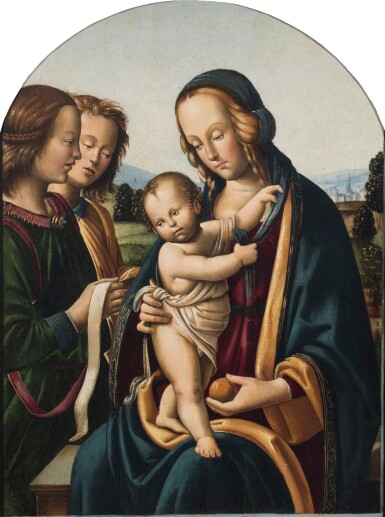
The Virgin and Child with two Angels
Lot Closed
July 7, 02:02 PM GMT
Estimate
40,000 - 60,000 GBP
Lot Details
Description
Property from a Dutch Private Collection
Johannes Hispanus
Acitve in central and southern Italy at the beginning of the 16th century
The Virgin and Child with two Angels
oil on panel, with rounded top
unframed: 50.7 by 37.9 cm.; 20 x 15 in.
framed: 57.4 x 44.8 cm.; 22½ x 17¾ in.
Colonel W. Cornwallis West, M.P., London, by 1891;
By whom sold, London, Christie's, 11 July 1919, lot 62 to Renton for £152–5s. (all the above as by Pinturicchio);
Dr and Mrs R.H. Rush, Washington, by 1959 (according to the entry in the Berenson Archive at Villa I Tatti, where listed as by Antonio da Viterbo, called il Pastura);
By whom gifted to the Finch College Museum of Art, New York (according to an old label on the reverse, as il Pastura);
By whom (anonymously) sold, New York, Parke-Bernet Galleries, 22 October 1970, lot 7 (as il Pastura);
Anonymous sale, Sotheby's, New York, 22 January 2004, lot 55 (as Rocco Zoppo, but with a saleroom notice thanking Everett Fahy and Andrea de Marchi for suggesting an attribution to the young Hispanus);
With Moretti Gallery, Florence, from whom acquired by the present collector in 2011.
London, Royal Academy, Exhibition of works by the old masters..., 1891, no. 146;
London, The New Gallery, Exhibition of Early Italian Art from 1300 to 1550, p. 24, 1893–94, no. 126 (here and above as Pinturicchio);
London, The Burlington Fine Arts Club, Pictures of the Umbrian School, 1910, no. 55, reproduced plate xxv (as ascribed to Pinturicchio);
Rovigo, Palazzo Roverella, Le Meraviglie della pittura tra Venezia e Ferrara. Da Bellini a Dosso a Tiepolo, 22 January – 4 June 2006, no. 23 (as Hispanus).
Exhibition of works by the old masters..., London 1891, p. 34, no. 146;
Exhibition of Early Italian Art from 1300 to 1550, London 1893–94, p. 24, no. 126 (here and above as Pinturicchio);
Catalogue of a Collection ofPictures of the Umbrian School, London 1910, p. 43, no. 55 reproduced plate xxv (as ascribed to Pinturicchio);
R. van Marle, The Development of the Italian Schools of Painting, 1923–38, vol. XIV, p. 293, note 1 (under works which ‘reflect the art of Pinturicchio’);
B. Berenson, Italian Pictures of the Renaissance: Venetian School, London 1957, vol. I, p. 194 (as Francesco Verla);
L. Puppi, Francesco Verla, Roma 1960, p. 277, reproduced fig. 12 (as Verla);
L. Puppi, Francesco Verla, Pittore, Trento 1967, p. 48, reproduced p. 60, fig. 7 (as Verla);
F. Todini, La Pittura Umbra, Milan 1989, p. 307, reproduced in colour vol. I, pl. XLV and vol. II, p. 522, no. 1203 (as Rocco Zoppo);
M. Tanzi, ‘Siparietti cremonesi’, in Prospettiva, 113–14, January–April 2004, p. 156, note 15 (as Hispanus);
F. Todini, ‘Il Perugino, le sue botteghe e i suoi seguaci. "Volendo fare di sua mano, lui è il meglio maestro d'Italia."’, in
Perugino a Firenze, exh. cat., Florence 2005, p. 62 (as Rocco Zoppo);
C. Agostini in V. Sgarbi (ed.), Le Meraviglie della pittura tra Venezia e Ferrara, exh. cat., Cinisello Balsamo 2005, pp. 84–85, no. 23 (as Hispanus, while a close follower of Perugino in Rome);
M. Tanzi, ‘Aggiornamenti per Filippo da Verona’, in Verona illustrata, 19, Verona 2006, pp. 105–6, note 3 (as Hispanus);
S. Castellana, Johannes Hispanus, Naples 2017, p. 115, no. 1, reproduced fig. 1 (as Hispanus).
This charming panel has been known since the latter part of the nineteenth century, when it was acquired in Italy and subsequently exhibited in London. Initially ascribed to Pinturicchio, as was customary in Britain with so many of the central Italian Renaissance panels brought back from Italy, the painting was subsequently given to Francesco Verla, a north Italian artist who came into contact with the great Perugino in Umbria. Filippo Todini subsequently incorporated a group of works given to the Master of the Finch Madonna, so-named after the present panel, under the corpus of Rocco Zoppo, a Florentine follower of Perugino.
More recently the panel has been convincingly attributed to Johannes Hispanus, an elusive artist whose catalogue has now been convincingly defined, initially by Marco Tanzi and more recently by his pupil Stefania Castellana, whose catalogue raisonné on the artist was published in 2017. Both Everett Fahy and Andrea De Marchi had both recognised Hispanus' hand at the time of the 2004 sale, when the painting had been attributed to Rocco Zoppo. The artist takes his name from a panel of the Deposition in the Saibene collection in Milan, which is signed IOANES ISPANUS.P.1 Presumably Spanish, he is thought to have been active in central and southern Italy at the very end of the fifteenth century and well into the sixteenth. He was strongly influenced by Pietro Perugino and Piero di Cosimo, but was clearly also aware of artists active in the north of Italy such as Cima da Conegliano, whose work is clearly felt in the Saibene panel. Castellani proposes that Hispanus must have stopped by Rome around 1492, and suggests a date around that time for the execution of the present panel.
1 Castellana 2017, pp. 127–28, no. 13, reproduced in colour plate XIII.