
Arshile Gorky
Untitled
This lot has been withdrawn
Lot Details
Description
Arshile Gorky
1904 - 1948
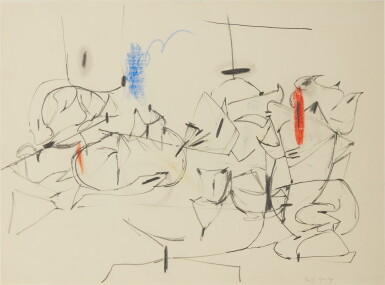
Untitled
signed by the artist's widow
graphite and crayon on paper
Sheet: 18⅛ by 24⅛ in. (46 by 61.2 cm.)
Framed: 25 by 30½ in. (63.5 by 77.4 cm.)
Executed circa 1944-1945.
This work is recorded in the Arshile Gorky Foundation Archives under registration number D1035.
"Drawing is the basis of art. A bad painter cannot draw. But one who draws well can always paint. Drawing gives the artist the ability to control his line and hand. It develops in him the precision of line and touch. This is the path towards a masterwork"
(Arshile Gorky quoted in Karen Mooradian, Arshile Gorky Adoian, Chicago 1978, p. 276)
Executed circa 1944-1945, Arshile Gorky’s Untitled hails from the most transformative period in his career. The swirling biomorphic combinations of lines and colors testify to the artist’s newly-found personal idiom, moving beyond the Cubists and Surrealists to fuse European modernism and New American painting. Describing Gorky’s work during this time, Surrealist leader André Breton exclaimed: “Here is an art entirely new, a leap beyond the ordinary and the known to indicate, with an impeccable arrow of light, a real feeling of liberty.” (André Breton quoted in: Hayden Herrera, Arshile Gorky: His Life and Work, New York 2003, p. 478) Acquired directly from the artist’s family, Untitled has been held in the present collection for decades; today, it stands as a poignant and paradigmatic example of the artist’s extraordinary contribution to Twentieth Century abstraction.
Having fled the Armenian Genocide, in 1920 Gorky arrived in New York where he found himself utterly inspired. Now in his purview, the art and intellectual discourse of the city prompted Gorky to engulf himself in a self-education of the history and practice of his peers and artists he delighted in, such as Wassily Kandinsky. As a primarily self-taught artist, Gorky was academic in the study of his predecessors and, with the emergence of Surrealism onto the New York art scene in the 1940s, Gorky discovered yet another exciting approach from which to be inspired. Stimulated by the free flowing and ethereal qualities associated with the surrealist practice, in Untitled Gorky at once references the work of artists such as Marcel Duchamp, while succinctly departing from their automatism to create a style undeniably his own. Indeed, as then Director of the Whitney Museum Lloyd Goodrich said in 1951 shortly following the tragic and untimely death of the artist, “[Gorky] never imitated the mere mannerisms, the superficial characteristics of the artists he admired. Always he strove for an understanding of the fundamental elements of their work, and there was nothing coldly intellectual in his use of others’ art. His own artistic nature was rich, so deeply sensuous, so healthily physical, so much in love with pigment and color, line and form that everything he touched, even in his most obviously influenced works, was himself." (Lloyd Goodrich quoted in Harry N. Abrams, Inc., Arshile Gorky, New York 1966, p. 16) This inimitable style solidified Gorky’s output as the bridge between the New York School and European modernism and in turn paved the way for the Abstract Expressionism, which would alter the course of artistry in the post-war period.