David Roberts, R.A.
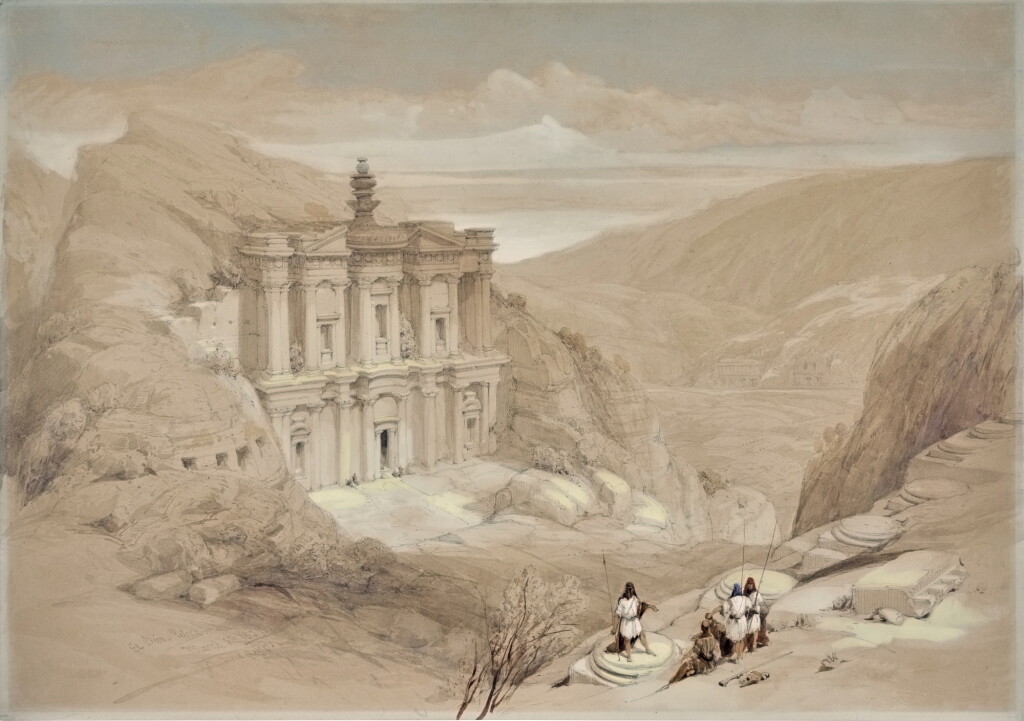
El Deir, Petra
Auction Closed
April 29, 03:51 PM GMT
Estimate
60,000 - 80,000 GBP
Lot Details
Description
David Roberts, R.A.
(Edinburgh 1796 - 1864 London)
El Deir, Petra
Watercolour over pencil, heightened with touches of bodycolour and gum arabic;
inscribed, dated and signed lower left: El Deir. Petra / March 8th 1839. / David Roberts
356 by 506 mm.
Lord Francis Egerton, later 1st Earl of Ellesmere (1800-1857), purchased from the artist,
The Ellesmere Sale, London, Christie's, 2 April 1870, lot 88, bt Agnew,
by whom sold to John Graham of London (1818-1893),
his executor’s sale, London, Christie's, 5 May 1894, lot 26;
sale, London, Sotheby's, 13 July 1989, lot 220, bt Agnew's on behalf of the parents of the present owners.
Lithographed:
by Louis Haghe for The Holy Land, London 1849, vol. III, pl. 90 & London 1856, vol. III, pl. 90
Oxford, The Ashmolean Museum of Art and Archaeology, on long-term loan, 2015 - 2021
The magnificent city of Petra was built by the Nabataean tribe over a period of five hundred years from around the sixth century BC onwards. In its heyday, under King Aretas IV (8 BC-AD 40), the city was home to around 30,000 people who had transformed themselves from desert traders - who dominated the incense and spice routes - into masterful architects, hydraulic engineers and craftsman, whose influence connected Arabia to the Mediterranean. By the seventh century, however, as a result of gradual changes to these trade routes, Petra had become a largely forgotten outpost and by the nineteenth century it was completely unknown to all but the local Bedouin. It was not until 1812 that Jean-Louis Burckhardt, a Swiss explorer who was travelling between Damascus and Cairo, accidentally stumbled across it. Although Leon de Laborde (1807-1869), a talented amateur draughtsman, had visited Petra in 1827 and had then included lithographic images of the city in his 1830 publication Voyage de l’arabie, it is David Roberts’s work - both created there and inspired by his time there - that have become iconic. The present watercolour is one of four in this sale of this magnificent and ancient place.
Roberts's party arrived in Petra on the 6th of March and remained there for just under a week. After initial concerns as to whether they would be granted safe passage to the ruins, they were not disappointed by what they saw. Roberts wrote of his astonishment and bewilderment 'with this extraordinary city’, while one of his travelling companions - John Kinnear - commented that ‘it was certainly one of the most wonderful scenes in the world. The eye wanders in amazement from the stupendous rampart of rocks which surrounds the valley to the porticoes and ornamented doorways sculptured on its surface. In the valley itself, the patches of green corn among the ruins, the stream bordered with oleander and willow, the sweet sound of the running water and the cry of the cuckoo and partridge were all delightful and refreshing after the silence and dreary solitude of the desert.’1
It was not until the 8th of March that they visited El Deir and Roberts wrote in his journal: 'Today, accompanied by a guard of Arabs, we wound our way up a steep ravine; a broken staircase extending the whole ascent, which was nearly a mile. We at length reached the object of our journey, which was a building rarely visited, called El Deir. It is hewn out of the face of the rock, and is of greater magnitude than the Khasne (see lot 305), being upwards of 100 feet in height... El Deir stands a thousand feet above the level of the City... Though the ruins of the extraordinary place are immense, they sink into insignificance when compared with these stupendous rocks. I have often thrown my pencil away in despair of ever being able to convey any idea of this extraordinary place. Whereas the present watercolour was made when back in England and was then lithographed by Louis Haghe for the Holy Land series, Roberts’s preliminary drawing for this subject is lot 304 in this sale.
This watercolour has a long and well documented history. It was one of those acquired directly from the artist by Lord Egerton (see lot 301 for further information on this important patron) and later it belonged to John Graham of 18 Albert Gate, London, a Glasgow merchant whose executor’s sale at Christie’s in 1894 also included works by John Constable and Sir Edward Burne-Jones.
1. J. Ballantine, The Life of David Roberts, R.A., London 1866, p. 121
2. J. Kinnear, Cario, Petra and Damascus in 1839, London 1841, p. 132
You May Also Like