
The Shapes of Cartier
Cartier, Paris
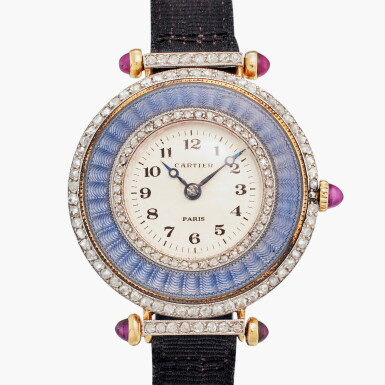
Diabolo | A yellow gold, platinum, enamel and diamond-set lady’s wristwatch with guillochéd Paris dial, Circa 1908
Auction Closed
June 15, 08:08 PM GMT
Estimate
15,000 - 20,000 USD
Lot Details
Description
Dial: silvered engine-turned dial, black Arabic numerals, outer minute ring, blued steel moon hands
Caliber: 10’’’ unsigned Swiss frosted gilded bar movement, lever escapement, bi-metallic compensation balance with timing and poising screws, Breguet hairspring
Movement number: numbered beneath dial 87'945 and 27
Case: 18k yellow gold and platinum, translucent blue guilloché enamel bezel framed by an inner and outer row of rose-cut diamonds, ogival cabochon ruby-set crown, screw-set vis armurier lugs, the bars faced with rose-cut diamonds and terminating to each side with a single collet-set ruby cabochon, snap-on case back
Case number: case back stamped 19'104, inside case back numbered 52'579, 87'945, 2'651, Edmond Jaeger punch mark and French eagle’s head assay mark
Closure: 18k yellow gold deployant clasp numbered 4'606 and 19'104, with Edmond Jaeger punch mark
Size: 29 mm diameter
Box: no
Papers: no
Alexander Barter, The Watch: A Twentieth-Century Style History, London: Prestel, 2019. See p. 40 for similar design but with blue guilloché enamel bezel, the engine-turned dial decoration also comparable to present watch.
One of the earliest wristwatch designs produced in series by any company, the round Cartier wristwatch with cabochon-set lugs and crown was first introduced by the firm in 1906. At a time when the majority of wristwatches were mere adaptations of the traditional pocket watch, this was a model unashamedly designed for wrist wear. It is the model’s lugs which are particularly striking. Most early wristwatches had simple wire attachments to secure a wrist strap, these were often soldered onto cases that were indistinguishable from the cases of small pocket watches. Here the lugs are a prominent and integral feature of the model, no only do they serve a practical function, but they also embellish the design - their cabochons complimenting the rich lustre of the enamel bezel. Stylish, so-called moiré straps made from ribbed black silk were often stitched onto the lugs. To ensure an elegant profile suitable for wrist wear, not only does the watch incorporate a slim movement, but rather than the thicker and more traditional enamel dial, a thin silver dial plate is used.