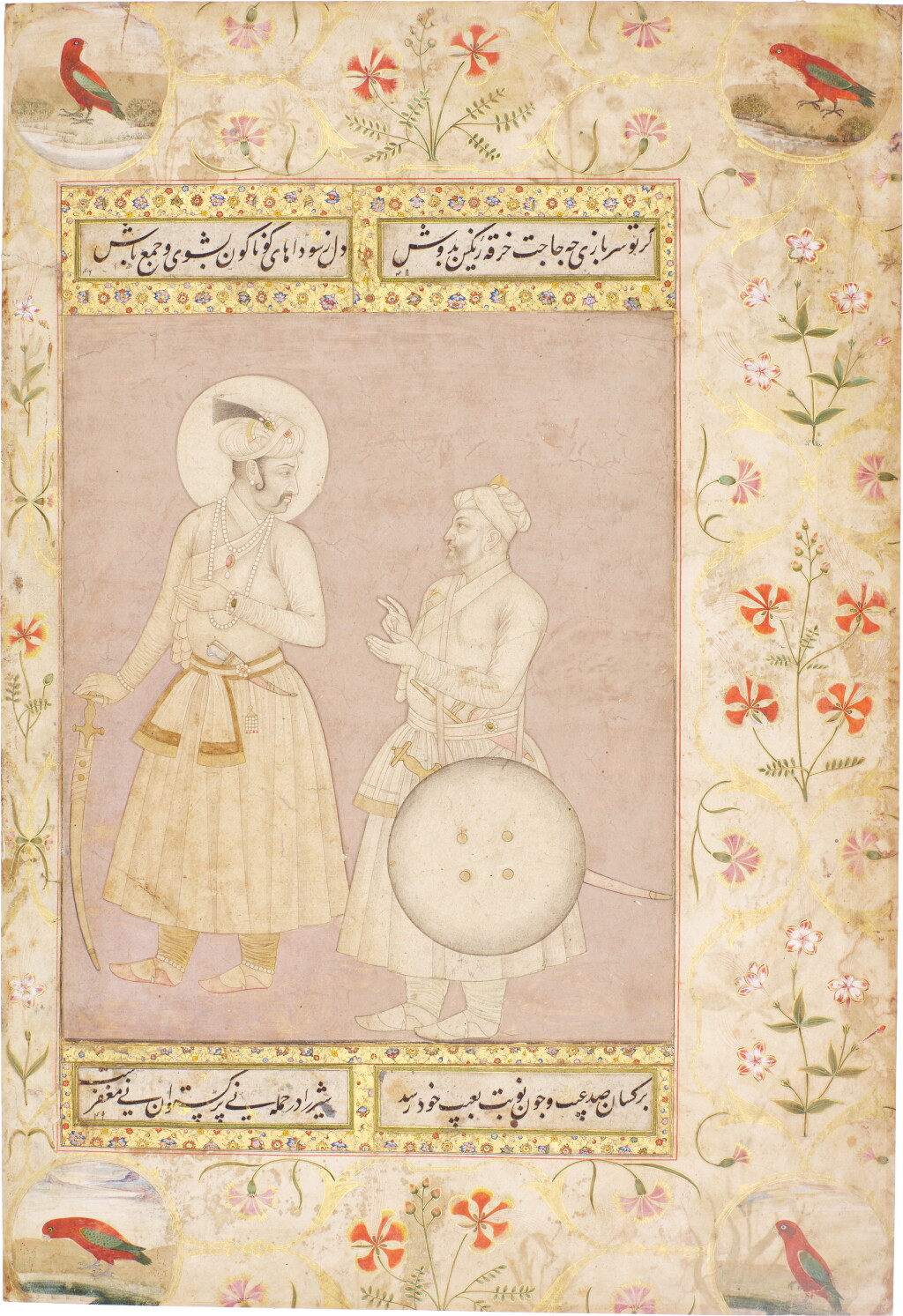
The Emperor Jahangir with Asaf Khan, Mughal, late 17th-early 18th century, with borders from the Late Shah Jahan Album, Mughal, circa 1650-58
Auction Closed
April 24, 03:45 PM GMT
Estimate
150,000 - 200,000 GBP
Lot Details
Description
pencil, gouache and gold on paper, two panels of illuminated calligraphy comprising two verses from different parts of a qasidah of Amir Khusraw Dehlavi, with floral borders
painting: 20.1 by 16.9cm.
leaf: 36.4 by 24.9cm.
Ex-collection Maurice and Edmund de Rothschild, Paris, first half 20th century
P & D Colnaghi & Co Ltd, London, 1976
The Khosrovani-Diba Collection, sold Sotheby’s, London, 19 October 2016, lot 9
Christie's, New York, Maharajas and Mughal Magnificence, 19 June 2019, lot 182
I. Stchoukine, Portraits Moghuls, IV, La Collection du Baron Maurice de Rothschild, Renne des arts asiatiques, tome VI, 1929-30, no.IV, pp.212-241, no.VII
T. Falk, Persian and Mughal Art, P & D Colnaghi and Co. Ltd., London, 1976, no.132, p.198
This delicate, coloured drawing of Jahangir conversing with a nobleman is unusual for the plain pink background against which the drawing is set. The nobleman represented here is Asaf Khan, the son of I'timad al-Daulat, brother of Empress Nur Jahan (and thus Jahangir's brother-in-law); and father of Empress Mumtaz Mahal (Shah Jahan's father-in-law). He was one of the most senior and trusted Mughal courtiers during the reigns of Jahangir and Shah Jahan. His final appointment was Khan-e Khanan which was conferred on him in 1636. Although his face here appears slimmer than in the portrait of him by Bichitr in the Minto Album (Victoria and Albert Museum, IM.26-1925, see Stronge 2002, pl.118, p.156), he is depicted several times in the Windsor Padshahnama, where his face is much closer to the present depiction, particularly in 'The wedding procession of Prince Dara Shikoh' (f.123A) and "The arrival of Prince Awrangzeb at the court at Lahore" (f.217B) (see Beach, Koch and Thackston 1997, no.23, p.65, no.44, p.107).
The exquisite borders originate from an imperial album prepared for Shah Jahan. It was known as the 'Late Shah Jahan Album' as it was compiled during the last decade of Shah Jahan’s reign, from 1650-58. Albums made for Jahangir and Shah Jahan have long been admired for their fine borders decorated with flowers, birds, floral scrolls or trellises, animals and human figures. The borders are also a reflection of the Emperors’ growing interest in the natural world. A number of albums with closely related floral borders were produced during the Shah Jahan period including the Minto, Wantage and Kevorkian albums.
The album was assumed to be part of the loot taken by Nadir Shah, the Afsharid ruler of Iran, when he plundered Delhi in 1739. In the late nineteenth century, the album was taken to Russia and sold to an Armenian dealer who subsequently sold it to the French dealer, Georges Demotte in Paris in 1909. Demotte split several folios, separating paintings from their borders and associated calligraphic sides. For further discussion on the album, see Wright 2008, pp.106-139.
For folios from the Late Shah Album sold at auction, see Sotheby’s, London, 19 October 2016, lot 6; 27 October 2020, lot 435; Sotheby’s Paris, 6 July 2017, lot 85; Christie’s, London, 10 June 2015, lot 10; 26 October 2017, lots 180-81; Christie’s, New York, 19 June 2019, lot 256.
You May Also Like