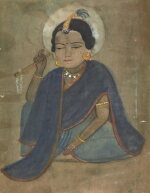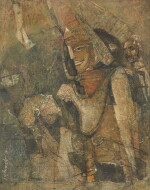
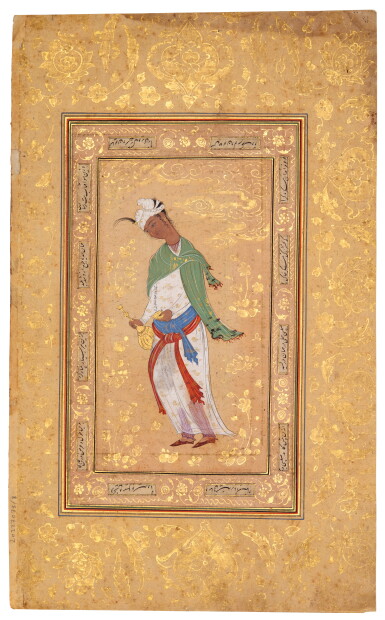
A youth in a white robe holding a wine flask and cup, Persia, Isfahan, Safavid, circa 1600-10, on a double-sided album leaf with calligraphy on the reverse by the Persian master Malik al-Daylami, Persia, mid-16th century
Auction Closed
April 24, 03:45 PM GMT
Estimate
15,000 - 25,000 GBP
Lot Details
Description
gouache with gold on uncoloured paper, background decorated with flowers and clouds in gold, inner border of small panels of nasta‘liq calligraphy set into gold-decorated pink paper, outer border of buff paper decorated with bold floral motifs in gold; verso with a quatrain of Persian poetry written diagonally in nasta‘liq script in black ink on an illuminated panel, signed at lower left by Malik al-Daylami, borders of pink and buff paper inset with small panels of calligraphy and decorated with gold scrolling floral motifs
painting: 18.7 by 10.2cm.
calligraphy: 19.2 by 8.9cm.
leaf: 35.7 by 21.9cm.
Sotheby's, London, 14 October 1999, lot 48
In subject matter and style, this painting of an elegant youth is typical of the Isfahan school in the early seventeenth century, showing the influence of the work of artist such as Sadiqi. The youth wears a small turban of Indian style, a type that appears in a number of paintings and drawings of the late sixteenth and early seventeenth century from Isfahan and other Persian schools such as Bukhara (e.g. an Isfahan drawing of youth holding a flower, circa 1590, Topkapi Sarayi Library, Istanbul, Canby 1997, cat.13, pp.46, 181; an Indian and a young Persian, Qazwin, c.1575, and a prince holding flowers, Bukhara, late sixteenth century, India Office Library, London, see Robinson 1976, nos.153, 899, pp.53, 179). It is not clear whether this indicates that the youth here was of Indian origin, or simply represents a contemporary fashion.
The royal calligrapher Malik al-Daylami was one of the most celebrated masters of the sixteenth century. He worked for Shah Tahmasp (r.1524-76) and was commissioned to prepare the inscriptions on several buildings in Qazwin. He also worked for Shah Tahmaps’s cousin Sultan Ibrahim Mirza (d.1577) and was one of the scribes of the well-known Haft Aurang manuscript made for that prince between 1556 and 1565 (known as the Freer Jami). He also composed the preface to the Amir Husayn Beg Album, of 1560-61. Qadi Ahmad, who was his pupil, along with the celebrated Mir Imad al-Hassani, described him as having acquired a reputation greater than anyone else at any time in the execution of nasta‘liq. He died in Qazwin in 1561-62. For further information about his career and works see Simpson 1997, pp.284-293; Qadi Ahmad, pp.141-5; Roxburgh 2005, pp.181-195, 212-7).
The calligraphy on the reverse consists of a quatrain of Abu Sa‘id Abi’l-Khayr (d. 1049).
You May Also Like