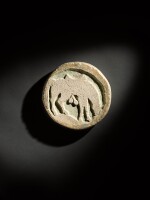

A rare Ilkhanid carved stone roundel, Persia, 14th century
Auction Closed
April 24, 03:45 PM GMT
Estimate
18,000 - 25,000 GBP
Lot Details
Description
each side carved in relief, one with the figure of a saddled horse grazing against a pale green ground with remnants of a silver pigment around the border, the reverse with an interlaced cursive inscription against a blue ground, the two faces aligned at 90 degrees
29cm. diam.; 6cm. depth
inscriptions
The bismillah
'In the name of God, The Compassionate, The Merciful.'
Sotheby's, London, 24 October 2007, lot 129
Christie's, London, 25 April 1997, lot 303
Riding Across Central Asia. Images of the Mongolian Horse in Islamic Art, The Metropolitan Museum of Art, New York, 2001
Inscription roundels are ubiquitous features of Islamic architecture, and were particularly prevalent in the thirteenth and fourteenth centuries. Under the Ilkhanids, the Greater Iranian region developed a particular taste for stucco carved in high relief with a blue painted background, as visible on the early fourteenth-century stucco mihrab in the Great Mosque of Isfahan in Iran. Circular stone features would adorn wall facades and gates, like a tympanum with a horse and rider from the second half of the fourteenth century in the Metropolitan Museum of Art (inv. no.38.96).
Further dating clues are provided by stylistic comparisons with contemporary Ilkhanid manuscript illustration. The horse and saddle are similar to representations in the Jami al-Tawarikh from the same period (see, for example, manuscript 727 in the Khalili collection, dated 1314/15 AD.) The Bismillah is consistent with calligraphy of the second quarter of the fourteenth century, suggesting either that it is contemporary, or that it was added to the obverse up to fifty years later.
You May Also Like


