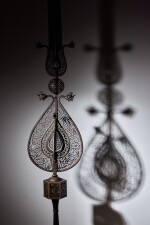

A monumental cut-steel processional standard ('alam), signed by Mir Taj al-Din, Persia, Safavid, dated 1122 AH/1710-11 AD
Auction Closed
April 24, 03:45 PM GMT
Estimate
150,000 - 200,000 GBP
Lot Details
Description
formed of 6 parts, rising from a tapering shaft to a hexagonal boss, each facet pierced with ogival medallions and spandrels, alternating with arabesques and inscriptions, to a tear-drop shaped central panel enclosed by ropework borders terminating in 2 dragon-head terminals, the outer band with inscriptions in thuluth on a scrolling ground, the inner band with floral vine, a smaller tear-drop shaped panel perpendicularly attached with similar ropework border terminating in dragon heads, around a rotating central four-sided drop element, a spherical openwork boss above, rising to a tall, flat panel, the lower section with openwork floral scrolls around a drop-shaped openwork element, enclosed by ropework borders terminating in dragon heads, the upper section with an openwork calligraphic roundel terminating in a trefoil, on stand
295cm. height
Christie's, London, 8 April 2008, lot 201
Falnama: The Book of Omens, Freer Gallery of Art, Washington D.C., 24 October 2009 - 24 January 2010
M. Farhad and S. Bagci, Falnama: The Book of Omens, Washington D.C., 2009, p.81, no.3
Babaie, Porter & Morris 2017, p. 39
inscriptions
Upper section roundel: Allah, Muhammad, 'Ali
Base of upper section: 'amal Mir Taj al-Din, 'work of Mir Taj al-Din'
Middle section: Qur'an, surah al-hashr (LIX), verse 20-21, preceded by the date 1122 AH
Hexagonal boss: invocations to God
This impressive standard demonstrates the prowess of Safavid metalworkers at the highest level. The artist, Mir Taj al-Din, has paired striking sculptural elements with minutely detailed decoration to produce a standard of exceptional visual impact exemplifying the grandeur of Safavid processions and rituals.
Standards held an important function within Safavid ceremony, originating in the context of battles where an ‘alam would indicate the presence of the ruler (Canby 2009, p.237). It is likely that the adoption of Shi’ism in the sixteenth century led to the increased practice of displaying standards in religious parades (Canby 2009, p.237, Allan and Gilmour 2000, pp.253-260). The standards were thought to emulate those carried by Imam Husayn in the Battle of Karbala and varied in size, shape, and quality (Farhad and Bagci 2009, p.78).
A section of an ’alam published by Allan and Gilmour and dated 1117 AH/1705 AD shows a comparable form to the present example comprising a drop-shaped panel joined with a smaller ogival section to create a three-dimensional cruciform arrangement. Like the present ‘alam it is decorated with inscriptions around a rotating centre and is assigned by Allan to Type ‘D’ which are among the most elaborately formed and decorated examples (op. cit., p.279, fig.47). It is remarkable that this ‘alam survives in its complete form demonstrating the majestic scale and sculptural nature of the group, and it allows us to better understand their intended impact. The drop-shaped four-sided body allows the viewer to experience it from multiple angles. This is juxtaposed against the exaggerated tall and flat blade giving the object considerable height, and each section is framed by bosses and punctuated by ferocious dragon-head terminals. The form and scale establish a theatrical silhouette and this is further emphasised by the kinetic elements, notably the blade which would have swayed above the procession, as well as a rotating central drop.
The exceptionally fine quality of the openwork decoration can only be fully appreciated up close. The maker has worked the calligraphic inscriptions masterfully against a particularly fine scrolling ground, emphasising the free-flowing thuluth inscriptions. The play on sculpture, decoration and movement inevitably contributed to the overall spectacle of Safavid religious processions (Farhad and Bagci op. cit., p.81).
Dated examples of ‘alams appear infrequently on the public market. An early seventeenth century ‘alam signed by Muhammad ibn Reza was sold in these rooms, 24 October 2018, lot 139. Fragmentary examples of dated eigthteenth century ‘alams include those sold in these rooms, 20 April 1983, lot 313; 16 April 1986, lot 184, and 18 April 2007, lot 121.
You May Also Like


