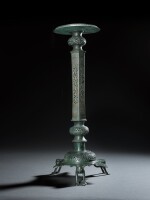
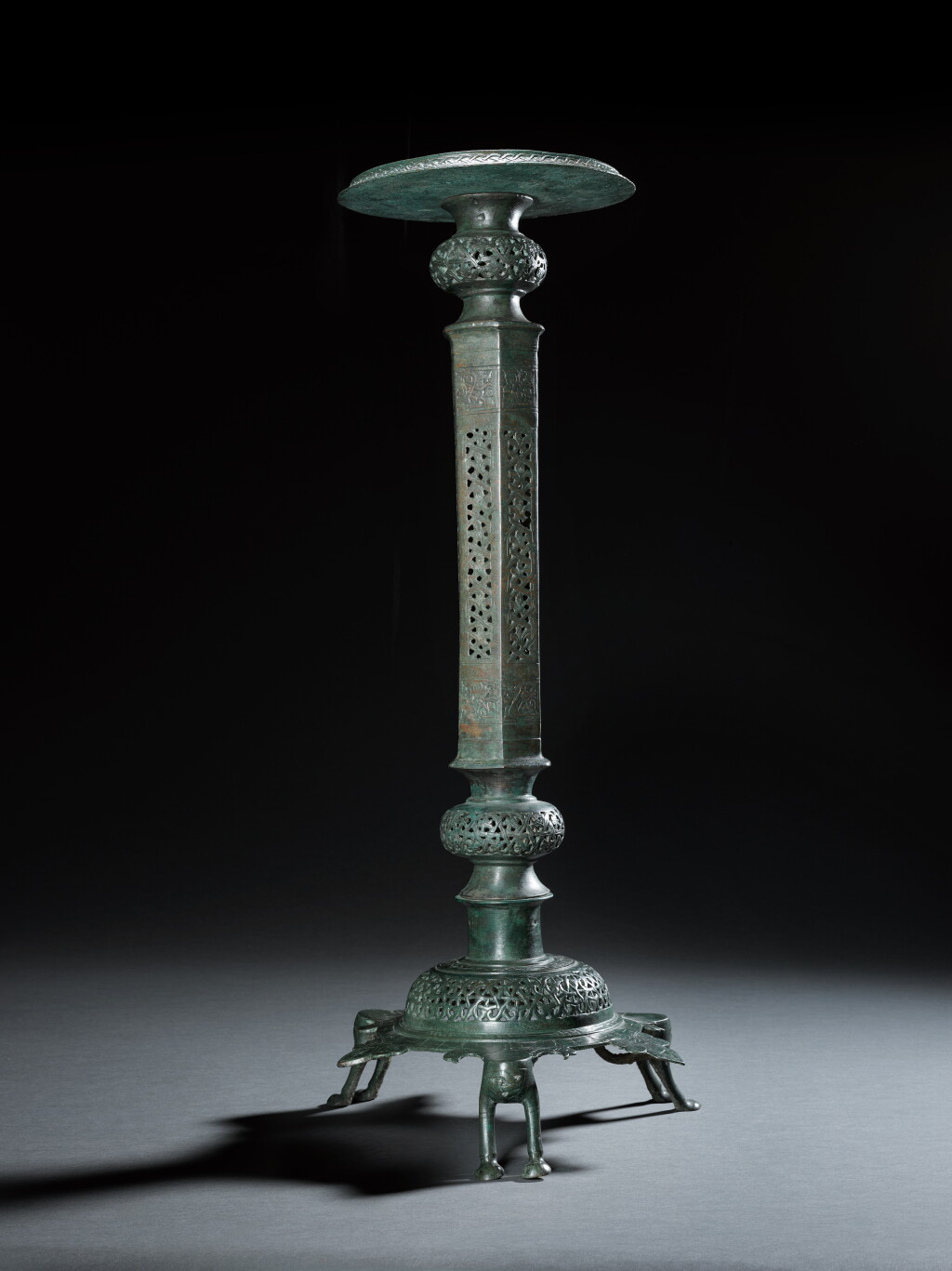
A large Khurasan bronze lampstand, Eastern Persia, 12th century
Auction Closed
April 24, 03:45 PM GMT
Estimate
10,000 - 15,000 GBP
Lot Details
Description
consisting of three interlocking parts, including an openwork domed tripod base on zoomorphic legs, a vertical hexagonal shaft pierced with interlacing strap work and openwork globular bulbs at each end, surmounted by a flat tray incised with interwoven patterns
83.5cm.
Sotheby's, London, 24 October 2007, lot 100
The unique features that characterise medieval Persian lampstands owe their origins to ancient Byzantine prototypes. While earlier Islamic examples were of rather rudimentary craftsmanship, typically made of ceramic materials with sparse adornment (see E. Baer 1983, p.12), subsequent iterations such as the present specimen display the innovative spirit of Khurasani metal workshops. The present example's hexagonal central shaft, zoomorphic tripod base, and intricately perforated body are so many intrinsically Persian elements, which would remain in fashion in the Islamic world until the fourteenth century (ibid., p.17).
A closely similar example is in the Islamic Arts Museum, Malaysia (ed. Fong Peng Kuan, 2002, p.250).
You May Also Like