
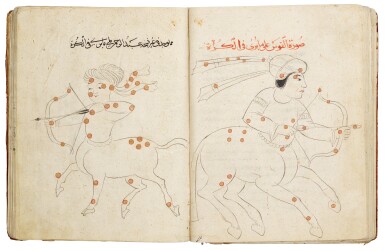
An illustrated manuscript of 'Abd al-Rahman al-Sufi's Suwar al-Kawakib (The Book of Fixed Stars), copied by Ibn Haidar 'Ali Muhsin, Persia, Safavid, dated 10 Ramadan 1052 AH/1 December 1642 AD
Auction Closed
April 24, 03:45 PM GMT
Estimate
40,000 - 60,000 GBP
Lot Details
Description
Arabic manuscript on paper, 174 leaves, 21 lines to the page written in naskh in black ink, headings picked out in red, 97 pages with drawings of the constellations and signs of the zodiac, numerous tables in red and black, in brown leather binding
25.5 by 19.2cm.
Abu’l-Hasan ‘Abd al-Rahman ibn Umar al-Sufi (903-986 AD) was one of the great Arab astronomers of the medieval period. Kitab Suwar al-Kawakib al-Thabita is arguably his most famous work and he completed the text in 965 AD. He wrote the text for Sultan Adud al-Dawla (949-983 AD) for whom he was also a tutor. In the text, al-Sufi presents lists of stellar coordinates and their relations to the zodiac that he based on parts seven and eight of Ptomely’s Almagest, alongside works by Arab astronomers and Bedouin astronomical traditions, known as Anwa. Early copies of the text include a manuscript dated 1005-11 AD in St. Petersburg (inv. no.I.O.L. Arab. 185), a copy in the Bodleian Library, Oxford, dated 1009 AD (inv. no.Marsh 144) and a manuscript sold in these rooms, 29 April 1998, lot 34.
The present manuscript comprises 21 illustrations of the constellations of the northern hemisphere, the twelve signs of the zodiac and thirteen illustrations of the constellations of the southern hemisphere. Each illustration is shown in twin form showing them as seen in the sky and as seen on the globe. The illustrations are followed by tables that lists the names, number, and coordinates of each of the individual stars that form the constellation.
Given that the illustrations were intended as a memory aid for scholars and students to identify and locate the constellations in the sky, the iconographic program of Kitab Suwar al-Kawakib remained relatively standardised (New York 2011, p.176). A comparison between the form of the present illustrations and those of the twelfth century copy sold in these rooms mentioned above, as well as a late fifteenth century copy in the MET Museum (acc. no.13.160.10), shows how the basic form of each illustration remained unchanged. There are, however, some stylistic variations related to the period in which each copy was produced.
In sixteen places in the present copy, the artist has included a second version of the constellation he illustrates labelled as deriving from another copy of the text. It is likely the illustrator included these to show the slight variations in other manuscript copies of the text. In the example of Aquarius, in one version, the water pours forth from the open palm of the figure, in the second version, the artist has clearly rendered a vessel in the figure’s hand.
The illustrations of the present copy include:
- Ursa Minor
- Ursa Major
- Draco
- Cepheus
- Bootes
- Corona Borealis
- Hercules
- Lyra
- Cygnus
- Perseus
- Auriga
- Serpentarius
- Sagitta
- Aquila
- Delphinus
- Equus Minor
- Pegasus
- Andromeda
- Pisces
- Triangulum
- Aries
- Taurus
- Gemini
- Cancer
- Leo
- Virgo
- Libra
- Scorpio
- Sagittarius
- Capricorn
- Aquarius
- Cetus
- Orion
- Eradanus
- Lepus
- Canis Major
- Canis Minor
- Argo Navis
- Hydra
- Crater
- Corvus
- Centaurus
- Ara
- Corona Australis
You May Also Like


