
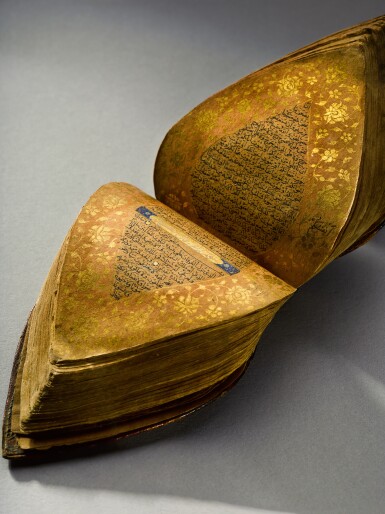
An important illuminated miniature Qur’an, copied by Ali ibn Abd al-Karim al-Samri al-Basri, India, Agra, Mughal, dated 982 AH/1574-1575 AD
Auction Closed
April 24, 03:45 PM GMT
Estimate
28,000 - 35,000 GBP
Lot Details
Description
Arabic manuscript on paper, 242 folios, of pointed leaf form and bound in safina form, 19 lines per page written in neat ghubar (miniature) script in black ink on cream-buff paper, colophon on final page, surah headings in white thuluth script on narrow panels of illumination, borders decorated with gold scrolling floral motifs, leather binding with panels of floral lacquer and doublures of polychrome leather filigree
7.5 by 6.2cm.
Sotheby’s, London, 24 October 2007, lot 24
This is an extremely rare miniature Qur'an produced at the Mughal capital of Agra during the reign of emperor Akbar and bound in safina form. The colophon states that it was copied by the scribe Ali ibn Abd al-Karim al-Samri al-Basri at Agra in the year 982 AH (1574-5 AD). It is an important survival and may be only the second known Qur’an manuscript securely attributable to the reign of Akbar (see below).
The physical form of the manuscript is unusual in several ways. The folios are shaped like small leaves or petals, and the text areas of each page follow this form. The manuscript is bound at the top of each page, in safina form. This is a form often used for anthologies of poetry in Persia in the fifteenth and sixteenth century, but extremely rarely for Qur’an manuscripts. Although the script is neat and legible, the small size of both the script and codex and the safina format would have made it impractical for reading, and like many miniature Qur’ans it was probably made to be carried about the person in a small case as an apotropaic item. The catchwords are written at the top of the lower page of a double-page spread, rather than the conventional placement at the lower left of the right-hand page. The gold floral decoration in the margins is typical of early Mughal work and shows the influence of sixteenth-century Safavid border illumination, and although the panels of coloured illumination at the surah headings are very small, what is visible further demonstrates this inherited Persian influence. The binding has been repaired at a later date, but the style of the floral decoration on gold ground on the outside of the covers and the filigree work on the doublures suggests that it may perhaps date from the seventeenth century.
The manuscript was produced at an interesting time in Akbar’s reign. Until the 1570s Agra was Akbar’s official capital and the most important Mughal city. As well as the imperial workshops and administrative bureaus, it was a centre of commercial and manufacturing activity, with carpet weavers, garment makers, a coin mint, and many other skilled artisans. The years 1571-76 saw the construction of Akbar’s imperial palace-city of Fatehpur Sikri, twenty-five miles west of Agra. In 1574-75, the year the present manuscript was copied, the construction of several of the most important buildings at Fatehpur Sikri took place, including the Translation Bureau, the Imperial Records Office and the House of Worship (Brand and Lowry 1985, p.158). In 982 AH, the same year the present Qur’an was copied in Agra, Abu’l Fazl Allami, arrived at court. He would go on to become Akbar’s advisor and chronicler, author of the Akbarnama and the Ain-i Akbari. According to the contemporary Mughal chronicler Bada’uni, in the following year (983 AH/1575-76 AD), “many places of worship were built at the command of His Majesty. … His Majesty passed much of his time in discussing the word of God (Qur’an), and the word of the prophet (the Hadiths or Tradition)… His Majesty passed whole nights in thoughts of God… and his heart was full of reverence for Him who is the true Giver”. (Bada’uni, quoted by Blochman in the Ain-i Akbari, vol.I, pp.177-9). Qur’ans securely attributable to Akbar’s reign (i.e. with an accepted colophon naming the pace and date) are extremely rare. In 981 AH/1573-74 AD, the year before the present manuscript was copied, a larger copy of the Qur’an was made in Lahore for emperor Akbar himself, copied by the scribe Hibatullah al-Husayni (British Library, Add. 18497). According to Brand and Lowry in 1985, the British Library manuscript was the only known Qur’an securely attributable to Akbar’s reign (Brand and Lowry 1985, p.141, no.21, illustrated on p.61). If that statement still stands, the present miniature Qur’an, copied a year later in the capital Agra, would appear to be only the second copy securely attributable to Akbar’s reign.
You May Also Like


