
Property from a Swiss Private Collection, Lots 630–637 formerly in the Rothschild Collection
Italian, Deruta, circa 1500 - 1520
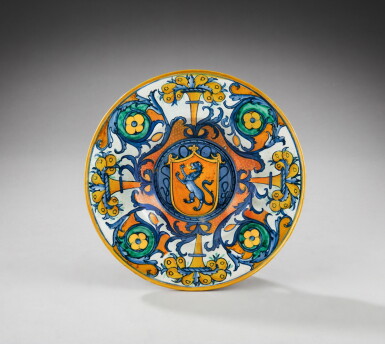
Armorial Dish with Rampant Lion
Auction Closed
February 7, 08:37 PM GMT
Estimate
6,000 - 8,000 USD
Lot Details
Description
Property from a Swiss Private Collection
Italian, Deruta, circa 1500 - 1520
Armorial Dish with Rampant Lion
decorated with a bianco sopra bianco dotted ground and a candelieri motifs, centered by a cartouche with an azure lion rampant on an orange ground, probably representing heraldic or (gold); the reverse is painted with radiating petals and centered by the letters ‘M’ and ‘P’. This sort of ornament, known as “petal-back”, is characteristic of unlustred maiolica made in Deruta at the end of the fifteenth and in the first years of the sixteenth century.1
tin-glazed earthenware (maiolica)
diameter: 9 ¼ in.; 23.5 cm
1Bernard Rackham, “A new Chapter in the History of Italian Maiolica”, in The Burlington Magazine, April 1915, vol. XXVII, pp. 28-35.
Private Collection, France, until 1991;
From whom acquired.
A large Deruta armorial basin, probably a little later than the present dish, circa 1515-1520, in the Philadelphia Museum of Art (1999-99-14), formerly in the Adda collection, is similar to the present dish in the palette and the typology of the flowering foliate scrolls.1
The crossed monogram of M and P, on the reverse, could be for a member of the Masci or the Mancini families who were among the principal producers of maiolica in Deruta during the first quarter of the 16th century.2 The shield with a lion, probably the arms of the family for whom the dish was made, is too common a heraldic charge for specific identification to be possible.
We are grateful to Professor Timothy Wilson and Mrs. Greta Kaucher for their invaluable contributions to the research on this entry.
1 W. Watson, Italian Renaissance Ceramics. The Howard I. and Janet H. Stein Collection and the Philadelphia Museum of Art, Philadelphia 2001, no. 69.
2 G. Busti and F. Cocchi, Maestri ceramisti e ceramiche di Deruta, Florence 1997.