
Property from a Swiss Private Collection, Lots 630–637 formerly in the Rothschild Collection
Follower of Bernard Palissy, French Normandy, Manerbe or Pré d’Auge, probaby from the ‘Maitre au Pied Ocre’ Workshop, circa 1600
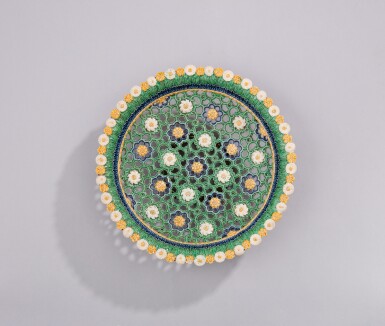
Moulded and Pierced Footed Dish
Auction Closed
February 7, 08:37 PM GMT
Estimate
4,000 - 6,000 USD
Lot Details
Description
Property from a Swiss Private Collection, Lots 630–637 formerly in the Rothschild Collection
Follower of Bernard Palissy, French, Normandy, Manerbe or Pré d’Auge
Probaby from the ‘Maitre au Pied Ocre’ Workshop, circa 1600
Moulded and Pierced Footed Dish
the reverse underside with mottled glaze
glazed earthenware
diameter: 11 ¾ in.; 30 cm
Baron Alphonse de Rothschild (1827-1905);
Thence by descent to his son, baron Édouard de Rothschild (1868-1949);
Thence by inheritance to his wife, Baronne Germaine de Rothschild (1884-1975), née Germain Halphen;
Sotheby’s Paris, 28 November 2016, lot 5.
G. de Rothschild and S. Grandjean, Bernard Palissy et son école (collection Édouard de Rothschild), Paris, 1952, pl. 9, cat. no. XIV;
I. Perrin, Les techniques céramiques de Bernard Palissy, Université Paris IV Sorbonne, Lille, 1998, t. I, p. 248;
C. Viennet, Bernard Palissy et ses suiveurs du XVIe siècle à nos jours, 2010, p. 102-103.
Some post-Palissy ceramics share a distinctive, recognizable mottled glaze on the reverse, with no blue tones, but instead fused green, ochre and purple lines and dots intermingled on a whitish ground. The center of the bottom is of a uniform ochre. The rim is often adorned with daisies, the molding is very fine, the glaze is thin, with a wide range of colors and a mottled finish giving an impression of speckling. The ochre-colored glaze on the reverse of the foot is the origin of the name Isabelle Perrin gave to this group of works, 'céramiques du Maître au pied ocre.'
Perrin notes that these pierced dishes with distinctive color scheme and mottled backs were probably made near Lisieux. She compares the mottled glaze on their undersides with that of certain floor tiles produced in that region. The resemblance to pieces produced in the Pré d’Auge region was confirmed by excavations carried out at the Bosquetterie site in 2004, which uncovered fragments of two bowls whose feet are not ochre-colored, but whose reverses are decorated with a similar mottled glaze.