Property of a Private Collector
The Hamilton Palace 'Tudor Chairs'
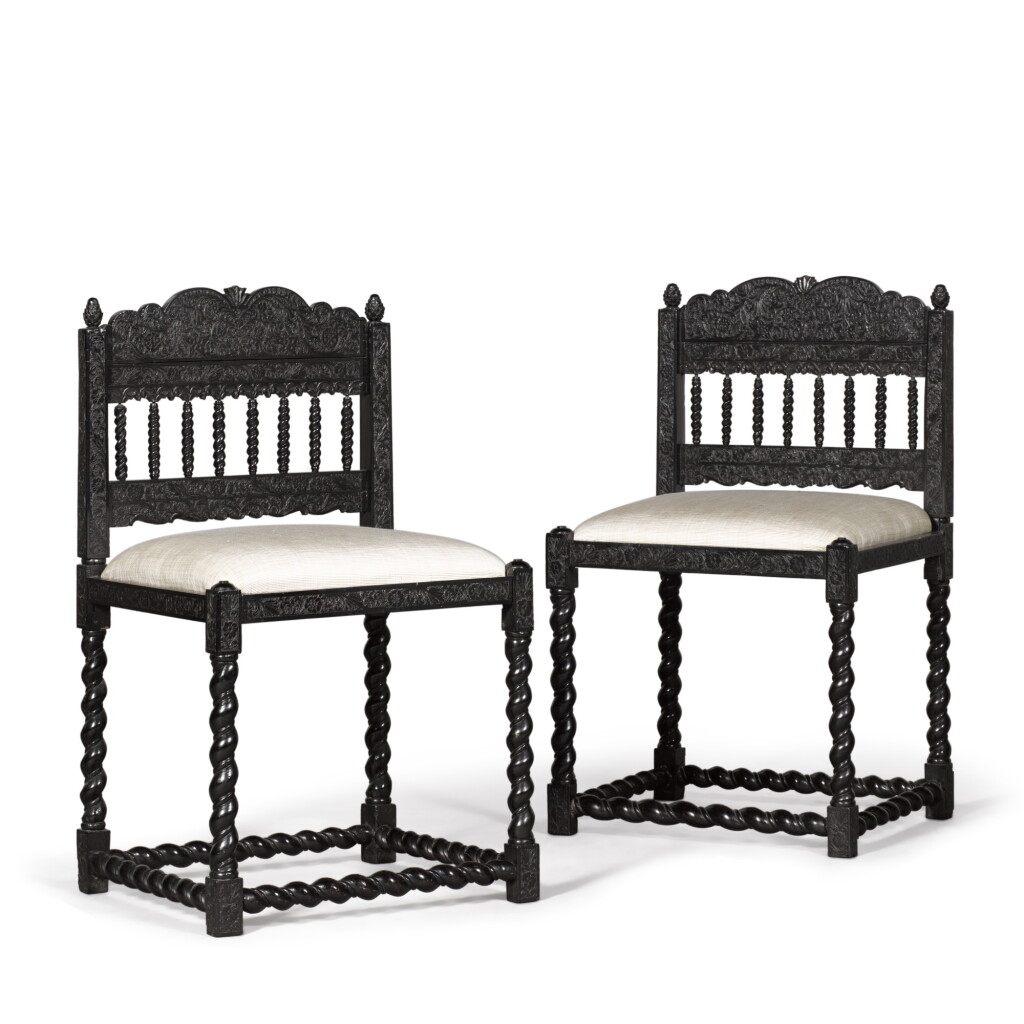
A pair of Indo-Dutch carved ebony side chairs, possibly Coromandel Coast or Batavia, last quarter 17th century
Lot Closed
May 23, 01:27 PM GMT
Estimate
3,000 - 5,000 GBP
Lot Details
Description
Property of a Private Collector
A pair of Indo-Dutch carved ebony side chairs, possibly Coromandel Coast or Batavia, last quarter 17th century
ornately decorated with shallow-relief carving throughout, with twisted columns to the arcaded backrest and pineapple finials to uprights, the later removeable drop-in seats on spiral-turned legs and stretchers, one rear seat rail with a paper label, printed 'Hamilton Palace ***', reduced in height, restorations
88.5cm. high;
2ft. 10 ¾ in.
Probably acquired by Alexander Hamilton, 10th Duke of Hamilton, 7th Duke of Brandon (1767–1852);
thence by descent and probably one of the two pairs of 'Tudor chairs' sold Christie's London, The Collection of Pictures, Works of art and Decorative Objects, The property of his Grace the Duke of Hamilton, K.T., 17-19 June 1882, lot 167 or 168.
The collecting of Indo-Dutch ebony furniture in England was based for a while on a misunderstanding of its historical origin. In the mid-18th century, influential collector Horace Walpole (1717-97) encountered a set of ebony chairs at Esher Place. Believing them to have once been the property of Cardinal Wolsey, who resided there after 1519, Walpole determined that the chairs must be examples of fine English Tudor furniture. The myth that this style of furniture originated in England was perpetuated through the work of furniture historian Henry Shaw who would record a closely related chair, one of a pair with with low relief carving, in his 1836 text Specimens of Ancient Furniture and which was reputedly brought to England by Catherine of Braganza in 1662 and gifted to Elias Ashmole by King Charles II (now in the Ashmolean Museum, Oxford, inventory WA.OA180 and WA.OA181).
The present chairs were similarly described when sold in the first major dispersal of the collection of the Dukes of Hamilton in 1882 and erroneously catalogued as "A PAIR OF TUDOR CHAIRS, of ebony, richly carved with flowers with spirally twisted columns and stretchers and leather seats, said to have belonged to Cardinal Wolsey" (see Christie's London, The Collection of Pictures, Works of art and Decorative Objects, The Property of his Grace the Duke of Hamilton, K.T., 17-19 June 1882, lot 167), and it is possible they once belonged to the set Walpole encountered at Esher Place.
In reality, carved ebony furniture of this type was produced across South Asia in the second half of the 17th century, with particular concentration along the Coromandel Coast, India. The distinct twist-turning is presumed to have originated along this coast; a synthesis of 17th century Dutch design and a form of spiral column found on Indian temples since the 1500s. A chair very similar pair of chairs is illustrated in Amin Jaffer, Luxury Goods From India: the art if the Indian Cabinet-Maker, V&A publications, 2002, p. 133, fig. 61 and several single chairs which relate closely to that presented here are illustrated and discussed by Jan Veenendaal in Furniture from Indonesia, Sri Lanka and India During the Dutch Period, Volkenkundig Museum Nusantara, 1985, pp.21-25. Veenendaal asserts that the combination of low relief scrolling designs and a pierced back containing both Hindu and Christian motifs indicate a dating of 1660-1680. Later pieces from the same region, or further South in Sri Lanka, tended to feature bold floral designs carved in higher relief.
Hamilton Palace, a great treasure house in Lanarkshire, Scotland, held one of Europe’s most important art collections. The 10th Duke was a passionate collector of art and many of the items he acquired for Hamilton Palace are now in museums and galleries around the world. Amongst a kaleidoscope of objects, the Duke acquired an extensive group of ebony furniture which included a fabled suite of ebony bedroom furniture, incorporating 17th century elements from the Coromandel Coast and were supplied by John Webb of Bond Street in 1826 and 1828. The group was for his ‘Ebony Room’ at the Palace. It is possible that the present chairs were an acquisition by the Duke during the period of collecting. He married Susan Euphemia Beckford, daughter of William Thomas Beckford, on 26 April 1810 and would no doubt have been influenced by Beckford’s remarkable collection of ebony furniture at Fonthill Abbey.
A tester bed, cradle and other components were sold from Hamilton Palace at Christie’s, 14 November 1919, lots 467-470 and and an 'OLD ITALIAN EBONY CABINET' from the same region as the present chairs was also sold in the 1882 auction (sold Christie's London, The Collection of Pictures, Works of art and Decorative Objects, The property of his Grace the Duke of Hamilton, K.T., 17-19 June 1882, lot 178 and most recently Sotheby's London, 3 May 2018, lot 128). For further details on the 10th Duke’s ebony furniture see Amin Jaffer, Furniture From British India and Ceylon, London, 2001, p. 141-142.
You May Also Like