Property from a European Private Collection
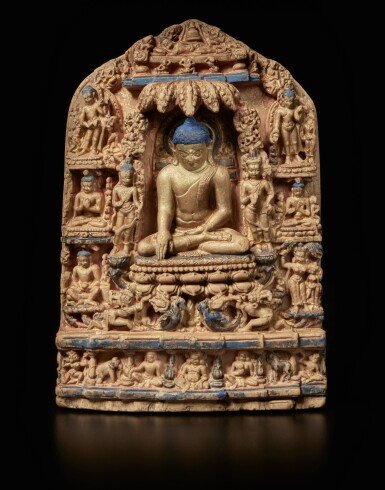
A portable stone votive stele depicting Shakyamuni Buddha and the 'Eight Great Events', Northeastern India, Pala period, 11th / 12th century
Auction Closed
March 21, 03:26 PM GMT
Estimate
80,000 - 120,000 USD
Lot Details
Description
Height 4 in., 10.3 cm
Himalayan Art Resources item no. 15010.
Acquired in Hong Kong in the 1990s (by repute).
European Private Collection.
The life events of Shakyamuni Buddha are not extensively documented, but various legendary stories highlight significant moments. The present sculpture exhibits the several key moments in the life story of the historical Shakyamuni Buddha. These 'Eight Great Events' have origins in early Indian Buddhism, though they are aniconically represented for the first few centuries during which they are taught. These narratives are primarily sourced from ancient Indian Buddhist texts, initially transmitted orally and later transcribed. The Pali Canon, the principal scripture of Theravada Buddhism in Pali language, and Mahayana texts in Sanskrit (like the Lotus Sutra, Avatamsaka Sutra, and Vimalakirti Nirdesa Sutra), describe the Buddha's birth, renunciation, enlightenment, and teaching career.
This small devotional plaque depicts various scenes in a clockwise direction, beginning at the bottom right corner (just below the proper-left knee of the central Buddha figure): the Buddha's miraculous birth from his mother Maya's side, the offering of honey by a monkey, his first sermon, his taming of the rampaging elephant Nalagiri, his death or parinirvana, his descent from the Trayastrimsha Heaven, and a miracle at Shravasti where he multiplied himself. The central figure, of course, represents the moment of his enlightenment in which he sat upon the vajrasana or ‘diamond throne’ and touched the earth after which it shook, bearing witness to this great moment of awakening.
This fine votive stele can be compared to an example from the Mr. and Mrs. John D. Rockefeller 3rd Collection within the collection of Asia Society Museum, New York (accession no. 1979.90). The Rockefeller example has been attributed to Bihar (Northeastern India), possibly Bodhgaya, as well as Myanmar, see Buddhist Art of Myanmar, Asia Society, New York, 2015, p. 77. The Indian attribution seems more likely given the extremely refined style of the Rockefeller example. However, an example at the Ackland Art Museum (accession no. 97.14.1) can, perhaps, be more firmly attributed to Myanmar–although also catalogued as a Pala-period production (ca. 12th-13th century). Stylistic differences between the Ackland example and the present example, such as the more slim proportions of the central Buddha figure here, point to its likely origins in Northeastern India. Moreover, the particular scenes on the Ackland example such as 'two youths tormenting the emaciated Buddha' are missing from the present example.
Market comparables are lacking, as the majority of these votive stelae representing Shakyamuni Buddha’s life story are in museums. However, a closely related example sold in these rooms, 16th March 2016, lot 754.
You May Also Like