
Cartier, Paris
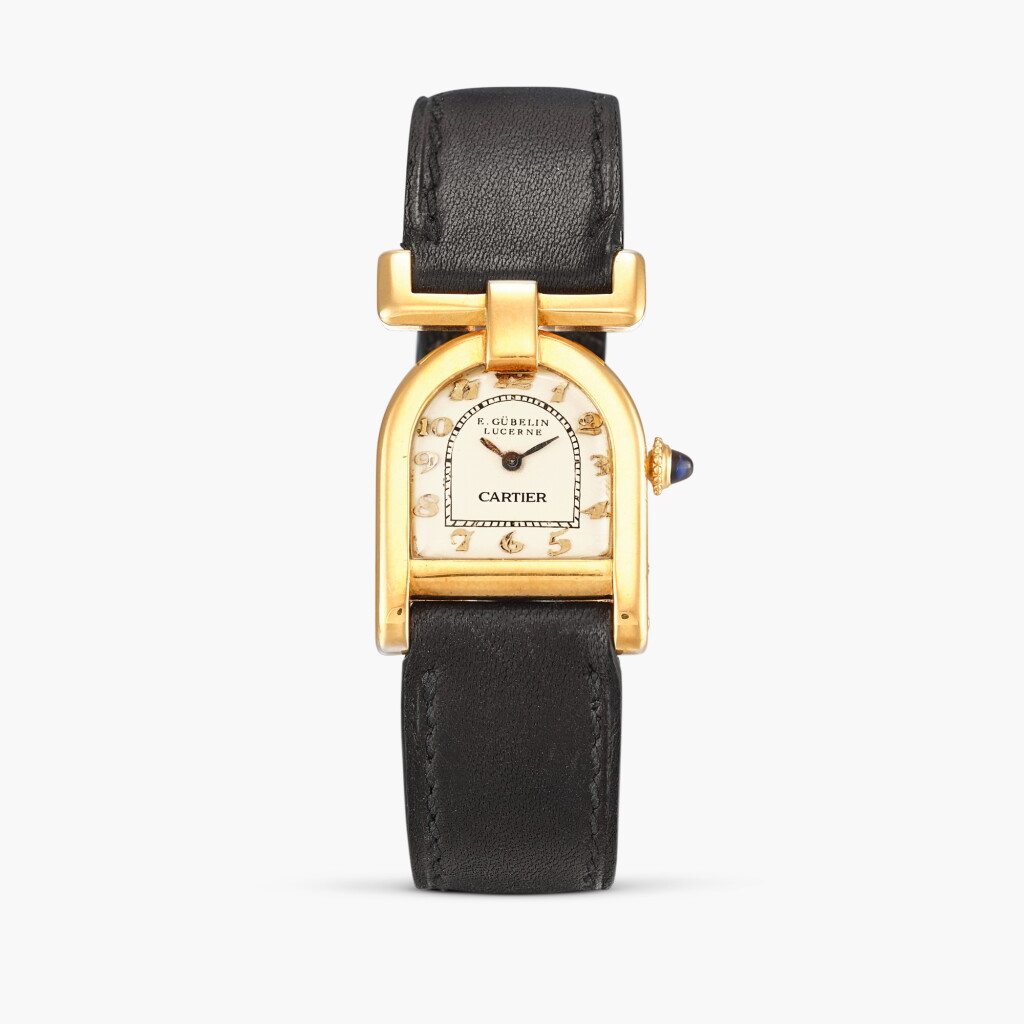
E. Gübelin, Lucerne retailed | Étrier | A yellow gold stirrup-form wristwatch, Circa 1929
Auction Closed
April 24, 04:23 PM GMT
Estimate
200,000 - 280,000 HKD
Lot Details
Description
Cartier, Paris
E. Gübelin, Lucerne retailed
Étrier
A yellow gold stirrup-form wristwatch, Circa 1929
Dial: silvered arch-form dial signed Cartier and E. Gübelin, Lucerne, applied gold Breguet hour indexes, inner arch-form chemin-de-fer minute track, blued steel hands
Calibre: 8’’’ circular LeCoultre movement signed European Watch and Clock Co. Inc., damascened Côtes de Genève decoration, lever escapement, 19 jewels, bi-metallic compensation balance with timing and poising screws, 8 adjustments, flat hairspring
Movement number: numbered to movement beneath dial 27'040
Case: 18k yellow gold polished stirrup-form case, the ‘eye’/stirrup loop forming the upper t-bar lug with screw-set bar, arch-form case body with screw-set lug bar to base, gold case back secured by 4 screws to case sides, beaded cabochon sapphire-set crown, French eagle’s head assay mark to case side, outside case back with Art Deco monogram,
Case number: hand stamped Paris Reference numbers 21'513, 27'040, inside case back with hand stamped numbering
Closure: black unsigned leather strap and 18k gold Cartier deployant buckle with D-shaped clasp, repeated French eagle’s head assay mark and Edmond Jaeger punch mark, twice with hand stamped numbers 9'824
Size: 30.5 mm length x 20 mm width
Accessories: none
The Étrier (stirrup) model, also referred to as the Calandre, was introduced by Cartier in 1921. The dial of the present watch carries the signature of E. Gübelin of Lucerne to whom Cartier must have supplied the watch for retailing. Interestingly, the dial has applied gold Breguet numerals, a style very rarely found on Cartier wristwatches, but one that can be seen on other Gübelin retailed wristwatches of the period made by other watchmakers, such as Patek Philippe and Audemars Piguet. This suggests that the configuration of the dial was almost certainly a special request by Gübelin. The outside of the case back has a handsomely executed Art Deco monogram.
Highly unusual for the period of its production, the design takes advantage of the growing interest in the fashionable sport of horse racing. In the 1920s, horse racing was enormously popular in Europe, particularly in the UK and France, where prestigious events like the Epsom Derby and Prix de l'Arc de Triomphe attracted large crowds. The sport benefitted from the economic prosperity and growing leisure culture of the “Roaring Twenties”. It was associated with social status and became a fashionable activity, drawing both elite and everyday spectators. Betting played a major role in its appeal, with wagering systems enhancing the excitement. In the U.S., races like the Kentucky Derby and the Triple Crown series also gained prominence, with legendary horses such as Man o' War bringing international attention to American racing.
Jader Barracca, Giampiero Negretti, Franco Nencini, Le Temps de Cartier, Milan: Publiprom, Second Edition, 1993. See p. 124 for an archival image of a similar example and p. 125 for a colour illustration of a further Étrier.
卡地亞 巴黎
E. Gübelin, Lucerne 發行
Étrier
黃金馬鐙形腕錶,約1929年製