Property from a Private Dutch Collection
M.C. Escher
Print Gallery (Bool 410)
Lot Closed
March 25, 03:59 PM GMT
Estimate
40,000 - 60,000 GBP
We may charge or debit your saved payment method subject to the terms set out in our Conditions of Business for Buyers.
Read more.Lot Details
Description
M.C. Escher
1898 - 1972
Print Gallery (Bool 410)
signed in pencil and numbered No. 41/43
lithograph on Holland wove paper
image: 313 by 318 mm. 12¼ by 12½ in.
sheet: 405 by 408 mm. 16 by 16⅛ in.
Executed in 1956.
Acquired from the artist, 15 May 1966
Thence by descent
‘You have to retain a sense of wonder, that’s what it’s all about.’ - M. C. Escher
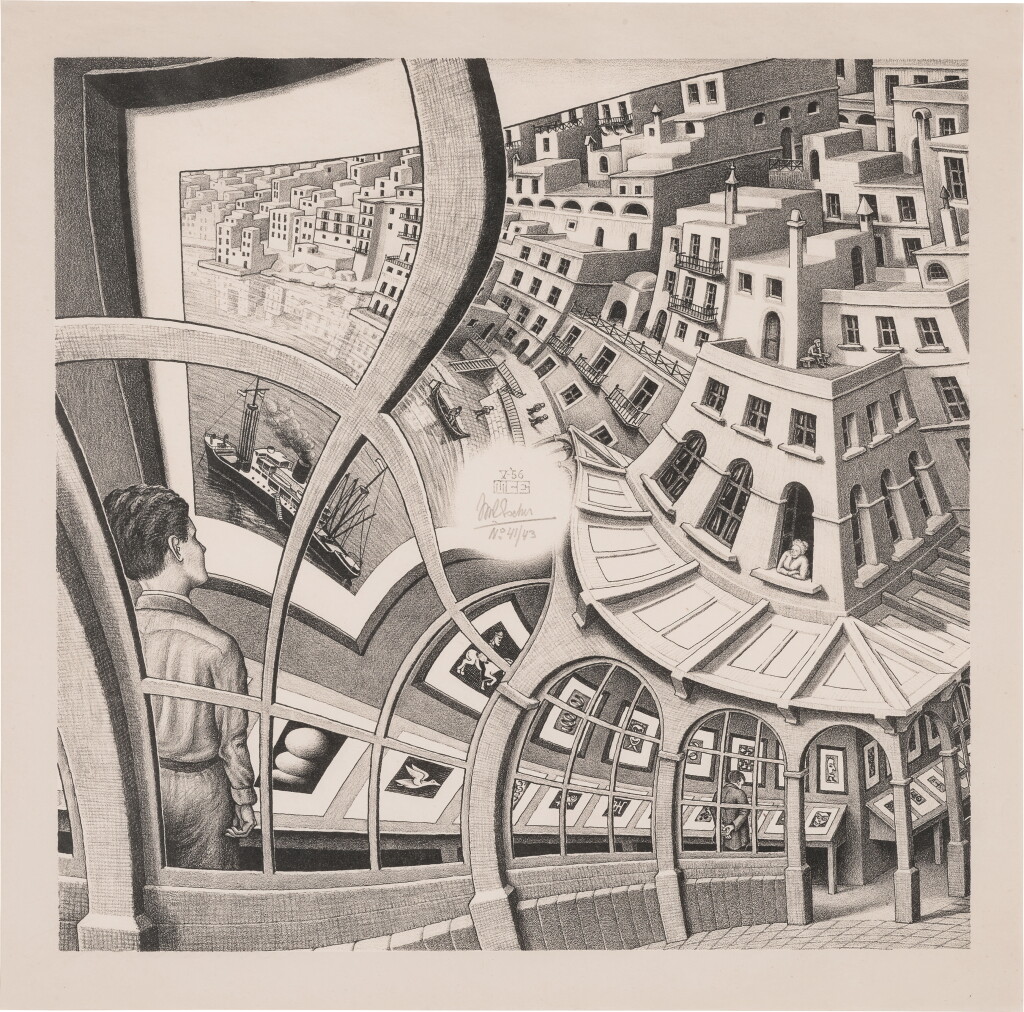
Print Gallery (1956) is widely regarded as one of Escher’s most conceptually complex works and exemplifies his lifelong exploration of perception, spatial ambiguity, and mathematical structures. The work depicts a young man observing an artwork in a gallery, yet the depicted cityscape within the artwork gradually expands and curves, turning into the artwork and ultimately looping back into the gallery itself. This recursive structure creates a visual paradox in which the observer becomes the observed and vice versa. In doing so, Escher destabilises the conventional distinction between subject and object, creating a sense of wonder.
Print Gallery’s composition reflects Escher’s sustained interest in visual paradoxes and their close relationship to mathematical principles, particularly recursion and topological transformation. As noted in The Magic of M. C. Escher (Locher, 2013), the artist was deeply concerned with representing infinite processes within a finite space. In Print Gallery, this is achieved through a gradual distortion of perspective, in which the architectural space bends into a circular structure while maintaining a sense of visual coherence.
At the centre of the composition a circular area is left unprinted, signifying the point at which the image becomes mathematically impossible to complete. Escher deliberately left this space open and unresolved, acknowledging the limits of his construction. The central area has since been analysed by mathematicians such as Hendrik Lenstra, who demonstrated its connection to conformal mapping and the underlying geometric structure of the work.
Within Escher’s broader oeuvre, Print Gallery typifies his exploration of recursive structures and visual loops. These central ideas are also present in works such as Drawing Hands (Bool 355) and Relativity (Bool 389). However, unlike these earlier works, Print Gallery integrates these principles into a single continuous system, making it one of his most intellectually ambitious compositions.
Escher’s work continues to resonate across different disciplines, influencing not only artists but mathematicians, designers, psychologists and engineers. As discussed in M. C. Escher: Art and Science (Coxeter et. al., 1986) his prints challenge viewers to reconsider the boundaries between visual experience and abstract reasoning. Print Gallery stands as a compelling example of how artistic imagination can engage with complex mathematical ideas, perfectly bridging the gap between art and science.
You May Also Like