
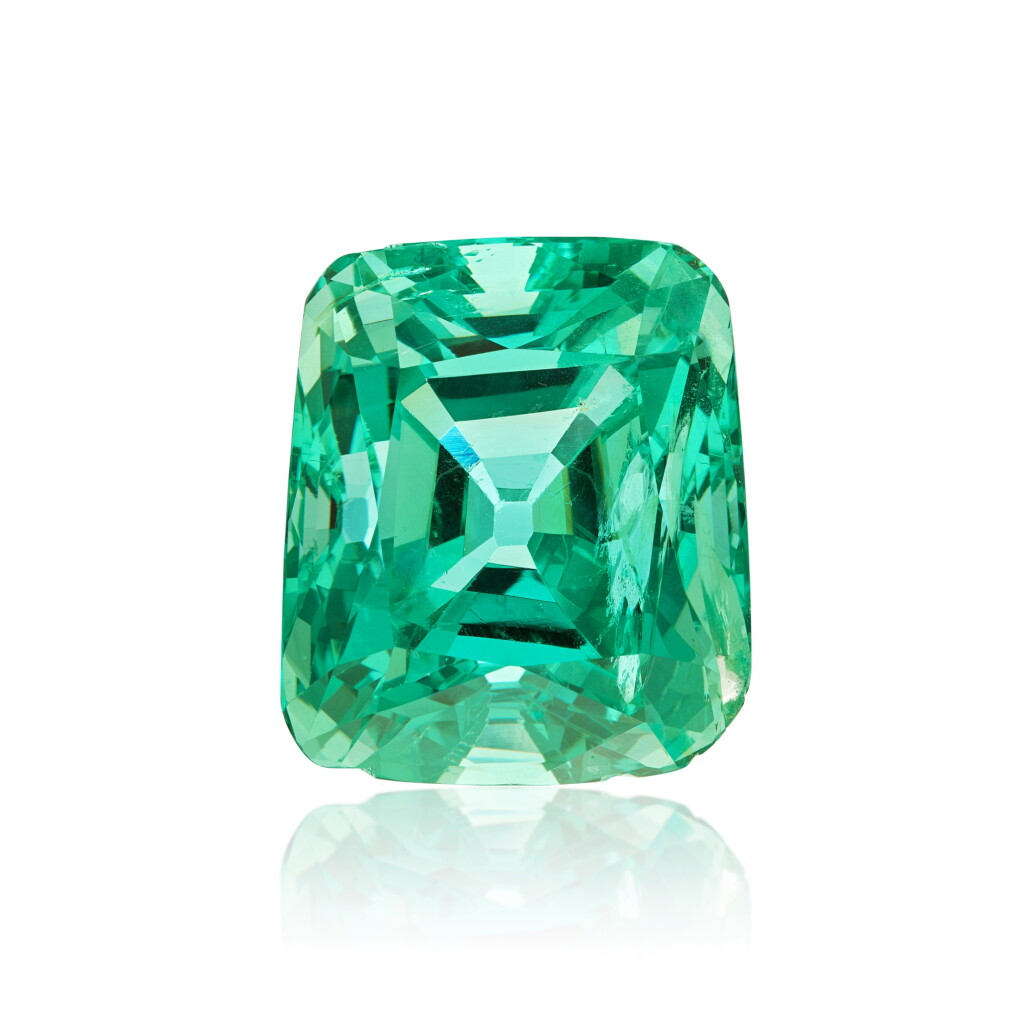
Formerly in the Collection of the House of Hohenzollern
Historical and Important Unmounted Green Beryl 歷史性及重要 132.66克拉未經鑲嵌綠柱石
Auction Closed
November 12, 02:56 PM GMT
Estimate
32,000 - 48,000 CHF
Lot Details
Description
The unmounted cushion-shaped green beryl weighing 132.66 carats.
By tradition worn by Emperor Napoleon I at his coronation
Princess Elisabeth Ludovika of Bavaria, Queen of Prussia (1801–1873)
Bequeathed to the Hohenzollern Family Jewels
Worn by Victoria, the Princess Royal of Great Britain, Empress of Germany and Queen of Prussia (1840-1901) and Auguste Viktoria of Schleswig-Holstein-Sonderburg-Augustenburg, Empress of Germany and Queen of Prussia (1858-1921)
Remounted for Grand-Duchess Kira Kirillovna of Russia, Princess of Prussia (1909-1967)
Private Collection
Dr. Tatiana Rosenstein, Adornment and Empire: Diamond Brooch and Green Beryl in Napoleonic and Hohenzollern Context – Objects from private ownership, 2025, pp. 25-26, 48-50, and 55-59 for the history of the green beryl.
Dr. Paul Seidel, Die Insignien und Juwelen der preussischen Krone in Brandenburg-Preussens Geschichte, Kultur und Kunst in Einzeldarstellungen und Meisterbildern - Hohenzollern Jahrbuch, Berlin – Leipzig, 1913, (pp. 5-69), pp. 50-51 for the testament of Queen Elisabeth Ludovika and a photograph of the green beryl mounted as a brooch.
Bernard Morel, Les Joyaux de la Couronne de France, Antwerp, 1988, p. 262 for the 1809 inventory of Empress Joséphine.
Two Historically Significant Napoleonic Jewels from the Hohenzollern Treasury
The historical and important diamond brooch/pendant and unmounted green beryl were heirlooms of the Prussian Royal House of Hohenzollern for over two centuries, both having a connection to Emperor Napoleon I. The former can conclusively be identified as a hat ornament left behind by Napoleon in his carriage when retreating from the battlefield at Waterloo. The beryl would have been worn by Napoleon at his coronation in 1804 according to tradition. Both jewels possess an extraordinary historical significance through their provenance of the illustrious House of Hohenzollern.
The Hohenzollern Napoleonic Green Beryl
According to family tradition, the green beryl weighing 132.66 carats was worn by Emperor Napoleon I at his coronation in 1804. However, the first written record of the beryl can be found in the inventory included in the last will and testament of Elisabeth Ludovika of Bavaria, Queen of Prussia (1801–1873). It is listed as 'an aquamarine mounted in a diamond border worn by Napoleon at his coronation'. The dowager Queen bequeathed this item to the crown jewels, together with her important collection of pearls, her extensive ruby and diamond and sapphire, pearl and diamond parures, a carved emerald demi-parure and a yellow diamond. She also made provisions for Victoria, the Princess Royal and Crown Princess of Prussia (1840-1901), to enjoy the use of these jewels even in the case her husband never succeeded to the Prussian throne. It is noteworthy that all these jewels were her personal property. Therefore, the beryl and diamond brooch only entered the Hohenzollern treasury following the Queen’s death in 1873.
Queen Elisabeth Ludovika’s Family Connections
A possible link between Elisabeth Ludovika’s jewellery collection and Napoleon can be found in her family relations. She was the daughter of the first Bavarian King Maximilian I Joseph (1756 – 1825) and his second wife Caroline of Baden (1776 – 1841). Maximilian I Joseph succeeded in elevating Bavaria to the rank of Kingdom with Napoleon’s support. The first Bavarian King famously commissioned his regalia from Napoleon’s crown jeweller Nitot, precursor to Chaumet. In 1806, Elisabeth Ludovika’s half-sister, Princess Auguste of Bavaria (1788-1851), married Napoleon’s adopted stepson Eugène de Beauharnais, Vice-Roy of Italy and Duke of Leuchtenberg (1781 – 1824). Auguste of Bavaria acquired an extensive jewellery collection during Napoleon’s reign, while her husband Eugène inherited a portion of the jewels of his mother Empress Joséphine. It is not excluded that the green beryl may have passed from the Bonaparte family to Elisabeth Ludovika through her half-sister.
Later Remounting of the Green Beryl
Records from the Hohenzollern family archive reveal that Empress Auguste Viktoria, the wife of Wilhelm II, occasionally wore the aquamarine and diamond brooch. At this time the brooch could be used as the centre of a diamond tiara. Unfortunately, there are no photographic records of her wearing the piece. The beryl retained its mid-19th century mount until 1950, when it was remodeled as the centrepiece of a small clover leaf tiara by the jeweller Koch of Frankfurt and Baden-Baden at the behest of Prince Louis Ferdinand, then the Head of the House of Hohenzollern, and his wife Grand-Duchess Kira Kirillovna of Russia. This small tiara was made using elements from an imposing diamond coronet created for Empress Auguste Viktoria by Koch at the turn of the century.
Some jewels carry the history that the family has given to them. The Hohenzollern family passed down this heirloom for generations, preciously keeping alive its link to Emperor Napoleon I. It was a preponderant part of their collection given the Imperial connotations given to this jewel and underlined the dynasty's legacy.