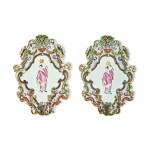

An Exceptionally Rare Pair of Chinese Export 'Torchbearer' Wall Sconces, Qing Dynasty, Qianlong Period, Circa 1740
清乾隆 約1740年 粉彩人物圖壁燭座一對
Auction Closed
April 20, 12:24 AM GMT
Estimate
50,000 - 70,000 USD
Lot Details
Description
An Exceptionally Rare Pair of Chinese Export 'Torchbearer' Wall Sconces
Qing Dynasty, Qianlong Period, Circa 1740
清乾隆 約1740年 粉彩人物圖壁燭座一對
attributed to a design by Cornelis Pronk, later fitted with a pair of silver-plated two-light candlestick holders
19½ in. (49 cm.) high
Heirloom & Howard, London
Wolf Family Collection No. 0140 (acquired from the above on March 15, 1977)
David Howard and John Ayers, China for the West, London, 1978, vol. I, p. 295 (one sconce)
C. J. A. Jörg, Pronk Porcelain, Groninger, 1980, p. 38, fig. 13 (one sconce)
Anthony du Boulay, Christie's Pictorial History of Chinese Ceramics, Oxford, 1984, p. 263, fig. 5
Boldly decorated and sturdily potted, the present pair of sconces represent the most sophisticated Chinese porcelain expressly made for a European audience in the early Qianlong period around 1740. While the original drawings of the design are not yet discovered, the thickly applied enamels, strong European influence in form and function, as well as the Chinese-inspired figure featured in the central reserve, all indicate that the present pair can be attributed to designs by Dutch artist and porcelain designer Cornelis Pronk (1691-1759).
Pronk was one of the most important multi-genre artists in the Dutch Republic in the early 18th century. He studied portrait painting under Dutch painter Arnold Boonen (1669-1729), and became well-known in for his views of cities and topographical drawings, which were turned into copper engravings for the book Verheelijkt Nederland (The Netherlands Glorified). In 1734, the Dutch East India Company (Verenigde Oostindische Compagnie abbreviated VOC) faced financial and management challenges in the Chinese porcelain trade, and subsequently contracted Cornelis Pronk to produce drawings of designs for porcelains to be made in China for a period of three years. Pronk was to produce one design per year including the painted decorations as well as the forms of the works.
In total, he supplied designs on four occasions over the period of three and a half years. Drawings for the first two designs, 'La Dame au Parasol' and 'The Doctors' Visit' are extant and in the collection of the Rijksmuseum, Amsterdam, acc. nos. RP-T-1967-18 (plate design for La Dame au Parasol), RP-T-1967-20 (salt cellar design for La Dame au Parasol), RP-T-1967-17 (cup, saucer and dish design for The Doctors' Visit). Scholars, however, hold different opinions on the remaining Pronk designs, and pieces are attributed to Pronk based on stylistic similarities.
The present pair is the most widely illustrated and discussed example of a very small group of Chinese export wall sconces molded with elaborate designs. One of the sconces in the present pair is illustrated in C. J. A. Jörg, Pronk Porcelain, Groninger, 1980, p. 38, fig. 13, who notes that wall sconces, known as 'tapestry sconces', were a new addition in the orders in China for the VOC's orders in 1739. A purely European form, Jörg suggests that Pronk may have had wooden molds made in Delft to send over to Canton (Guangzhou) for the painters and potters in Jingdezhen to model after, as the form is also known in earlier Delftware. However, given that the present 'torchbearer' motif does not appear on any other wares, he theorizes that these examples were ordered privately and as such, a bespoke commission.
Only two other nearly identical pairs of examples appear to be published. A pair, formerly in the collection of Kathryn Bache Miller, New York, sold Christie's New York, April 17-19, 1980, lot 1179, and currently in the collection of the Museum of Fine Arts, Boston, in the Kiyi and Edward M. Pflueger Collection, bequest of Edward M. Plueger and Gift of Kiyi Powers Pflueger, acc. no. 2006.891.1 and 2006.891.2. The other pair is illustrated in William Motley, Take Two!, Antwerp, 2017, cat. no. 52, and offered at Bonhams New York, January 24, 2023, lot 155. Motley suggested that while the figure itself was most likely invented to fit the reserve, the inspiration may have derived from figures seen in prints by Bernard Picart (1673-1733) in Ceremonies et coutumes religieuses (Ceremonies and Religious Customs of Various Nations of the World) published in London for Claude Du Bosc between 1733-1739. A pair of smaller and less elaborately decorated examples, also decorated with the 'torchbearer' in the center, formerly in the collection of a New England Museum, sold in these rooms, January 18, 1996, lot 333.
You May Also Like