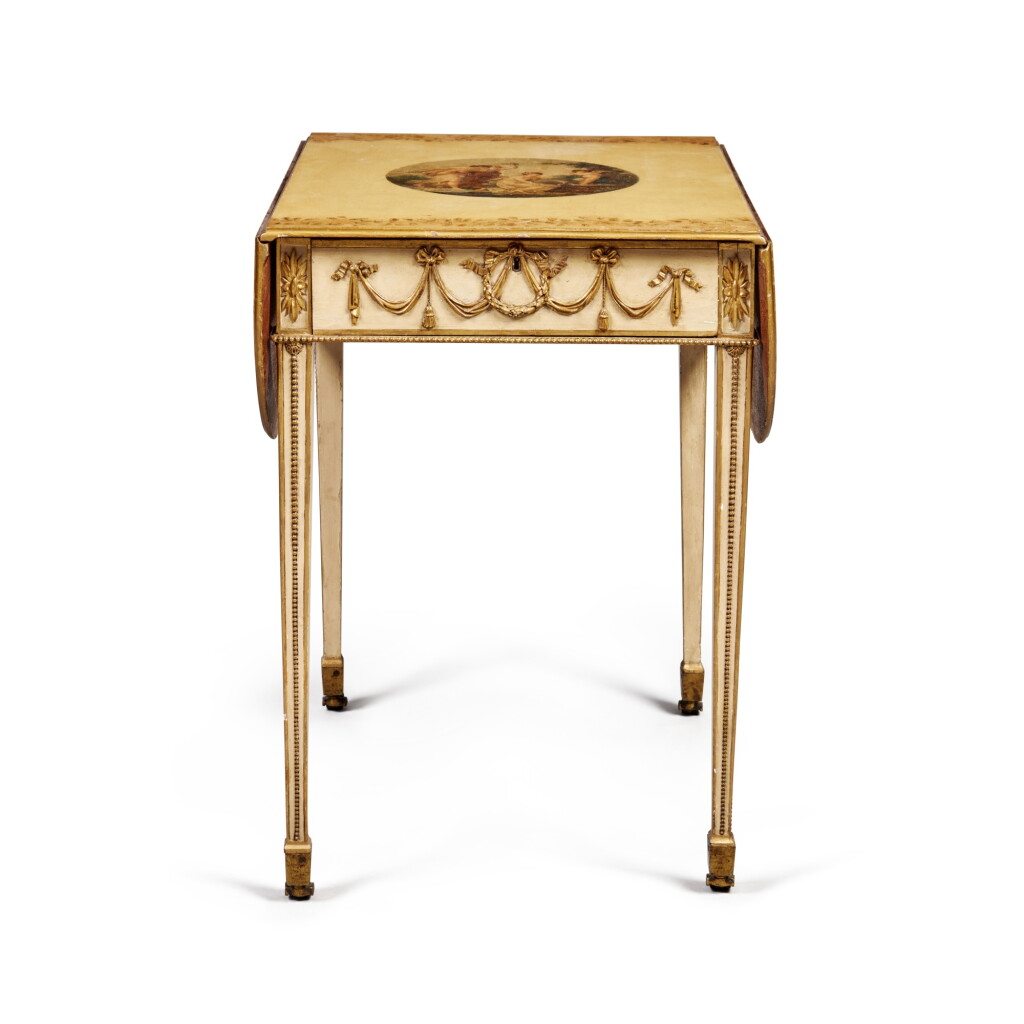
A George III Cream and Polychrome-Painted Parcel-Gilt Pembroke Table attributed to George Brookshaw, Circa 1785-88
No reserve
Auction Closed
January 31, 05:43 PM GMT
Estimate
15,000 - 20,000 USD
Lot Details
Description
A George III Cream and Polychrome-Painted Parcel-Gilt Pembroke Table attributed to George Brookshaw, Circa 1785-88
with applied oval coloured aquatints within borders of painted flowering vines
height 28 1/3 in.; width 20 in.; width extended 39 1/4 in.; depth 27 in.
72 cm; 51 cm; 100 cm; 69 cm
By descent until circa 1950
H. Blairman & Sons Ltd., June 1960, exhibited at the Antique Dealer's Fair, Grosvenor House, London
Dr & Mrs Jules C. Stein, Los Angeles
Christie's New York, 19 April 1986, lot 139
Heritage Auctions, Dallas, Texas 26 May 2010
On loan to Bolling Hall Museum, Bradford, 1964
Emily Eerdmans, Classic English Design and Antiques: Period Styles and Furniture, The Hyde Park Antiques Collection, New York 2006, p. 197
This rare table forms part of a celebrated painted and parcel gilt suite of furniture decorated with hand-coloured engravings by Bartolozzi after Angelica Kaufmann,comprising eight open armchairs, a settee, a pair of fire screens and a pair of torcheres (the chairs and settee illustrated in Ralph Edwards, The Shorter Dictionary of English Furniture, London 1964, p. 159, fig. 165, and Clifford Musgrave, Adam and Hepplewhite Furniture, 1966, p. 196, no. 72 and p. 198, no. 88 and fig. 88). It was acquired by James Beal Bonnell, who on the death of his father James Bonnell, Lord of Purleigh Manor, in 1774 inherited Upton House in Essex, and in 1788 removed to Pelling Place in Old Windsor, a cottage acquired by his father that was enlarged to create a 14-room villa 'with a bold view of Windsor Castle and the picturesque Scenery in its Vicinity' along with twenty acres of pleasure grounds (William Angus, The Seats of the Nobility and Gentry in Great Britain and Wales in a Collection of Select Views, London 1787, pl. 51). According to family tradition the suite was used by the Royal Family on an informal visits to the villa in 1797, with Queen Charlotte and her daughters breakfasting on the sofa, and King George scratching the engraved medallion with the buttons of his coat (E. T. Joy, 'The Upton House Suite of Adam Painted Furniture', The Connoisseur, June 1960, p.29).
A handwritten catalogue of the Pelling Place collection written in August 1852 by Bonnell's half sister Mary Anne Harvey Bonnell lists a chimney piece with frieze panels by Angelica Kauffman supplied by the London cabinetmaker George Brookshaw (sold Sotheby's London, 7 July 2000, lot 81), and he is likely to have created the furniture en suite. Relatively little is known about the career of the Peintre Ebéniste Brookshaw (c.1751-1823), who is recorded at 48 Great Marlborough Street from 1783-1788 and worked for the Prince Regent at Carlton House, where in 1783 he supplied 'an elegant commode highly finished with a basket of flowers painted in the front of the body and sprays of jasmine all over the top, and ditto on the front, the body with carved and gilt mouldings and legs’. He appears to have specialised in painted furniture and would later cease his furniture making activity and become exclusively a botanical illustrator (see Lucy Wood, 'George Brookshaw: The Case of the Vanishing Cabinet-Maker,' Apollo, May and June 1991).
You May Also Like