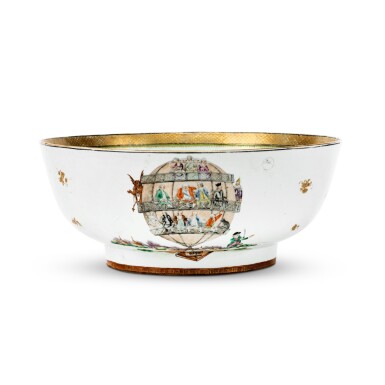
An Extremely Rare Chinese Export 'The Aerostatick Stage Balloon' Punch Bowl, Qing Dynasty, Qianlong Period, Circa 1786 | 清乾隆 約1786年 粉彩氣球圖大盌
Auction Closed
January 31, 05:43 PM GMT
Estimate
20,000 - 30,000 USD
Lot Details
Description
An Extremely Rare Chinese Export 'The Aerostatick Stage Balloon' Punch Bowl, Qing Dynasty, Qianlong Period, Circa 1786
清乾隆 約1786年 粉彩氣球圖大盌
painted on the exterior on two sides with 'The Aerostick Stage Balloon' after the engraving signed 'Hanibal Scratch del.', published by William Wells of London in 1783, depicting historical figures on a balustraded balloon anchored at the base by a tub inscribed 'VANITY' and filled with foam, about to be cut lose by a Frenchman holding a knife, the other sides and interior decorated with sparse floral sprigs
diameter 14 1/8 in.; 35.9 cm
Delicately painted with figures on a hot air balloon and referencing a collection of political and societal happenings in England around 1783, the present example is one of only two recorded examples of Chinese export punch bowls painted after 'The Aerostatick Stage Balloon' print, and also the only example remaining in private hands. The only other example first sold in our London rooms, December 11th, 1962, lot 75, when it was thought to be the only example recorded. It later entered the collection of Mr. and Mrs. Rafi Y. Mottahedeh, and illustrated in David Howard and John Ayers, China For the West, Vol. I, London, 1978, cat. no. 241, p. 246, where the authors identified the source print as well as every single figure depicted on the balloon. It later sold in these rooms, January 30th, 1985, lot 149, and is currently in the collection of the Peabody Essex Museum, Salem, Massachusetts, acc. no. E82865, and is illustrated in William R. Sargent, Treasures of Chinese Export Ceramics, Salem, 2012, cat. no. 176, pp. 329-330.
The decoration on the present example is based on an etching titled 'The Aerostatick Stage Balloon' and signed Hannibal Scratch del., published in England by William Wells in London on 23rd December 1783. One example of the print is in the collection of the British Museum, acc. no. 1868,0808.5067. A hand-colored example is in the collection of the Science Museum Group, acc. no. 1978-466, and the catalogue entry identifies it as the work of John Nixon (c.1750-1818), working under the name Hannibal Scratch. The remarkable similarities in coloring between the hand-colored example and the present bowl strongly suggests that it was indeed a hand-colored print that was sent to Jingdezhen to serve as inspiration for the decoration.
The balloon depicted is encircled by three tiers of galleries, and the figures are all identified in the etching. The top tier depicts three ladies who were at the time, notorious for their love affairs, they are:
Grace Elliott (or Eliot, née Dalrymple, known as 'Dally the tall', c. 1754-1823) is in the center holding a fan. She was married to prominent and wealthy physician John Elliott in 1771, but later entered into affairs with Lord Valentia (1774) and Lord Cholmondeley (1776). In 1782, she had a concealed intrigue with the Prince of Wales (later King George IV) and gave birth to a daughter in the same year, whom Elliott declared the Prince to be the father and reported by The Morning Post in January 1782. She later was introduced to the Duke of Orléans in 1784, after the print's publication, and became a courtesan in the French court. She later aided French aristocrats during the French Revolution, and recorded her experience in her memoir, which to this date is one of the best-known English-language accounts of The Terror between 1793-94. She was later rumored to be involved with Napoleon but rejected his offer for marriage.
Mary Robinson (née Darby, 1757-1800) is on the left. A celebrated actress and poet, and famed for her role as Perdita, the heroine of Shakespeare's The Winter Tale, Robinson earned the nickname 'Perdita' in 1779. She was married to an articled clerk Thomas Robinson, but during her performance in The Winter Tale, she attracted the attention of the Prince of Wales (later King George IV) who offered to pay her twenty thousand pounds to become his mistress, with the Prince ending the affair in 1781. Robinson later became famous in her work as a poet, and was referred to as 'the English Sappho' during her lifetime, after the Archaic Greek poet. While much of the early scholarship on Robinson's life focused on her sexuality, recent scholars turned to her contributions in advocating for women writers and women's rights in her writing.
Seymour Fleming (1758-1818), is on the right. Fleming married Sir Richard Worsley in 1775 and became Lady Worsley. The marriage was soon in turmoil, however, and Fleming gave birth to a daughter fathered by Worsley's close friend, Maurice George Bisset. In 1782, Sir Richard Worsley brought a criminal conversation (adultery) case against Bisset, after Lady Worsley eloped with Bisset a year prior. During this case, testimonies of Lady Worsley's lovers were provided and it was later proven that Worsley had displayed his undressed wife to Bisset at the bath house in Maidstone.
The second tier depicts political figures of the day, including members of the short-lived Fox-North coalition between April and December of 1783.
Lord North (Frederick North, 1732-1792), seated in the center of the balloon, has his arm around his old enemy and later coalition government partner, prominent Whig statesman Charles James Fox (1749-1806). Lord North, a Tory, served as Prime Minister of Great Britain from 1770 until in 1782, when he was forced to resign due to his handling of the American War. Along with Charles James Fox, Lord North regained parliamentary power by forming a coalition government with the Duke of Portland (1738-1809) as the figurehead of the government. The dynamic of the three men are depicted by Lord North and Charles James Fox each holding a thread attached to the Duke of Portland's nose. Edmund Burke (1729-1797), the statesmen and political writer, is on the right of the three men, dressed in Jesuit clothing and looking towards the Pope who is peeking from behind the balloon. While both Fox and Burke are prominent Whigs at the time, Burke and Fox were split in their views of the French Revolution, with Fox supports the revolution while Burke champions traditional values. The split is shown in the etching as Burke and Fox facing away from each other, and with Burke facing towards the Pope. The Jesuit dress refers to Burke's education at the Jesuit College of St. Omer, and his political opponents often accused him of harboring Catholic sympathies.
The last tier depicted other London public personalities at the time, including:
James Graham (1715-1794), a self-proclaimed doctor best known for his unusual treatments incorporating electro-magnetic apparatus, musical therapy and pneumatic chemistry. His most well-known invention by 1781 is the electro-magnetic musical Celestial Bed meant to provide the best position for couples to conceive. He advertised his therapies with performances alongside women employed as the 'Goddess Hebe Vestina', the goddess of youth from Greek mythology, and shown on his right on the etching. Adjacent to Graham is Jeffery Dunstan (c.1759-1797), a second hand wig dealer who took part in a satirical mock election to become the 'Mayor of Garrat' and was known to possess vulgar wit. To his right, the well-known publican Samuel House who was a supporter of the Fox-led Whigs and opened a pub named 'The Interpid Fox' in 1784. On the very right is the Prussian conjurer Gustavus Katterfelto (c. 1743-1799), who performed in London between 1780-84, and performed with a black cat, depicted beside him. He ironically claimed to have launched the first hot air balloon fifteen years before the Montgolfier brothers.
You May Also Like