Girolamo di Tommaso, called Girolamo da Treviso the Younger
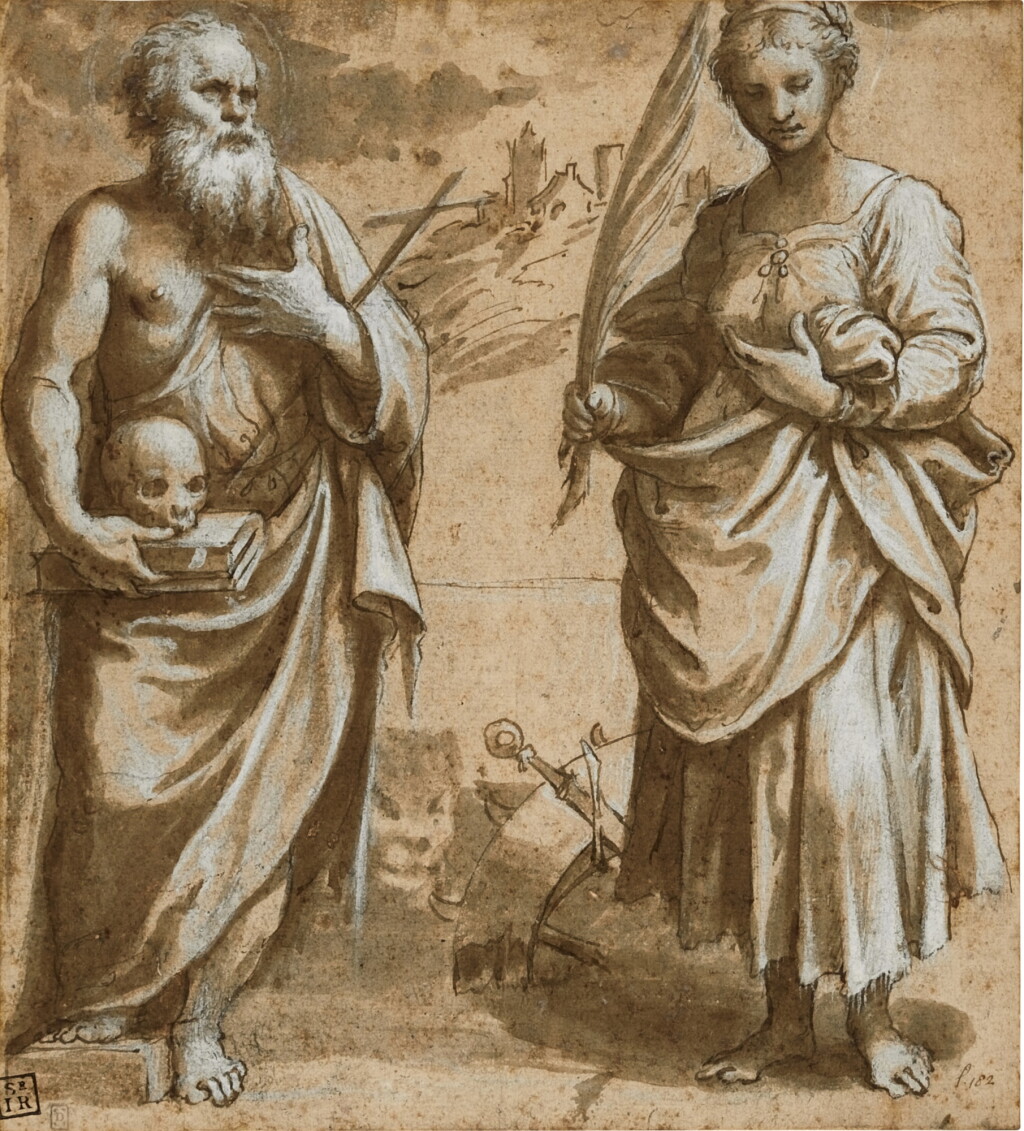
Saint Jerome and Saint Catherine of Alexandria Standing in a Landscape
Auction Closed
February 4, 06:26 PM GMT
Estimate
120,000 - 180,000 USD
Lot Details
Description
Girolamo di Tommaso, called Girolamo da Treviso the Younger
(Treviso circa 1497 - 1544 Boulogne)
Saint Jerome and Saint Catherine of Alexandria Standing in a Landscape
Pen and brown ink and gray wash, heightened with white, over black chalk, on buff-colored paper;
bears inscription lower left, in the hand of Lord John Somers: l 182; on verso of mount in ink, in the hand of Jonathan Richardson, Sr.: Pellegrini Tibaldy [illegible] Daniel de Volterre [crossed out in pencil]/ ne a Boulongne [sic] 1522 mort en 1592; below in pencil in an unknown hand: coll. Lord Somers raisonnablement provenant / de Padre Reste / Reynolds / le dessin peut-être date autour 1550 / dans le style des dessins pour la decoration du Palais Sacchetti
243 by 220 mm; 9½ by 8⅝ in.
Padre Sebastiano Resta (1635-1714), Rome (L.2992a) (Lansdowne manuscript, no. 182: 'delle più belle cose di Giovanni de' Vecchi da Borgo')
Giovanni Matteo Marchetti, bishop of Arezzo (1647-1704);
Lord John Somers (1650-1716), Worcester (L.2981),
his sale, London, 1717;
Jonathan Richardson Sr. (1665-1745), London (L.2183), on his mount, with his inscription lower center: Pellegrino da Bologna (i.e., Pellegrino Tibaldi);
Sir Joshua Reynolds (1723-1792), London (L.2364);
sale, London, Christie's, 10 April 1985, lot 25 (as attributed to Pellegrino Tibaldi);
Ian Duncan (bears his mark, not in Lugt);
with Thomas Williams Fine Art Ltd., London,
where acquired by Diane A. Nixon in 2010
London, Courtauld Institute Galleries, Drawing in Bologna, 1500-1600, 1992 (catalogue by E. Llewellyn and C. Romalli), cat. 34, reproduced;
Northampton, Massachusetts, Smith College Museum of Art; Ithaca, New York, Herbert F. Johnson Museum of Art, Drawn to Excellence: Renaissance to Romantic Drawings from a Private Collection, 2012-2013, no. 9, reproduced (entry by Nicholas Turner)
N. Turner, 'Courtauld Institute: Bolognese Drawings', review of London 1992, Burlington Magazine, 134, (August 1992), p. 540, reproduced fig. 43;
D. Cordellier, Un siècle de dessin à Bologne 1480-1580. De la Renaissance à la riforme tridentine, Paris 2001, under no. 29;
Idem, in Il Cinquecento a Bologna. Disegni dal Louvre e dipinti a confronto, exhib. cat., Bologna, Pinacoteca Nazionale, 2002, under no. 43;
P. Ervas, Girolamo da Treviso, Saonara 2014, pp. 156-157, no. 15, reproduced p. 166, fig. 18
The attribution to Girolamo da Treviso was first proposed in 1985 by Philip Pouncey, when this drawing appeared on the London art market with its traditional attribution to Pellegrino Tibaldi (see Provenance).1 It was later connected by the late Mario di Giampaolo to the lower part of the altarpiece representing the Madonna and Child in Glory with St. Jerome and Catherine of Alexandria, in the Narodowe Muzeum, Warsaw, (fig. 1).2 The painting, which was in the Belloni chapel in the Church of San Salvatore, Bologna until the mid-nineteenth century, is mentioned by Vasari in his life of Girolamo da Treviso, where he writes: 'E cosi dimorando poi in Bologna, vi lavorò molte pitture;.. Fece una tavola.., a San Salvatore, ed un altra con La Nostra Donna in aria con alcuni fanciulli, ed ai pié San Jeronimo e Santa Caterina;..' (Thus working in Bologna he did many paintings.. He did a panel painting..., in San Salvatore and another with the Madonna in the clouds with putti, and below St. Jerome and St. Catherine).3 The panel can be dated about 1530, during Girolamo's Bolognese period (c. 1523-before 1538).
This extremely rare drawing, connected to a known and significant work by the artist, is exquisitely drawn in pen and brown ink, enriched by abundant, painterly brown wash, skillfully applied, contrasting with the luminous and generous application of white heightening. The landscape and the sky in the background, together with the foreground where the two Saints are standing and the subtle indication of the head of the lion behind St. Jerome, are drawn solely with the point of the brush, enhancing the solid contours and volumes of the beautifully executed figures of the two Saints, mostly built with contrasting light and shadow.
As Nicholas Turner rightly noted in his 2013 catalogue entry for the drawing (see Exhibited), both the painting and the Nixon drawing demonstrate Girolamo's early training in the Veneto, especially evident in the areas of freely applied brush and wash, with little or no accompanying pen work, such as the cloud-filled sky, the landscape background, and some of the voluminous draperies. As Turner writes, 'Such pictorial effects echo the magical handling of drawings in the same medium by Lorenzo Lotto.' He also points out that the brilliant execution - mostly in point of a fine brush with white heightening - of the head of Saint Jerome reflects a stylistic debt to Parmigianino, and 'a method of drawing that Girolamo would have seen in Bologna, in the work of such artists as Amico Aspertini, Biagio Pupini, and others, who frequently used biacca (white heightening) in their drawings.'
Though Girolamo made interesting changes between the Nixon preparatory study and the final painting, there are unmistakable correspondences between the two works, such as the horizontal line running across the gap between the two figures in the drawing, which, as Turner points out, reflects a horizontal division that occurs in about the same position in the painting, between the darkened rear edge of the foreground platform on which the saints stand and the distant space behind. The poses of both saints have, though, been slightly modified in the final painted work. For instance, in the drawing St. Jerome carries a small cross in an oblique position, his left arm bent and his left hand open on his chest, and holds in his right hand a book with a skull on top, which he also rests on his hip. In the painted work, however, he is holding the book and skull with both hands raised to the right, while looking down to the left. In the drawing his bearded head is turned slightly to the right, while he gazes forward, but in the painting Girolamo seems to have swapped the positions of the heads of the two saints. In the drawing St. Catherine, for her part, looks down and not up, towards the Madonna and Child, her head slightly to the right. She holds an ample, draped cloth with her bent left arm, while with the right hand she carries a palm, symbol of her martyrdom, closer to her right shoulder, and not with her arm outstretched towards the middle of the composition, as in the painting.
It must be said, the positions of the two Saints in the drawing seem rather better orchestrated to suit the composition than the versions that we see in the painting. There are, though, no significant changes between drawing and painting in the lower foreground, or in the background view through to a distant hill town.
While overall the figures in the drawing, and also the landscape, are still strongly Venetian in character - and the facial features of St Catherine especially recall early Titian - the impact and solidity of the figures cannot be explained without a knowledge of Raphael, and in particular of the Saint Cecilia altarpiece, completed around 1516-1517 for the chapel of Santa Cecilia in the Augustinian church of San Giovanni in Monte, Bologna, and today in that city's Pinacoteca Nazionale.4 As Turner concluded in his entry, the particular distinction of Girolamo's work is to a considerable extent based on this combination of styles, resulting from his first artistic training in the Veneto, where he seems to have been in contact with Titian and Pordenone, and the superimposed Raphaelesque elements that he acquired when working in Bologna.
A rare study like this gives us a unique opportunity to understand and appreciate the complexity of a talented artist who was able successfully to integrate into his style such seemingly different elements, developing his own harmonious, individual and original artistic personality.
1.See E. Llewellyn and C. Romalli, exh. cat., op. cit., 1992
2.Ibid.
3.G. Vasari, Le Vite de' più eccellenti Pittori Scultori ed Architettori, ed. Milanesi, vol. v, Florence 1880 pp. 136-137
4.Bologna, Pinacoteca Nazionale, inv. no. 577
You May Also Like