
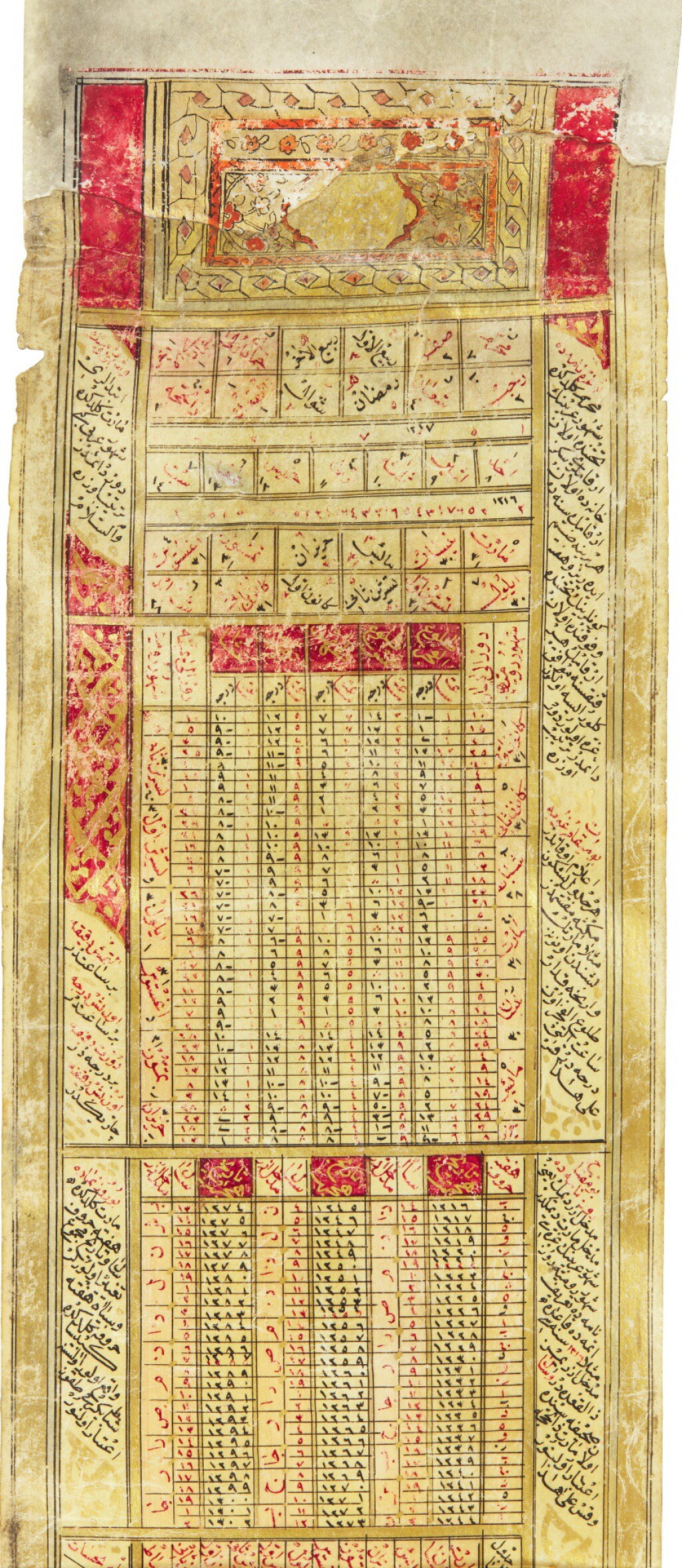
AN ILLUMINATED RUZNAME (ALMANAC OR CALENDAR), COPIED BY SULEYMAN KNOWN AS HIKMATI, TURKEY, OTTOMAN, LATE 18TH/EARLY 19TH CENTURY
Auction Closed
October 23, 11:03 AM GMT
Estimate
4,000 - 6,000 GBP
Lot Details
Description
AN ILLUMINATED RUZNAME (ALMANAC OR CALENDAR), COPIED BY SULEYMAN KNOWN AS HIKMATI, TURKEY, OTTOMAN, LATE 18TH/EARLY 19TH CENTURY
Arabic and Ottoman Turkish on vellum, text and tables written horizontally and vertically in naskh in black and red ink, columns ruled in gold, on a wooden spool with two amber terminals
10.2 by 75cm.
N. Safwat, A Collector’s Eye. Islamic calligraphy in Qur’ans and other manuscripts, London 2010, no.79, pp.294-5.
Ruznames, literally ‘Book of Days’, were calendars which provided tables of times of prayers for each month, as well as the length of day and night and when the sun is in the direction of Mecca. Written usually on vellum and of pocket size, they were intended to be portable objects. For additional information see Rogers 1995, pp.118-9.
The same scribe is recorded in a ruzname sold at Bonhams London, 1 May 2003, lot 72 (dated 1223 AH/1808 AD), whilst another is in the John Rylands University Library (published in Schmidt 2011, pp.261-2, no.157), dated 1199 AH/1784-85 AD and another offered at Christie's London, 28 November 1983, lot 107.