Jean-Michel Liotard
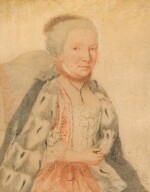
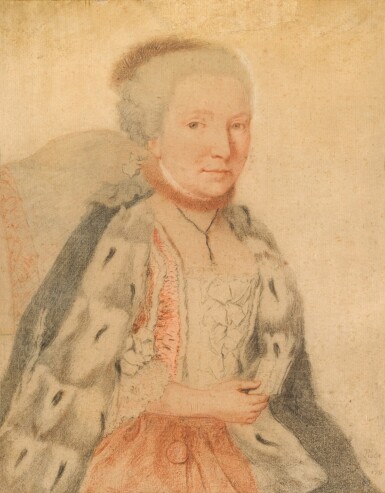
Portrait of Madame de Pourtales holding a letter | Portrait de Madame Portalès tenant une lettre
Lot Closed
June 14, 01:31 PM GMT
Estimate
6,000 - 8,000 EUR
Lot Details
Description
Jean-Michel Liotard
Geneva 1702 - 1796
Portrait of Madame Portalès holding a letter
Black and red chalk and light brown wash, heightened with white chalk
Signed and dated, lower right, in black chalk Liotard / Dessiné/ 1762, and inscribed on the letter a Madame / Madame Portales/ a Geneve; heightened with colour on the verso
227 x 176 mm; 9 by 6⅞ in.
____________________________________________
Jean-Michel Liotard
Genève 1702 - 1796
Portrait de Madame Portalès tenant une lettre
Pierre noire et sanguine, lavis brun et rehauts de craie blanche
Signé et daté en bas à droite à la pierre noire Liotard / Dessiné/ 1762, et inscrit sur une lettre a Madame / Madame Portales/ a Geneve ; rehauts de couleurs au verso
227 x 176 mm ; 9 by 6⅞ in.
Anonymous sale, Auctiones AG, Gesellschaft fur Kunstversteigerungen, Basel, April 1990, lot 45 (as Jean-Étienne Liotard);
Where acquired by Jacques-Louis Isoz;
Anonymous sale, Sotheby's, New York, 25 January 2023, lot 15.
____________________________________________
Vente anonyme, Auctiones AG, Gesellschaft fur Kunstversteigerungen, Bâle, avril 1990, lot 45 (comme Jean-Étienne Liotard) ;
Où acquis par Jacques-Louis Isoz ;
Vente anonyme, Sotheby's, New York, 25 janvier 2023, lot 15.
M. Roethlisberger and R. Loche, Liotard, Catalogue Sources et Correspondance, Doornspijk 2008, vol. II, p. 735, cat. no. JML34, fig. 897.
____________________________________________
M. Roethlisberger et R. Loche, Liotard, Catalogue Sources et Correspondance, Doornspijk, 2008, vol. II, p. 735, cat. n° JML34, fig. 897.
Jean-Michel Liotard (1702-1796) was the twin brother of Jean-Étienne Liotard.
Sensitively drawn, with color applied to the verso in the manner in which his brother, Jean-Étienne, typically worked, this drawing reflects closely the techniques of the better-known Liotard. The close familial and working relationship of the brothers inevitably meant their artistic methods were comparable, and this can occasionally result in uncertainties regarding attribution.
The identity of the sitter in this portrait remains unclear, despite the indication of her name inscribed on the letter. Roethlisberger suggests she could be a member of the Pourtalès family of Neuchâtel, of Prussian nobility since 1750, but that name does not appear in any other context within Liotard’s oeuvre.1
Portrayed seated in an armchair, this elegant lady wears a lavish French dress with a small fur collar and a large ermine coat. Tangible textures are created in the application and color combination of the chalks and the overall effect of the portrait is enhanced by the technical device of applying areas of color to the verso to heighten depth and luminosity. This technique involved tracing the outlines of the figure on the verso in black chalk and filling in areas of the figure with blocks of strong red and black, possibly moistened pastel, allowing the colors to show through to the recto, subtly modifying the tonality of the page.
1. M. Roethlisberger and R. Loche, op.cit., p. 735, cat. no. JML34.
____________________________________________
Jean-Michel Liotard (1702-1796) était le frère jumeau de Jean-Étienne Liotard.
Dessiné avec sensibilité, avec de la couleur appliquée au verso à la manière de son frère Jean-Étienne, ce dessin reflète tout particulièrement les techniques du plus célèbre des Liotard. L’étroite relation familiale et professionnelle entre les deux frères a inévitablement eu pour conséquence des méthodes artistiques comparables, entraînant parfois des incertitudes quant à l'attribution.
L'identité du modèle dans ce portrait reste incertaine, malgré le nom inscrit sur la lettre. Roethlisberger suggère qu'elle pourrait être un membre de la famille Pourtalès de Neuchâtel, de la noblesse prussienne depuis 1750, mais ce nom n'apparaît dans aucun autre contexte en dehors de l'œuvre de Liotard1.
Assise dans un fauteuil, cette élégante dame porte une somptueuse robe française avec un petit col en fourrure et un grand manteau d'hermine. Les textures sont traitées à la craie de différentes couleurs, et l'effet général du portrait est renforcé par le procédé technique consistant à appliquer des zones de couleur au verso pour intensifier la profondeur et la luminosité. Cette technique impliquait de tracer les contours de la figure au verso avec de la craie noire et de remplir les zones de la figure avec des blocs de rouge vif et de noir, probablement du pastel humidifié, permettant aux couleurs de transparaître au recto, modifiant subtilement la tonalité de la feuille.
1. M. Roethlisberger et R. Loche, op. cit., p. 735, cat. n° JML34.
You May Also Like


