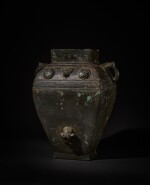
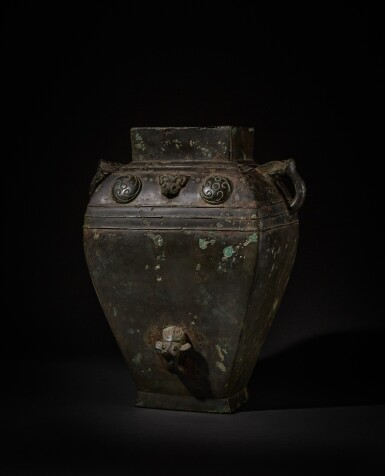
An archaic bronze ritual wine vessel (Fang lei), Late Shang / Early Western Zhou dynasty | 商末 / 西周初 青銅獸面渦紋方罍
Auction Closed
September 19, 02:55 PM GMT
Estimate
100,000 - 120,000 USD
Lot Details
Description
An archaic bronze ritual wine vessel (Fang lei)
Late Shang / Early Western Zhou dynasty
商末 / 西周初 青銅獸面渦紋方罍
metal liner, Japanese wood box (4)
Height 15⅜ in., 39.2 cm
Japanese Private Collection, acquired in the 1980s and 1990s.
Ikeda Kobijutsu, Tokyo.
日本私人收藏,得於1980年代至1990年代
いけだ古美術,東京
This fang lei is notable for its sharp, angular form as well as its simplicity in design. Vessels of this type existed as wine containers for only a short period of time from the late Shang (c.1600-c.1046 BC) to early Western Zhou dynasty (c.1046-771 BC), and were popular mostly in central and northern China. By the late Western Zhou period, lei vessels were replaced by another ritual bronze form, ling. The handle on the lower part of the body would have been held to tilt the vessel as its contents were being poured or ladled out (see Chen Peifen, Zhongguo qingtongqi cidian [The dictionary of Chinese archaic bronzes], vol. 1, Shanghai, 2013, pp 43-44).
See a late Shang dynasty bronze lei of a similar form and design, in the Palace Museum, Beijing, donated by Feng Gongdu in 1955, included in Wang Xiantang's 1943 Guoshi jinshizhi gao [Manuscript of archaic bronze in Chinese history], vol. 1, republished in Qingdao, 2004, p. 485, pl. 12; one published in Noel Barnard and Cheung Kwong-Yue, Rubbings and Hand Copies of Bronze Inscriptions in Chinese, Japanese, European, American and Australasian Collections, Taipei, 1978, no. 1092; and another illustrated in Wu Zhenfeng, Shang Zhou qingtong qi mingwen ji tuxiang jicheng [Compendium of important inscriptions and images of bronzes from the Shang and Zhou dynasties], vol. 25, Shanghai, 2012, no. 13708.
For early Western Zhou dynasty examples of this type, see one excavated at Zhuangbai village, Fufeng county, Shaanxi province, in 1976, now in the collection of Zhouyuan Musuem, illustrated in Li Xixing, ed., Shaanxi qingtongqi / The Shaanxi Bronzes, Xi'an, 1994, pl. 178; one discovered in Zhanghuang village, Fufeng county, in 1961, now in the Shaanxi History Museum, published in The Institute of Archaeology, Chinese Academy of Social Sciences, ed., Yin Zhou jinwen jicheng [Compendium of Yin and Zhou bronze inscriptions], Beijing, 1984, no. 09795; a third excavated from a Western Zhou tomb in Qu village, Quwo county, Shanxi province, attributed to the later phase of the early Western Zhou period, included in Tianma - Qucun [Qu village and Tianma village], Beijing, 2000, p. 173, fig. 179.1; and another with a cover, decorated with masks and whorls on both the shoulder and cover, flanked by a more elaborate pair of handles and lacking a foot, from the Avery Brundage Collection in the Asian Art Museum, San Francisco, published on the Museum's website (accession no. B60B1053).
You May Also Like


