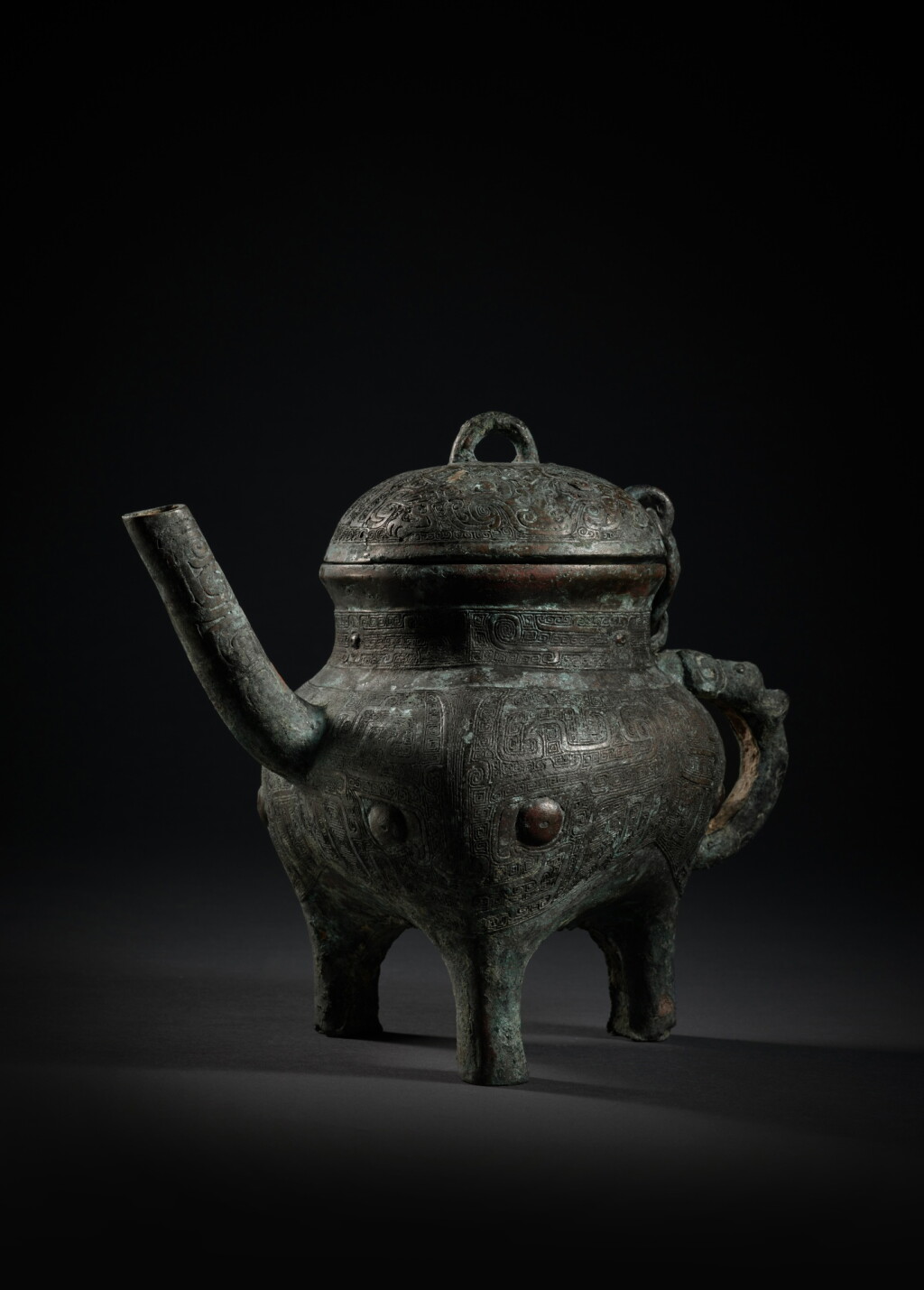
An archaic bronze ritual tripod pouring vessel and cover (He), Late Shang / early Western Zhou dynasty | 商末 / 西周初 青銅獸面紋盉
Auction Closed
September 19, 02:55 PM GMT
Estimate
70,000 - 90,000 USD
Lot Details
Description
An archaic bronze ritual tripod pouring vessel and cover (He)
Late Shang / early Western Zhou dynasty
商末 / 西周初 青銅獸面紋盉
Japanese wood box (3)
Height 8¼ in., 21 cm
Japanese Private Collection, acquired in the 1980s and 1990s.
日本私人收藏,得於1980年代至1990年代
It is rare to find a he vessel of this type with a clearly defined lobed body, and such crisp taotie masks so skilfully cast into the form of the vessel. The shape possibly evolves from lobed li and jia vessels. The famous Yi He in the Metropolitan Museum of Art appears to be a closely related example, with its highly articulated shape, upright neck set sharply off from the lobes, similarly decorated with crisply articulated taotie masks. The Yi He is illustrated in Jessica Rawson, Western Zhou Ritual Bronzes from the Arthur M. Sackler Collections, vol. IIB, Cambridge, Massachusetts, 1990, fig. 115.1. Compare also a he in the British Museum, London, with similar lobed body in four sections, each lobe decorated with a taotie head bearing ram's horns in relief, illustrated in Jessica Rawson, Chinese Bronzes. Art and Ritual, London, 1987, pl. 8.
See also a closely related late Shang tripod pouring vessel and cover sold at Christie's New York, 21st September 2004, lot 149, and another without taotie decoration, originally in the collections of Liu Tizhi and Rong Geng, sold more recently at Christie's New York, 24th March 2023, lot 1103.
The tripod form of the current he vessel probably derives from pottery counterparts found at the Erlitou culture (19th-16th century BC) and from simpler bronze examples being created by the Erligang culture (16th-14th century BC). For a pottery example excavated from the second stratum at Erlitou, see Robert W. Bagley, Chinese Ritual Bronzes in the Arthur M. Sackler Collections, Washington, D.C., 1987, p. 67, fig. 9; and for examples in bronze, see ibid., p. 71, fig. 23.
You May Also Like