A rare large bronze and amber-glazed pottery 'money tree', Eastern Han dynasty | 東漢 青銅搖錢樹
Auction Closed
September 19, 02:55 PM GMT
Estimate
50,000 - 70,000 USD
Lot Details
Description
A rare large bronze and amber-glazed pottery 'money tree'
Eastern Han dynasty
東漢 青銅搖錢樹
(27)
Height overall 57⅛ in., 145 cm
Acquired in the 1980s.
得於1980年代
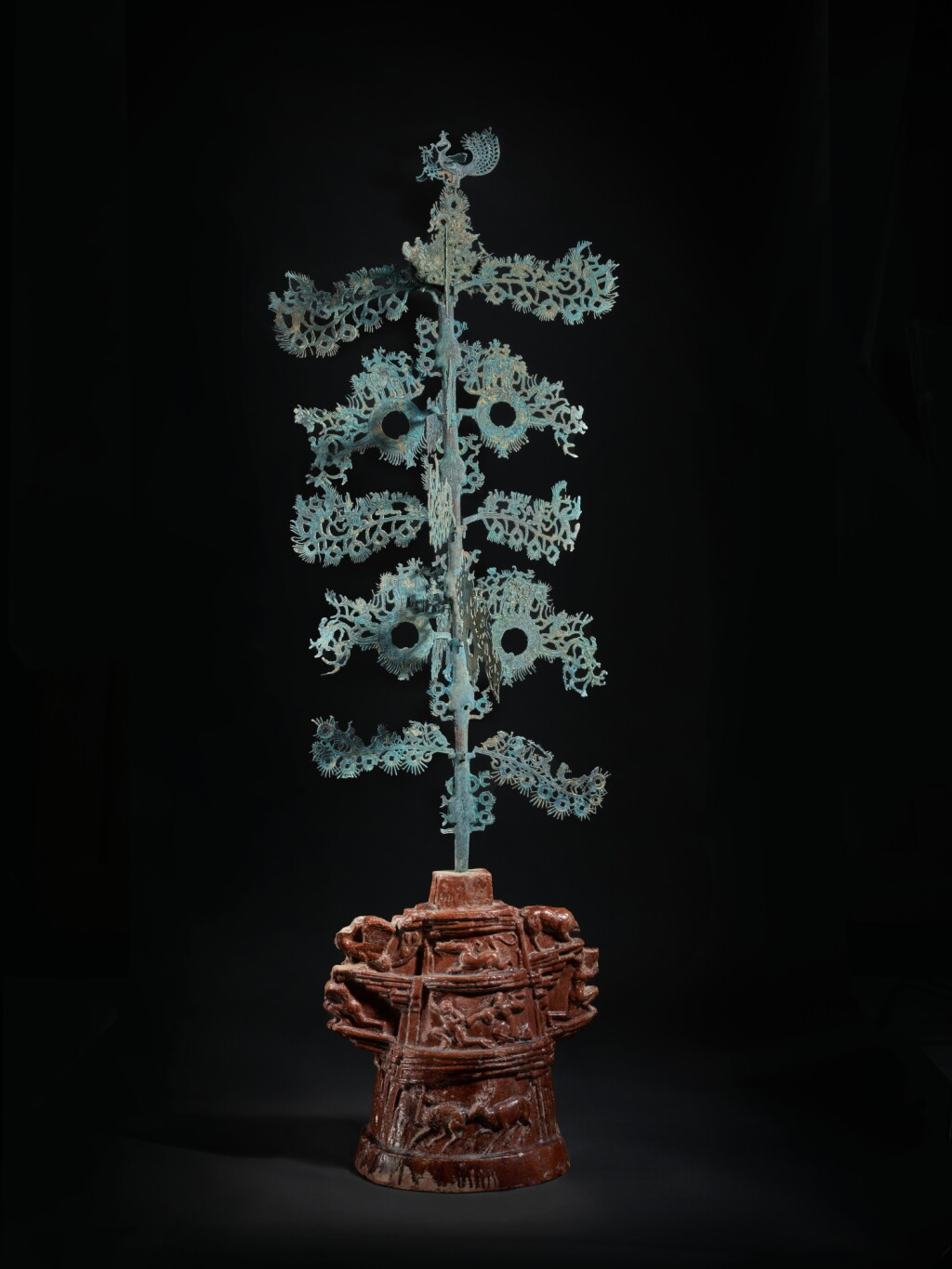
Comprised of a tree trunk set into a pottery base with masterfully cast bronze branches and a bird-form finial, the 'money tree' remains one of the most intriguing and unique luxury funerary objects discovered in Eastern Han tombs. The present lot shows different animals and mythical beasts parading along the branches of the tree, while numerous coins with rays projecting around the periphery hang from below. A majestic bird with an elaborate tail is seen perched at the top of the tree and seated mythical figures cast in relief decorate the central tree trunk, terminating at the pottery base, which divides intro three registers depicting figures and other beasts.
This group of funerary objects was given the auspicious name 'money tree' due to the abundance of circular discs hanging from branches, resembling coins. Believed to be a symbol of wealth, the 'money tree' is thought to be a burial object that ensured a glorious and prosperous after-life for the deceased. Furthermore, the bird at the top is sometimes identified as the mythical golden sun-bird, who visits the gigantic fusung tree that grows in the Eastern Sea every morning, bringing light and warmth to the beginning of each day.
However, as the term 'money tree' first appeared only in texts beginning in the eighth century AD, Chen Xiandan in his article 'On the Designation "Money Tree"', Orientations, September 1887, pp 70-71, argues that because of the common imagery of Xiwangmu (Queen Mother of the West) and the depictions of life in the celestial realm on the branches and earthenware base, 'to call these artefacts "money trees" solely on the basis of the coins cast onto the branches is clearly inconsistent with the subject matter of both the tree bases and the trees as a whole.' He argues that these objects in fact symbolized the riches of a divine paradise, and was thus more appropriate to be seen as the 'tree of life' or 'divine tree'.
See a few closely related examples in important museum collections: one gifted by Ruth and Bruce Dayton to the Minneapolis Institute of Art (accession no. 2002.47a-rrr); one from the Arlene and Harold Schnitzer Collection, in the Portland Art Museum (accession no. 2004.114.9A–C); and a third, in the Detroit Institute of Arts (accession no. 1996.29.A). For examples sold at auction, compare one with a green-glazed base, sold at Christie's New York, 22nd March 2019, lot 1605.
You May Also Like